 Middle Ages
Philippe de Vitry
Bishop, poet and theorist, he is associated with the fourteenth-century Ars nova.
A life and its times
The milestones of the life and work, the contemporaries and the major world events, on a single line of time.
A life at a glance
- 1291Birth
Born on 31 October, probably in Paris
- 1307Meanwhile
Dante begins the Divine Comedy (c. 1307)
- 1310Trainingage 19
Studies at the University of Paris; becomes master of arts
- 1316Workage 25
His early motets appear in the Roman de Fauvel
- 1322Workage 31
The Ars nova treatise, drawn from his teaching, circulates
- 1337Landmarkage 46
The Hundred Years’ War begins
- 1337Meanwhile
The Hundred Years’ War begins
- 1346Careerage 55
Counsellor and secretary to King Philip VI
- 1347Landmarkage 56
The Black Death sweeps across Europe
- 1348Meanwhile
The Black Death sweeps across Europe
- 1350Careerage 59
Close to the future King John II; friend of Petrarch
- 1351Careerage 60
Appointed Bishop of Meaux
- 1361Deathage 70
Dies in Meaux on 9 June
Listen
Excerpts from freely licensed recordings, with their performers and licences.
Excerpts last up to 90 seconds. Philippe de Vitry’s compositions are in the public domain; each recording is streamed from Wikimedia Commons under the licence shown, credited to its performers or uploader.
Listen to complete works on Wikimedia Commons
Wikimedia Commons is a free media library: you will find the complete recordings there, with their reuse conditions.
- Complete recordingVos qui admiramini (motet)
- Complete recordingGratissima virginis species (motet)
- Search for the workGarrit gallus / In nova fert
- Search for the workVos qui admiramini / Gratissima
- Search for the workArs nova (treatise)
- Search for the workTribum que non abhorruit
- Search for the workImpudenter circuivi
- Everything on CommonsAll recordings of Philippe de Vitry
The life of Philippe de Vitry
Philippe de Vitry was born on 31 October 1291, probably in Paris, into a family of clerics. He studied at the University of Paris, where he became a master of arts, and entered the service of the Church and the court early on. A man of immense learning, he was at once poet, composer, theorist, diplomat and prelate: his contemporaries regarded him as one of the most brilliant minds of his century.
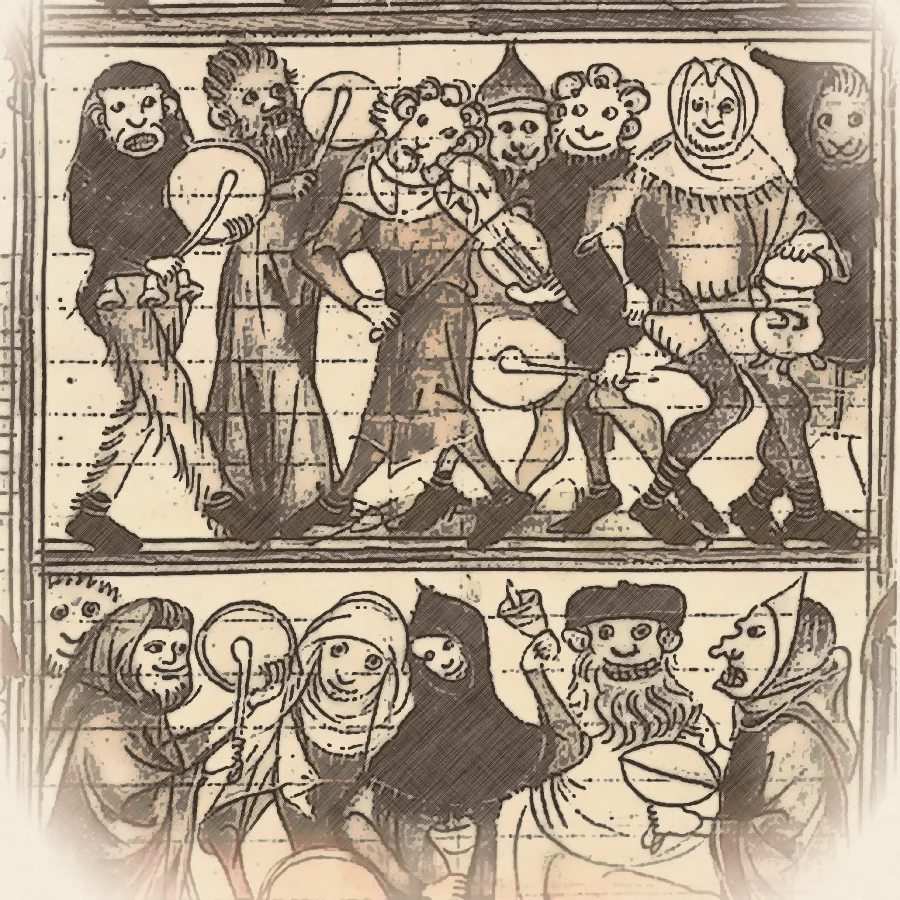
His earliest known works appear in a famous manuscript, the Roman de Fauvel, completed around 1317. This satirical verse narrative tells of the rise of an ambitious donkey, an image of the vices of the court. A richly illuminated version inserts many pieces of music, including several motets attributed to Vitry, such as Garrit gallus / In nova fert, which ironically denounces abuses of power.
His name remains linked to the expression Ars nova, “the new art”, the title of a treatise drawn from his teaching around 1322. Musicians of this generation developed a more precise notation, able to show shorter durations and to choose between dividing notes by three or by two. This opened the door to much more varied and supple rhythms. Pope John XXII was alarmed: in 1324–25 he condemned singers who “chop up melodies” in church.
Vitry also perfected the isorhythmic motet, in which the lowest voice repeats the same rhythmic pattern several times, like a hidden framework on which the upper voices hang. His motets often layer several different Latin texts sung at once, commenting on one another. About a dozen motets are attributed to him with some confidence, including Vos qui admiramini / Gratissima and Tribum que non abhorruit.
Alongside this he pursued a brilliant administrative career. Secretary and counsellor to kings Charles IV, Philip VI and John the Good, he carried out diplomatic missions, notably to the papal court at Avignon. The Italian poet Petrarch, who met him, described him as “the only true poet of France”. In 1351 Vitry was appointed Bishop of Meaux, a post he held until his death on 9 June 1361, amid the turmoil of the Hundred Years’ War and the Black Death.
To appreciate Vitry’s contribution, remember that before him notation allowed only a limited number of rhythmic combinations, almost all based on groups of three, the symbol of the Trinity. The Ars nova now accepted duple division, introduced the minim, a shorter value, and invented signs, ancestors of our time signatures, to tell the singer which system to use. Manuscripts even began to use red notes to signal a change of rhythm. These tools made it possible to write syncopations, shifted accents and off-beats that gave music an unprecedented liveliness. Contemporaries felt the break so clearly that they soon set the Ars nova against the Ars antiqua, the “old art” of the Notre-Dame school, a distinction historians still use today.
His influence was considerable: Guillaume de Machaut and the following generation adopted his techniques, and the isorhythmic motet remained in use until the mid-fifteenth century, as late as Guillaume Du Fay. Vitry thus embodies the passage from medieval music to a more learned, precise and personal style of writing.
Works to know
- 1316
Garrit gallus / In nova fert
Satirical motet from the Roman de Fauvel — the rooster crows against the powerful.
Listen on Wikimedia Commons - 1320
Vos qui admiramini / Gratissima
Elegant isorhythmic motet to the Virgin.
Listen on Wikimedia Commons - 1322
Ars nova (treatise)
A new way of notating rhythm that names a whole era.
Listen on Wikimedia Commons - 1330
Tribum que non abhorruit
Political motet on the fall of a royal minister.
Listen on Wikimedia Commons - 1340
Impudenter circuivi
Mature motet with complex rhythms.
Listen on Wikimedia Commons
Anecdotes
The Italian poet Petrarch called him ‘the only poet of France’.
His motet Garrit gallus mocks the powerful by comparing them to animals.
The Roman de Fauvel, which contains his first motets, tells the adventures of a donkey who rules the world.
He ended his life as Bishop of Meaux, during the Hundred Years’ War.
Same era · Middle Ages
 1098 – 1179Middle Ages
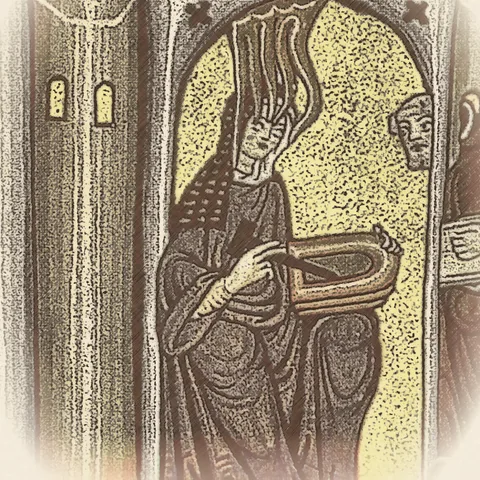
Hildegard von Bingen
Abbess, thinker and composer, she combined spiritual poetry with expansive melodic lines.
 c. 1135 – c. 1201Middle Ages
Léonin
Associated with Notre-Dame in Paris, he is a foundational figure of polyphonic organum.
 c. 1160 – c. 1230Middle Ages
Pérotin
At Notre-Dame in Paris, he developed polyphony by combining independent vocal lines.
 c. 1300 – 1377Middle Ages
Guillaume de Machaut
A poet and musician, he joined courtly song with sophisticated polyphonic writing.