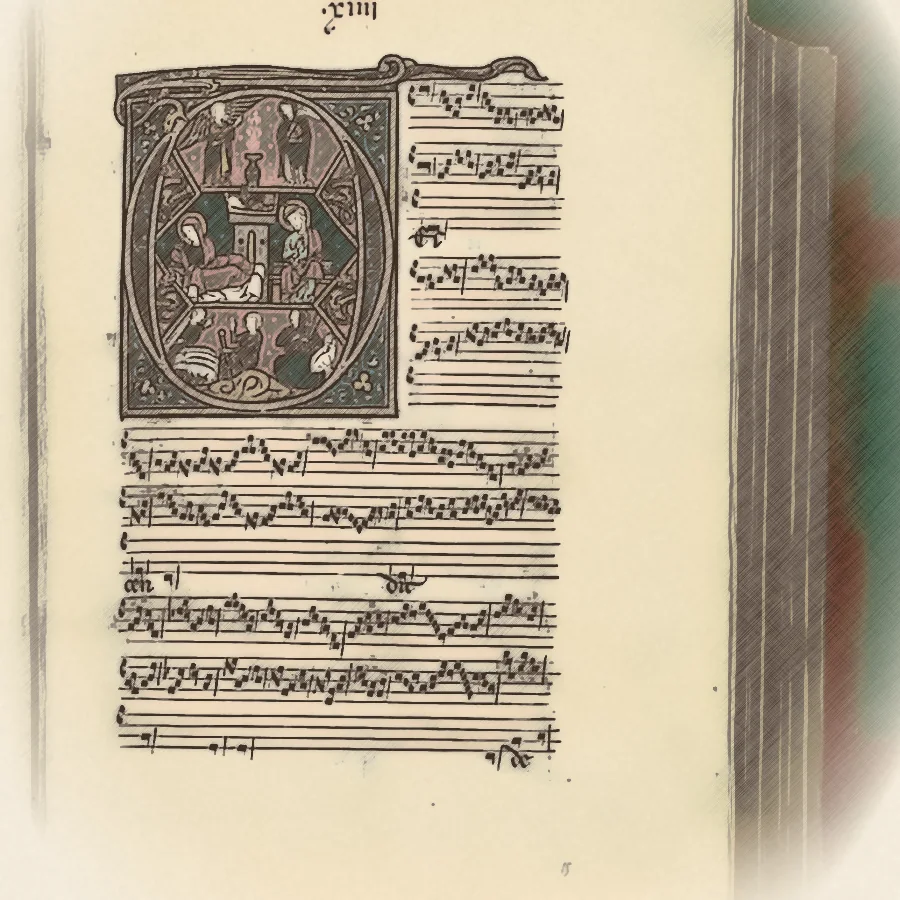
 Middle Ages
Pérotin
At Notre-Dame in Paris, he developed polyphony by combining independent vocal lines.
A life and its times
The milestones of the life and work, the contemporaries and the major world events, on a single line of time.
A life at a glance
- 1160Birth
Probable birth
- 1163Landmarkabout age 3
Building work on Notre-Dame de Paris begins
- 1163Meanwhile
Construction of Notre-Dame de Paris begins
- 1180Trainingabout age 20
Trained in the Notre-Dame musical circle, after Léonin
- 1190Workabout age 30
Revises and expands the Magnus liber organi
- 1190Meanwhile
Philip Augustus builds the Paris city wall and the Louvre fortress
- 1198Workabout age 38
Four-voice Viderunt omnes, for Christmas
- 1199Workabout age 39
Four-voice Sederunt principes, for St Stephen’s Day
- 1200Workabout age 40
Conductus for one or more voices (Beata viscera…)
- 1215Landmarkabout age 55
University of Paris receives its statutes
- 1215Meanwhile
Magna Carta is sealed in England
- 1230Deathabout age 70
Probable death around 1230
Listen
Excerpts from freely licensed recordings, with their performers and licences.
Excerpts last up to 90 seconds. Pérotin’s compositions are in the public domain; each recording is streamed from Wikimedia Commons under the licence shown, credited to its performers or uploader.
Listen to complete works on Wikimedia Commons
Wikimedia Commons is a free media library: you will find the complete recordings there, with their reuse conditions.
- Complete recordingSederunt principes (organum excerpt)
- Complete recordingOrganum “Quid tu vides”
- Search for the workViderunt omnes (organum quadruplum)
- Search for the workSederunt principes
- Search for the workAlleluia Nativitas
- Search for the workBeata viscera
- Search for the workDum sigillum summi Patris
- Everything on CommonsAll recordings of Pérotin
The life of Pérotin
Pérotin, also called Perotinus Magnus, “Pérotin the Great”, succeeded Léonin as the leading figure of polyphonic music at Notre-Dame de Paris. As with his predecessor, his biography is almost entirely lost: he is thought to have been born around 1160 and to have died around 1230, his activity centring on the year 1200. Some scholars have linked him to a certain Petrus, cantor or succentor of the cathedral at that time, but the identification remains uncertain.
What we know of him again comes from the English theorist known as “Anonymous IV”. He relates that Pérotin, “the best discantor”, revised Léonin’s Magnus liber organi, shortening some pieces and composing many more rhythmic clausulae. Above all he names several specific works, which allow a few to be recognised with reasonable confidence: the four-voice organa Viderunt omnes and Sederunt principes, the three-voice Alleluia Nativitas and several conductus.
Pérotin’s great innovation was writing in three and four voices. Above a Gregorian tenor stretched into immense notes, he layered two or three voices moving in regular rhythms, answering one another, exchanging motifs and forming chords of very full sonority. The effect is almost hypnotic: blocks of sound that seem to revolve on themselves, punctuated by powerful cadences.
Two decrees by Bishop Eudes de Sully, dated 1198 and 1199, provide for organum in three or four voices to be sung at the feasts of Christmas, the Circumcision and St Stephen. Scholars often see a link with Pérotin’s two great works, Viderunt omnes for Christmas and Sederunt principes for St Stephen’s Day, which would thus have been sung in the choir of the cathedral while it was still being built.
Pérotin also wrote conductus, Latin songs on new poems for one or more voices, such as Beata viscera on a text by Philip the Chancellor. His clausulae, detached from the great organa, soon received new words in their upper voices: this is how the motet was born, the most important genre of the following centuries.
Pérotin’s organa demanded singers of great virtuosity. The upper voices, often in the same range, constantly cross and practise voice exchange: a phrase sung by one is immediately taken up by another, like a play of mirrors. The cadences, where all voices meet on consonances of fifths and octaves, act as pillars for these vast structures, comparable to the columns that punctuate a Gothic nave. The composer also organised time carefully: some sections are built on precise proportions, evidence of a very conscious sense of form. These pieces, which could last more than a quarter of an hour, circulated throughout Europe; copies are found in Spanish and English manuscripts, and thirteenth-century theorists cite them as models of the art of discant.
Rediscovered in the twentieth century, Pérotin fascinated modern composers, particularly minimalists such as Steve Reich, who were drawn to his repetitions and long pulses. He remains the symbol of the golden age of the Notre-Dame school and of a moment when Paris, alongside Gothic architecture, invented a music on the scale of its cathedrals.
Works to know
- 1198
Viderunt omnes (organum quadruplum)
Four voices whirling above a sustained chant — a monument of sound.
Listen on Wikimedia Commons - 1199
Sederunt principes
Four-voice organum for 26 December, with hypnotic energy.
Listen on Wikimedia Commons - 1200
Alleluia Nativitas
Three-voice organum built on repeated rhythmic patterns.
Listen on Wikimedia Commons - 1200
Beata viscera
Single-voice conductus with a dancing tune.
Listen on Wikimedia Commons - 1200
Dum sigillum summi Patris
Two-voice conductus, simple and luminous.
Listen on Wikimedia Commons
Anecdotes
His four-voice pieces are among the very first in the history of European music.
20th-century composers such as Steve Reich admired him greatly.
Decrees of the Bishop of Paris in 1198 and 1199 call for four-voice organum at Christmas: probably his music.
The motet, a major genre for three centuries, was born by adding words to clausulae from Pérotin’s time.
Same era · Middle Ages
 1098 – 1179Middle Ages
Hildegard von Bingen
Abbess, thinker and composer, she combined spiritual poetry with expansive melodic lines.
 c. 1135 – c. 1201Middle Ages
Léonin
Associated with Notre-Dame in Paris, he is a foundational figure of polyphonic organum.
 1291 – 1361Middle Ages
Philippe de Vitry
Bishop, poet and theorist, he is associated with the fourteenth-century Ars nova.
 c. 1300 – 1377Middle Ages
Guillaume de Machaut
A poet and musician, he joined courtly song with sophisticated polyphonic writing.