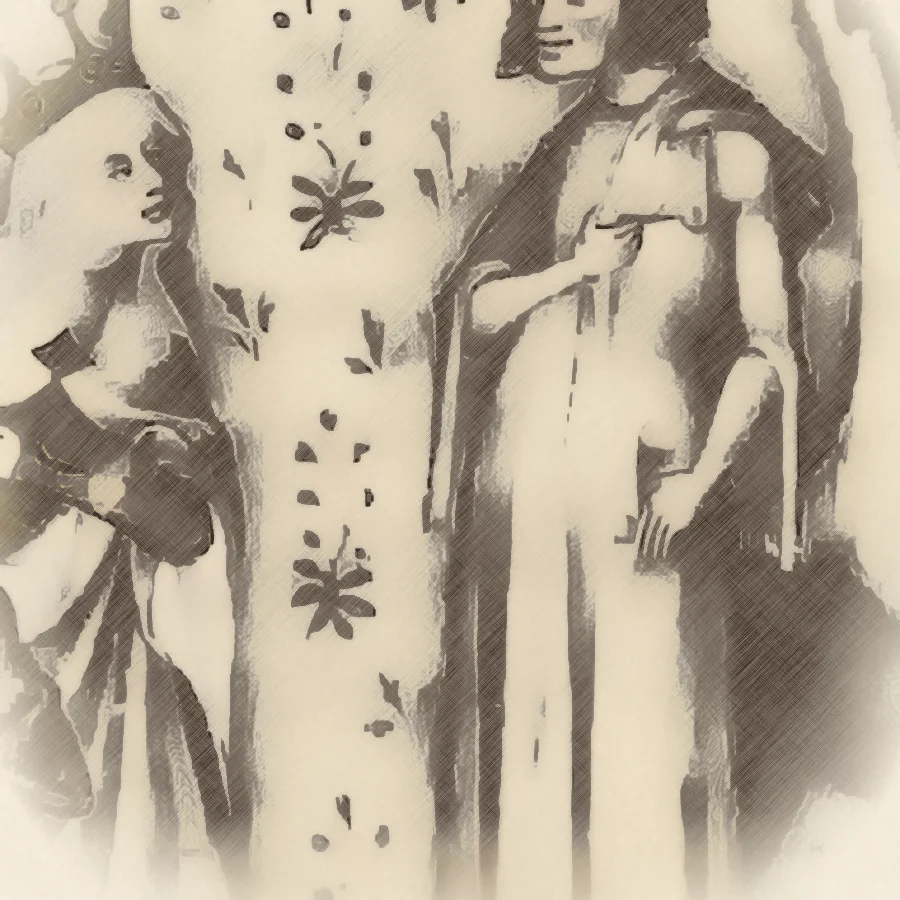
 Middle Ages
Guillaume de Machaut
A poet and musician, he joined courtly song with sophisticated polyphonic writing.
A life and its times
The milestones of the life and work, the contemporaries and the major world events, on a single line of time.
A life at a glance
- 1300Birth
Born around 1300 in Champagne
- 1307Meanwhile
Dante begins the Divine Comedy (c. 1307)
- 1323Careerabout age 23
Secretary to John of Luxembourg, King of Bohemia
- 1329Journeyabout age 29
Travels with the king to Bohemia, Poland and Lithuania
- 1337Careerabout age 37
Canon of Reims cathedral
- 1337Meanwhile
The Hundred Years’ War begins
- 1346Landmarkabout age 46
John of Bohemia is killed at the Battle of Crécy
- 1348Meanwhile
The Black Death sweeps across Europe
- 1349Workabout age 49
The Judgement of the King of Navarre; plague strikes France
- 1359Landmarkabout age 59
Reims besieged by the English
- 1363Workabout age 63
Le Voir Dit, a love story in verse and music
- 1365Workabout age 65
Messe de Nostre Dame (c. 1360–65)
- 1370Workabout age 70
Has his complete works copied into fine manuscripts
- 1377Deathabout age 77
Dies in Reims in April
Listen
Excerpts from freely licensed recordings, with their performers and licences.
Excerpts last up to 90 seconds. Guillaume de Machaut’s compositions are in the public domain; each recording is streamed from Wikimedia Commons under the licence shown, credited to its performers or uploader.
Listen to complete works on Wikimedia Commons
Wikimedia Commons is a free media library: you will find the complete recordings there, with their reuse conditions.
- Complete recordingMesse de Nostre Dame — Kyrie
- Complete recordingDouce dame jolie (virelai)
- Complete recordingRiches d’amour et mendians d’amie (ballade)
- Search for the workMesse de Nostre Dame
- Search for the workDouce dame jolie
- Search for the workMa fin est mon commencement
- Search for the workLe Remède de Fortune
- Search for the workRose, liz, printemps, verdure
- Search for the workLe Voir Dit
- Everything on CommonsAll recordings of Guillaume de Machaut
The life of Guillaume de Machaut
Guillaume de Machaut was born around 1300 in Champagne, probably in the village of Machault near Reims. From a modest background, he studied to the rank of master and around 1323 entered the service of John of Luxembourg, King of Bohemia, as secretary and almoner. This chivalrous, ever-restless prince took him across Europe: Machaut followed him to Bohemia, Silesia, Poland and as far as Lithuania on military campaigns.
Through his patron he obtained several church benefices and in 1337 became a canon of Reims Cathedral, where he settled for good. After John of Bohemia was killed at the Battle of Crécy in 1346, Machaut served other great lords: John’s daughter Bonne of Luxembourg, King Charles of Navarre, Duke John of Berry and then the future King Charles V. In Reims he lived through the great ordeals of the century: the Black Death of 1348–49 and the English siege of the city in 1359–60.
Machaut was as much a poet as a musician. He wrote long narrative poems, the “dits”, such as the Judgement of the King of Bohemia, the Remedy of Fortune and the Book of the True Story, which tells, late in his life, of a love correspondence with a young admirer, Péronne. These texts mix prose, poetry and musical pieces and made him the model for court poets from Christine de Pizan to Geoffrey Chaucer.
His musical output is the largest of his century: more than 140 pieces. He practised every genre of the Ars nova: isorhythmic motets, lais, virelais such as Douce dame jolie, and polyphonic ballades and rondeaux. The rondeau Ma fin est mon commencement is a musical riddle: one voice is sung backwards relative to another. Machaut fixed the “formes fixes” of French song that dominated secular music until the fifteenth century.
His sacred masterpiece is the Messe de Nostre Dame, composed around 1360–65 for Reims Cathedral. It is the oldest complete polyphonic mass written by a single known composer: the six parts of the Ordinary, from Kyrie to Ite missa est, form a unified whole in four voices. Machaut apparently wished it to be sung in memory of his brother Jean and of himself.
In his polyphonic songs Machaut invented a new manner: an upper voice, the cantus, carries the poem and the main melody, while the lower voices, tenor and contratenor, often played on instruments, form an accompaniment. This “accompanied song” became the model of European secular music for more than a century. His monophonic virelais, by contrast, stay close to dance and popular song, with refrains that are easy to remember. His ballades, such as De toutes flours or Dame, de qui toute ma joie vient, unfold long, ornate melodies over sometimes daring harmonies in which dissonances resolve with refinement. Machaut also reflected on his art in the Prologue to his works, where Nature and Love present their children to inspire him: a rare testimony of a medieval composer speaking about his own work.
Mindful of his legacy, Machaut personally supervised the copying of his complete works into magnificent illuminated manuscripts arranged by genre, which allowed his music to survive the centuries. He died in Reims in April 1377. The poet Eustache Deschamps and the composer François Andrieu paid tribute to him in a lament, a sign of the admiration he inspired.
Works to know
- 1340
Douce dame jolie
Single-voice virelai, one of the best-known medieval songs.
Listen on Wikimedia Commons - 1342
Le Remède de Fortune
Long poem containing a sample of every musical form of the day.
Listen on Wikimedia Commons - 1350
Ma fin est mon commencement
A puzzle rondeau in which one voice is read backwards!
Listen on Wikimedia Commons - 1360
Rose, liz, printemps, verdure
Gentle four-voice rondeau.
Listen on Wikimedia Commons - 1363
Le Voir Dit
Love story between the ageing poet and a young admirer.
Listen on Wikimedia Commons - 1365
Messe de Nostre Dame
The first complete polyphonic Mass by a single known composer.
Listen on Wikimedia Commons
Anecdotes
In ‘Ma fin est mon commencement’, one of the voices is sung backwards!
He had all his works copied in his lifetime — one of history’s first ‘complete collections’.
He rode with the King of Bohemia as far as Poland and Lithuania.
The English poet Geoffrey Chaucer drew on his poems when writing some of his own.
Same era · Middle Ages
 1098 – 1179Middle Ages
Hildegard von Bingen
Abbess, thinker and composer, she combined spiritual poetry with expansive melodic lines.
 c. 1135 – c. 1201Middle Ages
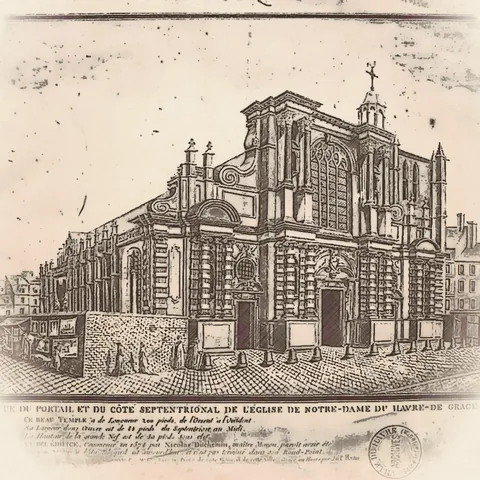
Léonin
Associated with Notre-Dame in Paris, he is a foundational figure of polyphonic organum.
 c. 1160 – c. 1230Middle Ages
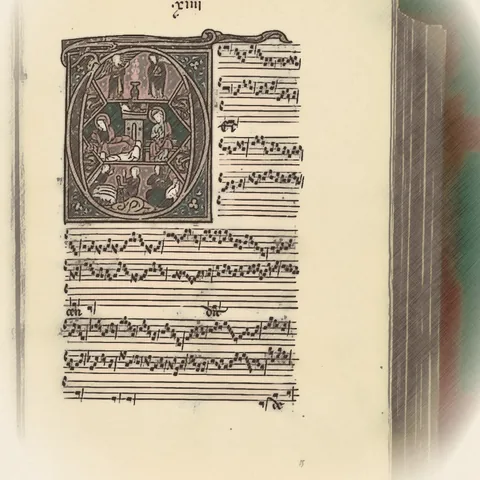
Pérotin
At Notre-Dame in Paris, he developed polyphony by combining independent vocal lines.
 1291 – 1361Middle Ages
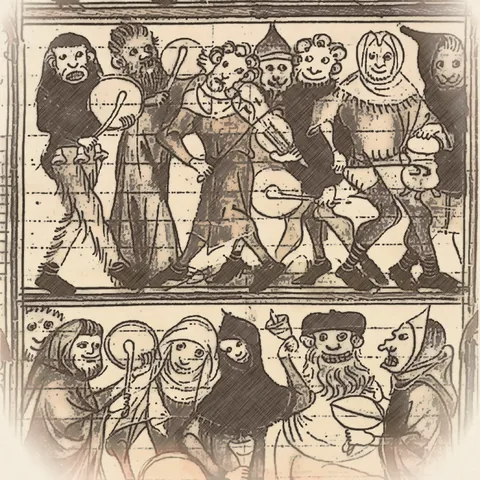
Philippe de Vitry
Bishop, poet and theorist, he is associated with the fourteenth-century Ars nova.