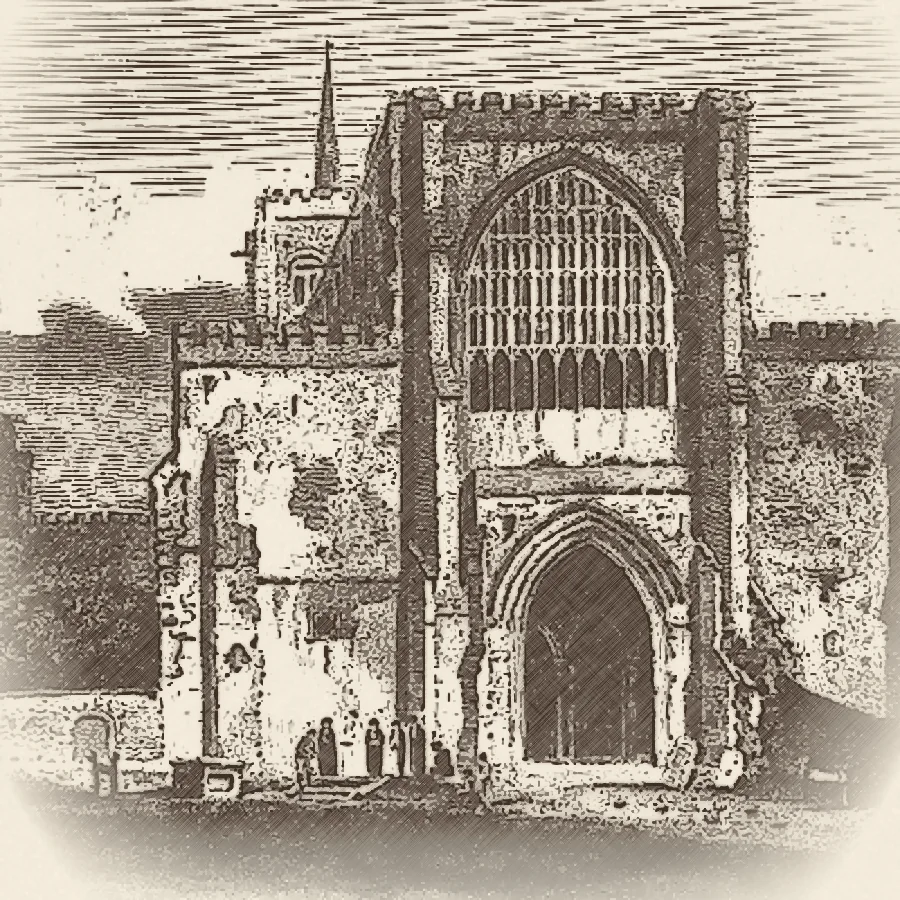
 Renaissance
John Dunstaple
His English music helped spread a new harmonic language across Europe.
A life and its times
The milestones of the life and work, the contemporaries and the major world events, on a single line of time.
A life at a glance
- 1390Birth
Born around 1390 in England
- 1415Landmarkabout age 25
Battle of Agincourt
- 1422Careerabout age 32
In the service of John, Duke of Bedford, regent of France
- 1427Milestoneabout age 37
Holds lands in Normandy
- 1429Meanwhile
Joan of Arc lifts the siege of Orléans
- 1431Landmarkabout age 41
Joan of Arc dies in Rouen
- 1435Careerabout age 45
After the duke’s death, serves Queen Joan of Navarre then Humphrey of Gloucester
- 1436Meanwhile
Brunelleschi’s dome in Florence is completed
- 1440Landmarkabout age 50
Martin le Franc praises the ‘contenance angloise’
- 1445Workabout age 55
His works are copied all over Europe, as far as Italy
- 1453Deathabout age 63
Dies in London on 24 December
- 1453Meanwhile
Fall of Constantinople; end of the Hundred Years’ War
Listen
Excerpts from freely licensed recordings, with their performers and licences.
Excerpts last up to 90 seconds. John Dunstaple’s compositions are in the public domain; each recording is streamed from Wikimedia Commons under the licence shown, credited to its performers or uploader.
Listen to complete works on Wikimedia Commons
Wikimedia Commons is a free media library: you will find the complete recordings there, with their reuse conditions.
- Complete recordingO rosa bella (attributed to Dunstaple)
- Search for the workQuam pulchra es
- Search for the workVeni Sancte Spiritus / Veni creator
- Search for the workPreco preheminencie
- Search for the workMissa Rex seculorum
- Search for the workO rosa bella
- Everything on CommonsAll recordings of John Dunstaple
The life of John Dunstaple
John Dunstaple (or Dunstable) was born around 1390 in England, perhaps in the town of Dunstable in Bedfordshire, whose name he may have carried. Almost nothing is known of his youth or training: like many musicians of his time, he was probably a choirboy and then a cleric. Yet he became the most admired English composer of the fifteenth century, one whose influence crossed the Channel and transformed music on the Continent.
The documents concerning him show him in the service of the royal house of Lancaster. Around 1422 he joined the household of John, Duke of Bedford, brother of Henry V, who governed the French territories occupied by the English during the Hundred Years’ War on behalf of the young Henry VI. Dunstaple therefore probably lived part of his life in France, in Paris or Normandy, where he held land around 1427. This was the era of Agincourt, the Treaty of Troyes and then Joan of Arc, burned at Rouen in 1431 in a city held by the Duke of Bedford.
After his patron’s death in 1435 he served the dowager queen Joan of Navarre and then Humphrey, Duke of Gloucester, another brother of Henry V and a great lover of books and learning. Dunstaple was not only a musician: his epitaph, once visible in the church of St Stephen Walbrook in London, also describes him as an astronomer and mathematician, and several astronomical manuscripts belonged to him. He died in London on 24 December 1453, the very year the Hundred Years’ War ended.
His style is what contemporaries called the “contenance angloise”, the English manner. Around 1440 the poet Martin le Franc, in Le Champion des Dames, explained that Du Fay and Binchois had found a “new practice” of making “lively concord” by following Dunstaple. What struck continental musicians was the sweetness of his harmonies: he made generous use of thirds and sixths, intervals French music still regarded as unstable, and avoided harsh dissonances. His melodic lines are supple and singing, and the voices form full, luminous chords.
His surviving output numbers around sixty pieces, almost all sacred: isorhythmic motets for the great feasts, such as Veni Sancte Spiritus / Veni creator, Marian antiphons and mass movements. The motet Quam pulchra es, on a text from the Song of Songs, is one of the most famous: the three voices move almost together, declaiming the text clearly in harmony of great sweetness. He is also credited with the song O rosa bella, one of the most widely circulated of its century, although the attribution is sometimes disputed in favour of his compatriot John Bedyngham.
Remarkably, most of his works survived not in England, where manuscripts were largely destroyed during the Reformation in the sixteenth century, but in Italian and German copies, notably the great Trent and Aosta codices. This shows how far his music had travelled and how much it was sought after on the Continent. Dunstaple also contributed to the development of the cyclic mass, whose movements rest on the same borrowed melody, as in the Missa Rex seculorum attributed to him: a principle taken up by Du Fay, Ockeghem and the whole Renaissance.
Rediscovered by musicologists in the nineteenth and twentieth centuries, Dunstaple now holds a pivotal place in histories of music: he marks the passage from the learned, sometimes angular medieval Ars nova to the gentler, more consonant polyphony of the Renaissance. The complete edition of his works, published in 1953 for the five-hundredth anniversary of his death, revealed the full extent of his talent and influence.
Works to know
- 1430
Quam pulchra es
Three-voice motet on the Song of Songs, with a new sweetness.
Listen on Wikimedia Commons - 1430
Veni Sancte Spiritus / Veni creator
Grand four-voice isorhythmic motet.
Listen on Wikimedia Commons - 1430
Preco preheminencie
Motet in honour of St John the Baptist.
Listen on Wikimedia Commons - 1440
Missa Rex seculorum
Cyclic Mass (attribution shared with Power).
Listen on Wikimedia Commons - 1440
O rosa bella
Widely copied Italian song, sometimes attributed to Bedyngham.
Listen on Wikimedia Commons
Anecdotes
Most of his music was found… in Italy, not England!
He died on Christmas Eve 1453, the year the Hundred Years’ War ended.
The poet Martin le Franc wrote that Du Fay and Binchois learned from him a new way of making chords sound.
His London epitaph also described him as an astronomer and mathematician.
Same era · Renaissance
 c. 1397 – 1474Renaissance
Guillaume Dufay
Working between France and Italy, he bridged medieval traditions and Renaissance style.
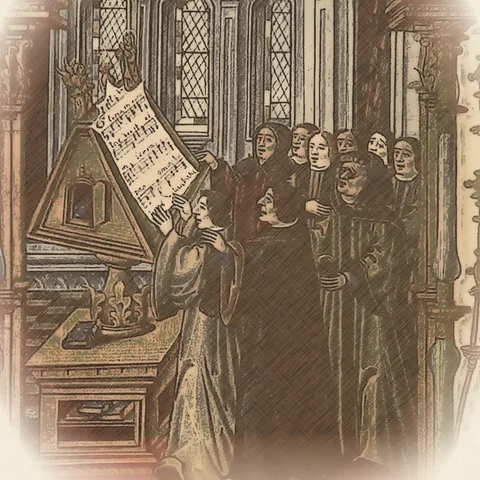 c. 1410 – 1497Renaissance
Johannes Ockeghem
A Franco-Flemish singer and composer, he developed remarkably sophisticated vocal counterpoint.
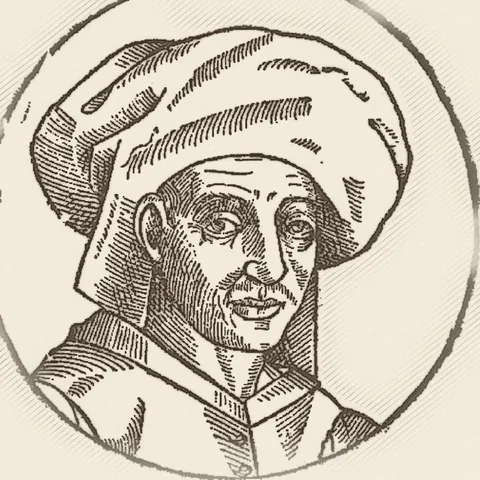 c. 1450 – 1521Renaissance
Josquin des Prez
His music lets voices converse with striking expressive clarity.
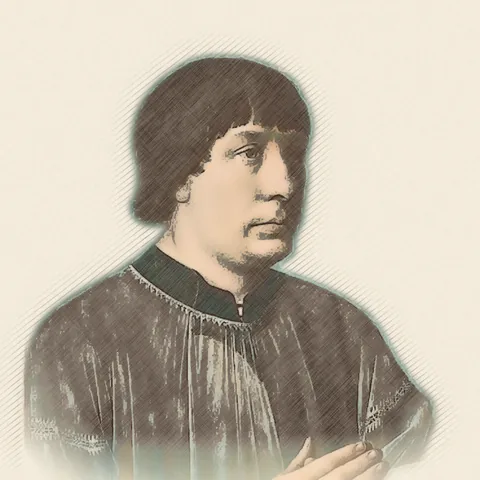 c. 1457 – 1505Renaissance
Jacob Obrecht
A Franco-Flemish composer celebrated for inventive polyphonic masses.
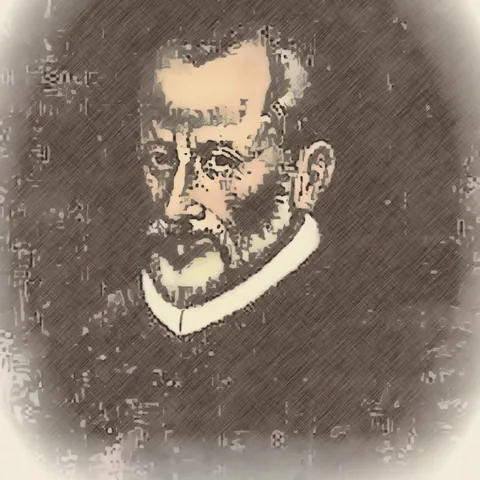 c. 1525 – 1594Renaissance
Giovanni Pierluigi da Palestrina
He epitomized balanced vocal polyphony in Renaissance sacred music.
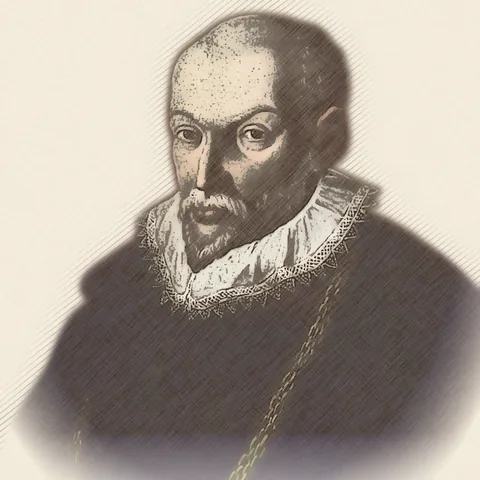 1532 – 1594Renaissance
Orlando di Lasso
A cosmopolitan musician based in Munich, he wrote in many languages and genres.