 Renaissance
Guillaume Dufay
Working between France and Italy, he bridged medieval traditions and Renaissance style.
A life and its times
The milestones of the life and work, the contemporaries and the major world events, on a single line of time.
A life at a glance
- 1397Birth
Born around 1397, near Brussels
- 1409Trainingabout age 12
Choirboy at Cambrai cathedral
- 1420Journeyabout age 23
Leaves for Italy, serving the Malatesta in Rimini and Pesaro
- 1428Careerabout age 31
Singer in the papal chapel in Rome
- 1429Meanwhile
Joan of Arc lifts the siege of Orléans
- 1433Careerabout age 36
Chapel master at the court of Savoy
- 1436Workabout age 39
Nuper rosarum flores for the dome of Florence Cathedral
- 1436Meanwhile
Brunelleschi’s dome in Florence is completed
- 1439Milestoneabout age 42
Returns to Cambrai as a canon
- 1453Landmarkabout age 56
Fall of Constantinople; he composes a Lamentation
- 1453Meanwhile
Fall of Constantinople; end of the Hundred Years’ War
- 1455Workabout age 58
Missa Se la face ay pale
- 1455Meanwhile
Gutenberg prints his Bible
- 1460Workabout age 63
Missa L’homme armé
- 1464Workabout age 67
Ave regina caelorum, intended for his deathbed
- 1474Deathabout age 77
Dies in Cambrai on 27 November
Listen
Excerpts from freely licensed recordings, with their performers and licences.
Excerpts last up to 90 seconds. Guillaume Dufay’s compositions are in the public domain; each recording is streamed from Wikimedia Commons under the licence shown, credited to its performers or uploader.
Listen to complete works on Wikimedia Commons
Wikimedia Commons is a free media library: you will find the complete recordings there, with their reuse conditions.
- Complete recordingSe la face ay pale (chanson)
- Complete recordingAve regina caelorum
- Search for the workNuper rosarum flores
- Search for the workMissa Se la face ay pale
- Search for the workSe la face ay pale
- Search for the workMissa L’homme armé
- Search for the workAve regina caelorum
- Search for the workResvellies vous et faites chiere lie
- Everything on CommonsAll recordings of Guillaume Dufay
The life of Guillaume Dufay
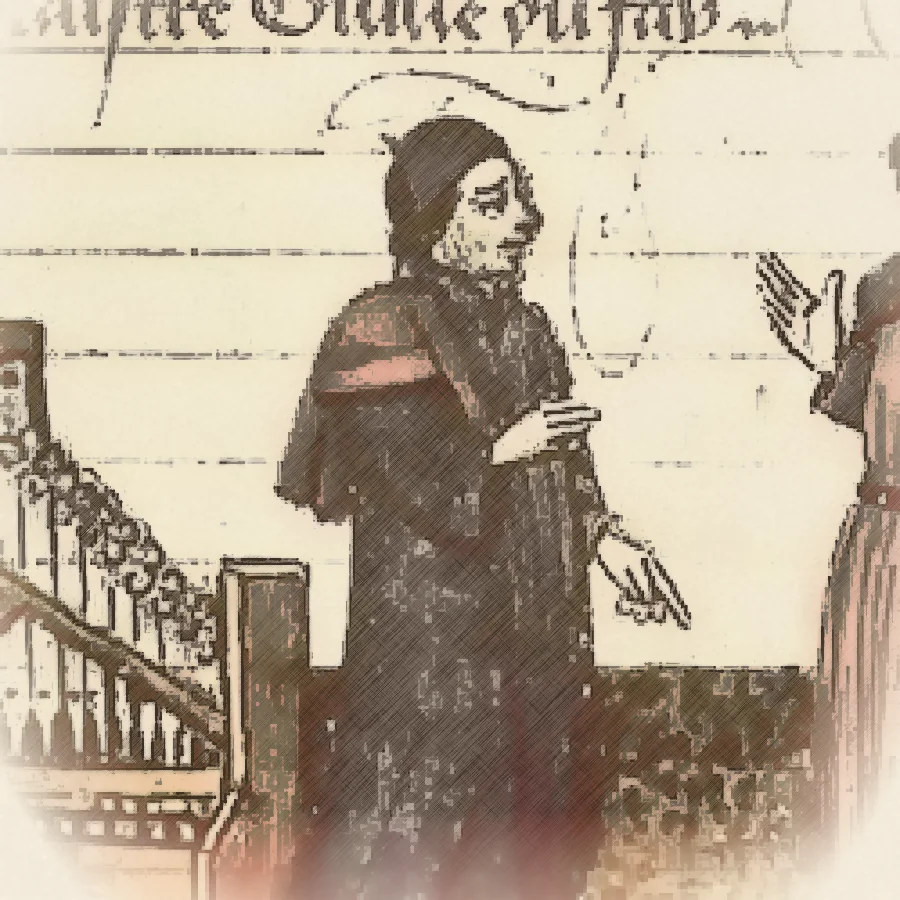
Guillaume Du Fay (or Dufay) was born around 1397, probably at Beersel near Brussels, the illegitimate son of a priest and a certain Marie Du Fayt, who later moved to Cambrai. It was in that city, then one of the great musical centres of Europe, that he grew up. In 1409 he was admitted as a choirboy at the cathedral, where he learned singing, composition and Latin from renowned masters. Cambrai remained his anchor throughout his life.
As a young man Du Fay left for Italy, like many northern musicians. Around 1420 he served the Malatesta family at Rimini and Pesaro, writing occasional works for them, such as the song Resvellies vous et faites chiere lie, composed in 1423 for a princely wedding. After a stay in Bologna, where he was ordained priest, he joined the papal chapel in Rome in 1428. There he mixed with the best singers of the day and composed motets for great papal occasions.
In 1433 he became choirmaster at the court of Savoy, under Duke Amadeus VIII, one of the most brilliant courts in Europe. He then returned to Pope Eugene IV, then residing in Florence. There in 1436 he composed his most famous work, the motet Nuper rosarum flores, for the consecration of the cathedral of Santa Maria del Fiore and its dome designed by Brunelleschi. Musicologists long believed that the proportions of the music reproduced those of the building; today it is seen rather as a reference to the Temple of Solomon described in the Bible, but the work remains a symbol of the union of music and architecture.
From 1439 Du Fay settled again in Cambrai as a canon of the cathedral. He spent most of his last decades there, with a long stay in Savoy in the 1450s. Admired throughout Europe, he received distinguished visitors and kept up links with the Medici in Florence and the court of Burgundy. His house in the heart of the city held a rich library. He also supervised the copying of the cathedral’s choirbooks, in which his music was regularly sung.
Du Fay practised every genre of his time. His eighty or so French songs, often rondeaux, are among the most refined of the century. His motets range from the learned isorhythm inherited from Vitry to a freer, more lyrical style. But it was in the mass that he made history: he made the cyclic mass, unified by a single underlying melody, the great genre of the Renaissance. The Missa Se la face ay pale is built on his own song; the Missa L’homme armé uses a famous martial popular song that dozens of composers would take up after him.
His music also responded to great events. After the fall of Constantinople to the Ottomans in 1453 he composed a Lament for the Holy Church of Constantinople, perhaps sung at the Feast of the Pheasant held by the Duke of Burgundy to call for a crusade. His last years were devoted to large-scale works such as the Missa Ave regina caelorum, in which he reached a new richness of sound in four voices.
Du Fay died in Cambrai on 27 November 1474. In his will he asked that his motet Ave regina caelorum, into which he had slipped a personal prayer — “Miserere tui labentis Dufay”, “have mercy on your dying Du Fay” — be sung at his bedside. There was no time, so it was sung at his funeral instead. Called by his contemporaries “the moon of all music”, he links the waning Middle Ages to the golden age of Franco-Flemish polyphony.
Works to know
- 1423
Resvellies vous et faites chiere lie
Festive ballade for a Malatesta wedding.
Listen on Wikimedia Commons - 1430
Se la face ay pale
Ballade: ‘If my face is pale, it is from love’.
Listen on Wikimedia Commons - 1436
Nuper rosarum flores
Motet for the consecration of Brunelleschi’s dome in Florence.
Listen on Wikimedia Commons - 1455
Missa Se la face ay pale
Mass built on his own love song.
Listen on Wikimedia Commons - 1460
Missa L’homme armé
One of the first Masses on the famous ‘armed man’ song.
Listen on Wikimedia Commons - 1464
Ave regina caelorum
Marian antiphon into which he slips a prayer for himself.
Listen on Wikimedia Commons
Anecdotes
The Florence dome he wrote a motet for is still the largest masonry dome in the world.
He built a whole Mass on his own love song!
He slipped his own name into the words of his motet Ave regina caelorum, asking mercy for “dying Du Fay”.
The song “L’homme armé”, which he used for a mass, became the basis of more than forty masses by other composers.
Same era · Renaissance
 c. 1390 – 1453Renaissance
John Dunstaple
His English music helped spread a new harmonic language across Europe.
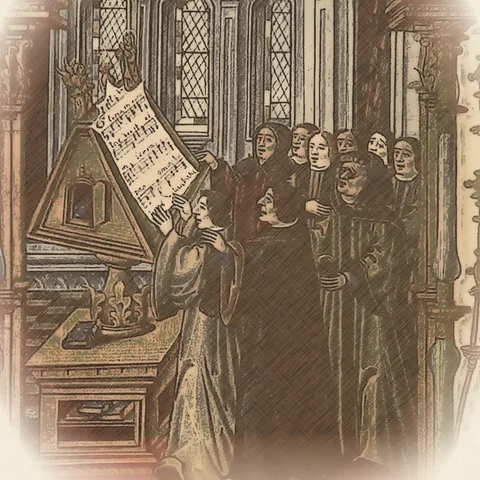 c. 1410 – 1497Renaissance
Johannes Ockeghem
A Franco-Flemish singer and composer, he developed remarkably sophisticated vocal counterpoint.
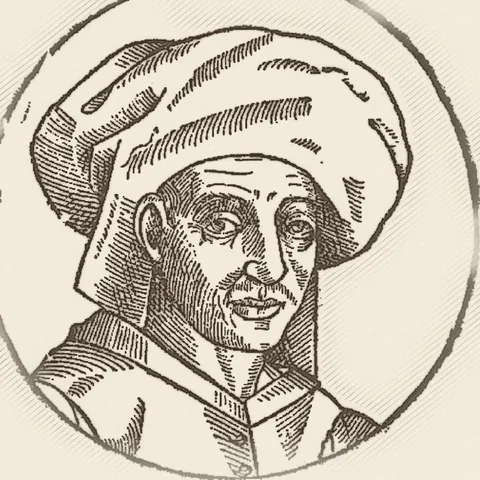 c. 1450 – 1521Renaissance
Josquin des Prez
His music lets voices converse with striking expressive clarity.
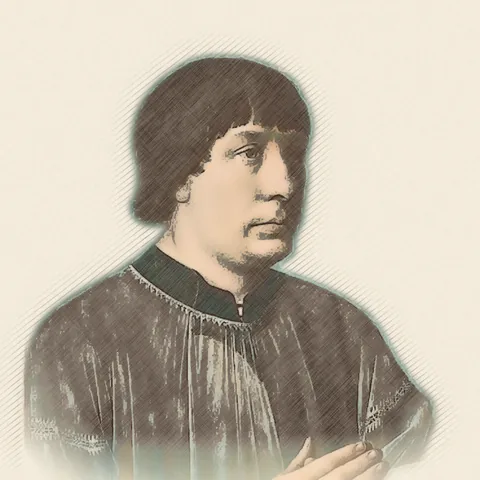 c. 1457 – 1505Renaissance
Jacob Obrecht
A Franco-Flemish composer celebrated for inventive polyphonic masses.
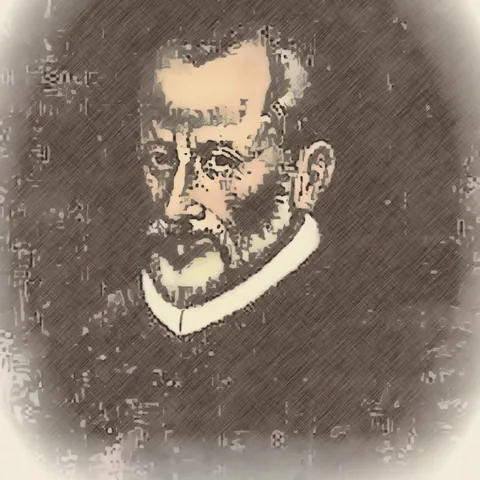 c. 1525 – 1594Renaissance
Giovanni Pierluigi da Palestrina
He epitomized balanced vocal polyphony in Renaissance sacred music.
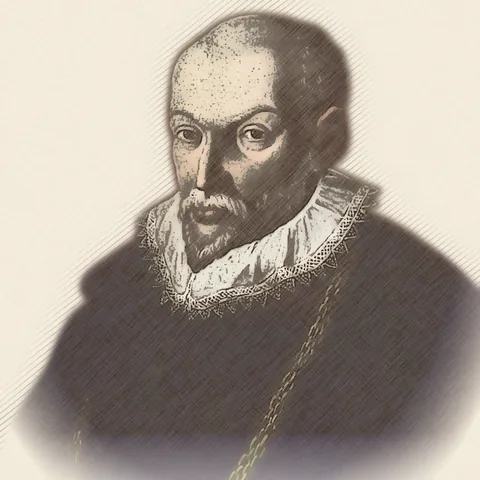 1532 – 1594Renaissance
Orlando di Lasso
A cosmopolitan musician based in Munich, he wrote in many languages and genres.