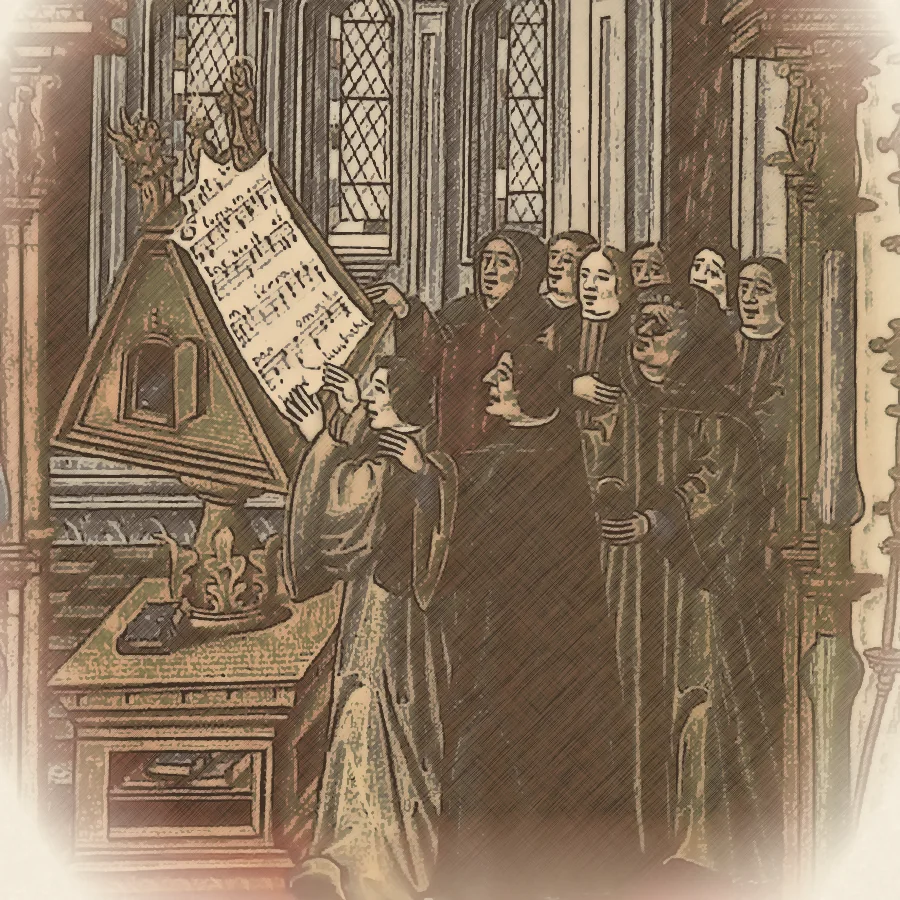
 Renaissance
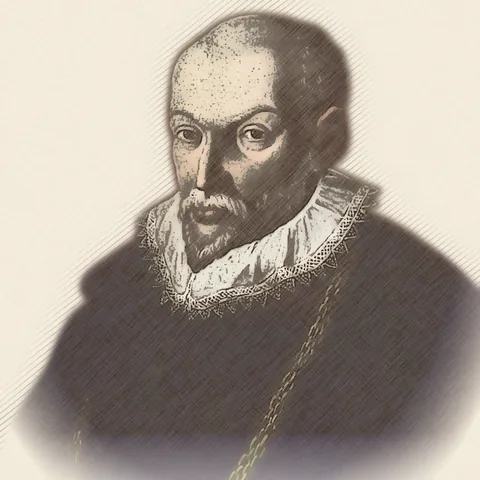
Johannes Ockeghem
A Franco-Flemish singer and composer, he developed remarkably sophisticated vocal counterpoint.
A life and its times
The milestones of the life and work, the contemporaries and the major world events, on a single line of time.
A life at a glance
- 1410Birth
Born around 1410 in Saint-Ghislain, Hainaut
- 1429Meanwhile
Joan of Arc lifts the siege of Orléans
- 1436Meanwhile
Brunelleschi’s dome in Florence is completed
- 1443Careerabout age 33
Singer at Notre-Dame, Antwerp
- 1446Careerabout age 36
In the service of Duke Charles I of Bourbon in Moulins
- 1451Careerabout age 41
Joins the royal chapel of Charles VII
- 1453Landmarkabout age 43
End of the Hundred Years’ War
- 1453Meanwhile
Fall of Constantinople; end of the Hundred Years’ War
- 1455Meanwhile
Gutenberg prints his Bible
- 1459Milestoneabout age 49
Treasurer of the abbey of Saint-Martin in Tours
- 1460Workabout age 50
Lament on the death of Binchois
- 1470Journeyabout age 60
Diplomatic journey to Spain for Louis XI
- 1475Workabout age 65
Requiem, the oldest surviving polyphonic Requiem
- 1492Landmarkabout age 82
Columbus reaches the Americas
- 1492Meanwhile
Christopher Columbus reaches the Americas
- 1497Deathabout age 87
Dies in Tours on 6 February; Josquin writes a lament
Listen
Excerpts from freely licensed recordings, with their performers and licences.
Johannes Ockeghem’s music is in the public domain, but Wikimedia Commons does not yet offer a freely licensed recording of these works. The links below lead to scores and searches on Commons; as soon as a free recording is published, it can be added here.
Listen to complete works on Wikimedia Commons
Wikimedia Commons is a free media library: you will find the complete recordings there, with their reuse conditions.
- Search for the workMissa prolationum
- Search for the workMissa pro defunctis (Requiem)
- Search for the workMissa cuiusvis toni
- Search for the workMort, tu as navré de ton dart
- Search for the workIntemerata Dei mater
- Search for the workDeo gratias (36 voices)
- Everything on CommonsAll recordings of Johannes Ockeghem
The life of Johannes Ockeghem
Johannes Ockeghem was born around 1410 at Saint-Ghislain in the County of Hainaut, a region now in Belgium. Nothing is known of his childhood, but he probably received the usual choirboy training in the churches of that land of musicians. The first certain record shows him in 1443 as a singer at the cathedral of Our Lady in Antwerp. He was famed for his magnificent, very deep bass voice, which may have shaped his taste for low lines in his music.
Around 1446 he entered the service of Charles I, Duke of Bourbon, at Moulins. Then, around 1451, he joined the chapel of King Charles VII of France, which he never left: he served three successive kings, Charles VII, Louis XI and Charles VIII, for more than forty years. He became first chaplain and then master of the royal chapel. These years coincided with the end of the Hundred Years’ War in 1453 and the rebuilding of the kingdom.
Royal favour brought him a large income. In 1459 Charles VII appointed him treasurer of the abbey of Saint-Martin de Tours, one of the richest religious institutions in the country, of which the king himself was abbot. From then on Ockeghem lived mainly in Tours, near the royal residences of the Loire Valley. Louis XI also entrusted him with missions: in 1470 he travelled to Spain, probably on diplomatic business. He met Du Fay in Cambrai in 1462 and 1464, and the two masters held each other in deep esteem.
His output is smaller than that of some contemporaries — about fifteen masses, a dozen motets, some twenty songs — but extraordinarily original. Ockeghem loved long melodic lines that seem never to stop, dense textures in which voices intertwine without obvious cadences, and low registers that give his music a dark, deep colour. He extended the range of polyphony downwards, writing for basses of unprecedented depth.
He was also a master of musical puzzles. His Missa prolationum is a true tour de force: each movement is a double canon in which the voices sing the same melody at different speeds. In the Missa cuiusvis toni, the “mass in any mode”, the music can be sung in several different modes depending on the clefs the singers choose. His Requiem is the oldest surviving polyphonic mass for the dead. He is even credited with a Deo gratias in thirty-six voices, though the attribution is doubtful.
His French songs, such as Fors seulement and Ma bouche rit, were known all over Europe. On the death of his friend Gilles Binchois in 1460 he composed the lament Mort, tu as navré de ton dart, starting a tradition: composers would now write musical laments to mourn their masters. Ockeghem also trained, directly or indirectly, a generation of musicians, and theorists constantly cite his name as a model.
He died in Tours on 6 February 1497 at a great age. His death prompted a wave of tributes: Josquin des Prez wrote the famous Lament on the Death of Johannes Ockeghem, on a poem by Jean Molinet calling his pupils to mourn. The poet Guillaume Crétin also wrote a long complaint. Long judged too learned or too abstract, Ockeghem is now recognised as one of the greatest polyphonists in history, and his spellbinding music moves many listeners.
Works to know
- 1460
Mort, tu as navré de ton dart
Lament on the death of his colleague Binchois.
Listen on Wikimedia Commons - 1470
Missa prolationum
Tour-de-force Mass: each pair of voices is a canon at different speeds.
Listen on Wikimedia Commons - 1470
Missa cuiusvis toni
A Mass singable in several modes at will.
Listen on Wikimedia Commons - 1470
Intemerata Dei mater
Five-voice motet descending into the depths.
Listen on Wikimedia Commons - 1470
Deo gratias (36 voices)
Giant canon attributed to Ockeghem.
Listen on Wikimedia Commons - 1475
Missa pro defunctis (Requiem)
The oldest surviving polyphonic Requiem.
Listen on Wikimedia Commons
Anecdotes
A Deo gratias for 36 voices is attributed to him — a real singing crowd!
He served three French kings in a row.
He had a very deep bass voice, famous in the royal chapel.
His Requiem is the oldest surviving polyphonic mass for the dead.
Same era · Renaissance
 c. 1390 – 1453Renaissance
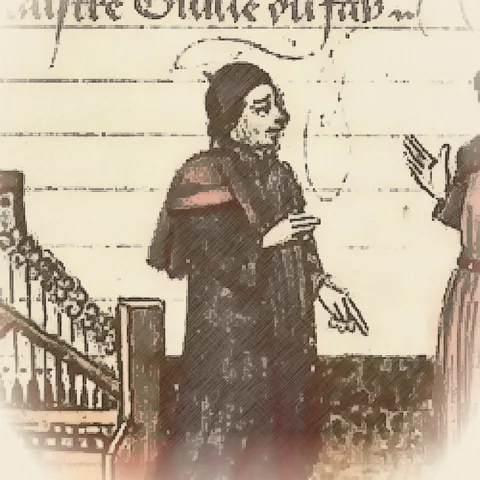
John Dunstaple
His English music helped spread a new harmonic language across Europe.
 c. 1397 – 1474Renaissance
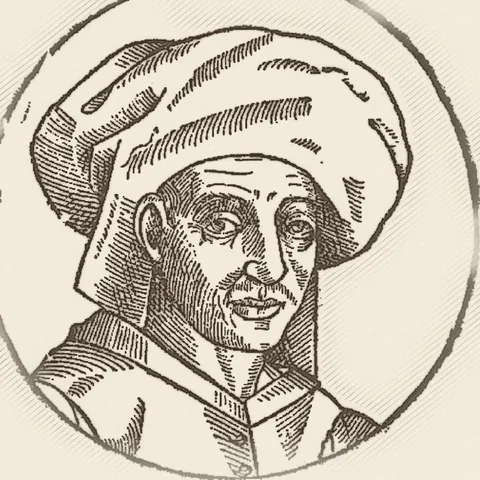
Guillaume Dufay
Working between France and Italy, he bridged medieval traditions and Renaissance style.
 c. 1450 – 1521Renaissance
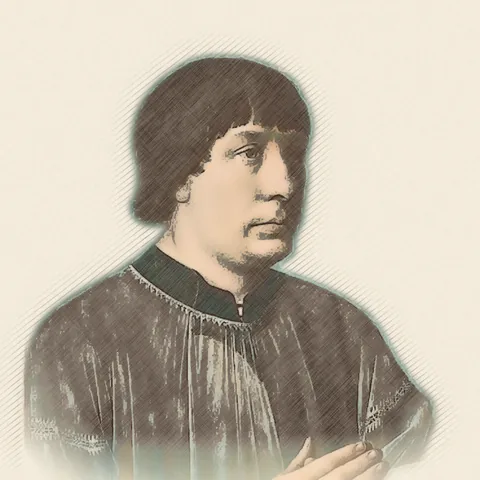
Josquin des Prez
His music lets voices converse with striking expressive clarity.
 c. 1457 – 1505Renaissance
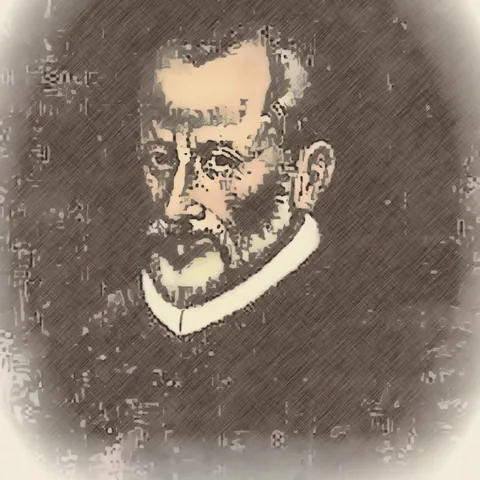
Jacob Obrecht
A Franco-Flemish composer celebrated for inventive polyphonic masses.
 c. 1525 – 1594Renaissance
Giovanni Pierluigi da Palestrina
He epitomized balanced vocal polyphony in Renaissance sacred music.
 1532 – 1594Renaissance
Orlando di Lasso
A cosmopolitan musician based in Munich, he wrote in many languages and genres.