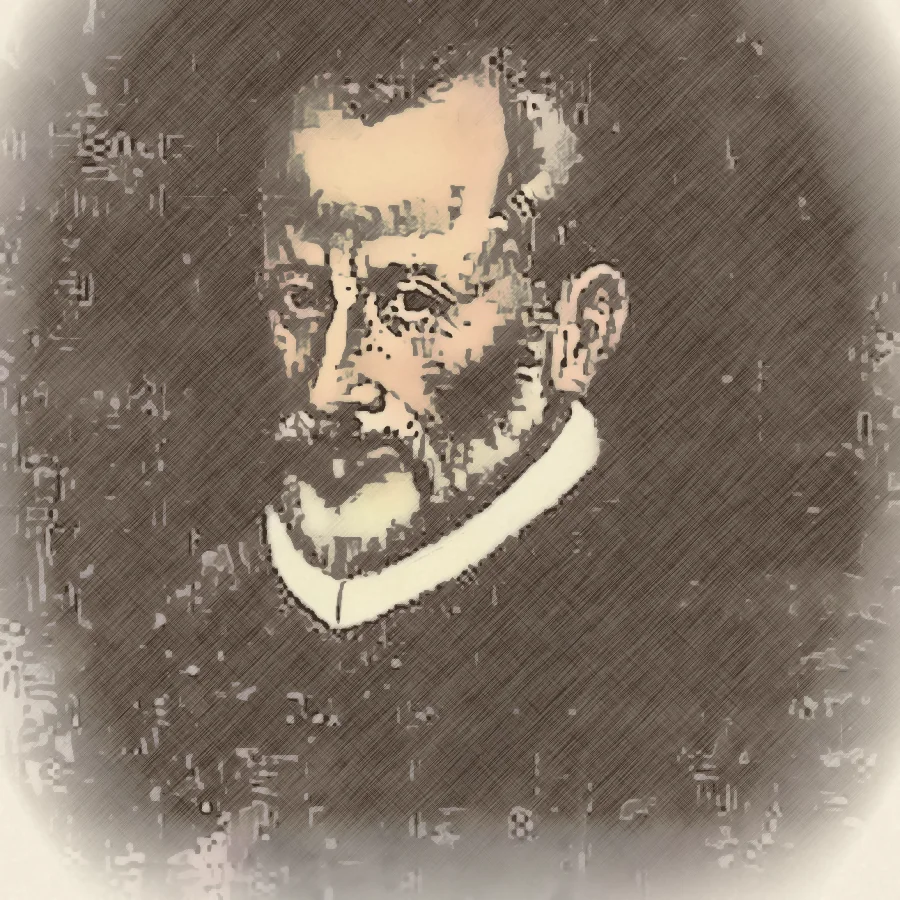
 Renaissance
Giovanni Pierluigi da Palestrina
He epitomized balanced vocal polyphony in Renaissance sacred music.
A life and its times
The milestones of the life and work, the contemporaries and the major world events, on a single line of time.
A life at a glance
- 1525Birth
Born around 1525 in Palestrina, near Rome
- 1537Trainingabout age 12
Choirboy at Santa Maria Maggiore in Rome
- 1543Meanwhile
Copernicus: the Earth goes round the Sun
- 1544Careerabout age 19
Organist of Palestrina cathedral
- 1545Meanwhile
The Council of Trent opens
- 1547Private lifeabout age 22
Marries Lucrezia Gori
- 1551Careerabout age 26
Master of the Cappella Giulia at St Peter’s, Rome
- 1554Workabout age 29
First Book of Masses, dedicated to Pope Julius III
- 1555Careerabout age 30
Joins the Sistine Chapel, then dismissed for being married
- 1555Meanwhile
Andrea Amati makes the earliest known violins in Cremona (c. 1555)
- 1563Landmarkabout age 38
The Council of Trent ends
- 1567Workabout age 42
Publication of the Pope Marcellus Mass
- 1571Careerabout age 46
Resumes direction of the Cappella Giulia until his death
- 1572Meanwhile
St Bartholomew’s Day massacre
- 1580Private lifeabout age 55
Loses his wife in an epidemic; remarries in 1581
- 1584Workabout age 59
Motets on the Song of Songs
- 1588Meanwhile
Defeat of the Spanish Armada
- 1594Deathabout age 69
Dies in Rome on 2 February
Listen
Excerpts from freely licensed recordings, with their performers and licences.
Excerpts last up to 90 seconds. Giovanni Pierluigi da Palestrina’s compositions are in the public domain; each recording is streamed from Wikimedia Commons under the licence shown, credited to its performers or uploader.
Listen to complete works on Wikimedia Commons
Wikimedia Commons is a free media library: you will find the complete recordings there, with their reuse conditions.
- Complete recordingPope Marcellus Mass — Gloria
- Complete recordingVestiva i colli (madrigal)
- Complete recordingSicut lilium inter spinas (motet)
- Wikimedia Commons fileThe Tudor Consort - 03 - Palestrina - Sicut Lilium Introduxit Me Rex
- Search for the workPope Marcellus Mass
- Search for the workSicut cervus
- Search for the workStabat Mater for eight voices
- Search for the workSong of Songs
- Search for the workVestiva i colli
- Search for the workLamentations of Jeremiah
- Everything on CommonsAll recordings of Giovanni Pierluigi da Palestrina
The life of Giovanni Pierluigi da Palestrina
Giovanni Pierluigi was born around 1525 in Palestrina, a small hill town east of Rome whose name he took. From a modest family, he went to Rome very young: in 1537 he was a choirboy at the basilica of Santa Maria Maggiore, where he received a solid musical training from masters from the north, heirs to the Franco-Flemish tradition. He hardly ever left the Roman region.
In 1544 he became organist and singing master at the cathedral of his home town, whose bishop was Cardinal Giovanni Maria del Monte. In 1547 he married Lucrezia Gori, with whom he had three sons. When his patron was elected pope as Julius III in 1550, he called Palestrina to Rome: the young musician was appointed in 1551 master of the Cappella Giulia, the choir of St Peter’s Basilica. In gratitude he dedicated to the pope in 1554 his first book of masses, the first published by an Italian composer.
In 1555 Julius III admitted him to the Sistine Chapel, the pope’s personal choir, without the usual examination. But a few months later the new, very strict Pope Paul IV enforced the rule requiring singers to be celibate: Palestrina, being married, was dismissed with a small pension. He then directed the music of St John Lateran and later Santa Maria Maggiore, and taught at the Roman Seminary founded by the Jesuits.
His name remains linked to the Council of Trent (1545–63), which reformed the Catholic Church in response to Protestantism. Some prelates wanted to ban polyphony in church, accusing it of making the words incomprehensible. A persistent legend says Palestrina “saved” sacred music by composing the Pope Marcellus Mass, published in 1567, which proved that one could write in six voices while keeping the text perfectly clear. The story is probably embellished, but the work illustrates well the ideal of clarity and dignity the council sought.
In 1571 he regained the direction of the Cappella Giulia, which he kept until his death. The 1570s were nonetheless painful: an epidemic took his brother, two of his sons and then his wife in 1580. He considered becoming a priest and received the tonsure, but in 1581 he married Virginia Dormoli, the wealthy widow of a fur merchant. He now also ran that business, which gave him comfort and allowed him to publish his works regularly.
His output is immense: more than a hundred masses, some three hundred motets, hymns, offertories, lamentations, litanies and nearly a hundred and fifty madrigals. His motets on the Song of Songs (1584) and pieces such as Sicut cervus or the double-choir Stabat Mater are among the finest of the Renaissance. His style is recognisable by its supple melodic lines rising and falling in small steps, by dissonances carefully prepared and resolved, and by perfect balance between the voices. Every part sings; none overwhelms the others.
Palestrina died in Rome on 2 February 1594 and was buried in old St Peter’s with the inscription “Prince of Music”. After him his style became a model. In 1725 the theorist Johann Joseph Fux held it up as the absolute example of counterpoint in his treatise Gradus ad Parnassum, studied by Haydn, Mozart and Beethoven. In the nineteenth century reformers of church music rediscovered him with fervour. Even today composition students learn writing in several voices by imitating his manner.
Works to know
- 1562
Pope Marcellus Mass
The most famous Mass of the Renaissance, perfectly clear.
Listen on Wikimedia Commons - 1566
Vestiva i colli
Secular madrigal, very famous in its day.
Listen on Wikimedia Commons - 1584
Sicut cervus
Motet on Psalm 42, a model of flowing polyphony.
Listen on Wikimedia Commons - 1584
Song of Songs
29 motets on the Bible’s love poems.
Listen on Wikimedia Commons - 1588
Lamentations of Jeremiah
Chants for Holy Week.
Listen on Wikimedia Commons - 1590
Stabat Mater for eight voices
Two choirs answer each other fervently.
Listen on Wikimedia Commons
Anecdotes
Legend says his music convinced the Pope not to ban singing in several voices.
He also ran a fur business!
On his tomb he was called “Prince of Music”.
Haydn, Mozart and Beethoven learned counterpoint from a book that took his style as its model.
Same era · Renaissance
 c. 1410 – 1497Renaissance
Johannes Ockeghem
A Franco-Flemish singer and composer, he developed remarkably sophisticated vocal counterpoint.
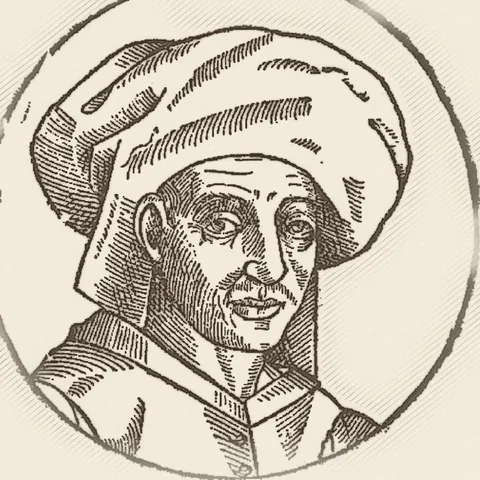 c. 1450 – 1521Renaissance
Josquin des Prez
His music lets voices converse with striking expressive clarity.
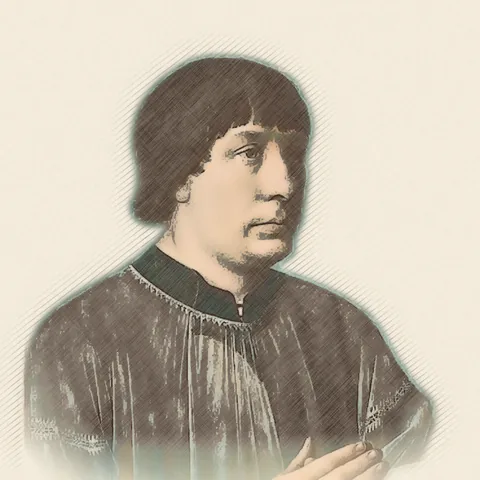 c. 1457 – 1505Renaissance
Jacob Obrecht
A Franco-Flemish composer celebrated for inventive polyphonic masses.
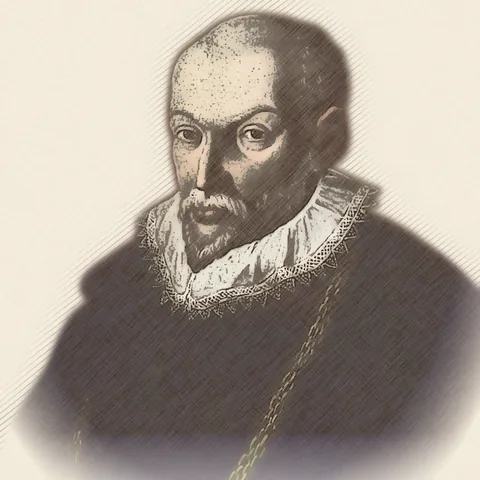 1532 – 1594Renaissance
Orlando di Lasso
A cosmopolitan musician based in Munich, he wrote in many languages and genres.
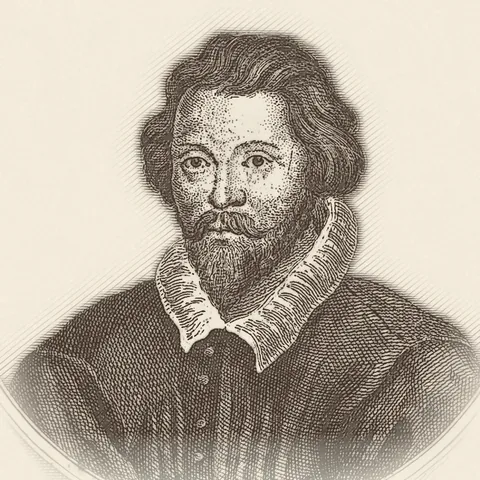 c. 1540 – 1623Renaissance
William Byrd
An English Catholic composer, he wrote deeply expressive music amid religious tensions.
 c. 1548 – 1611Renaissance
Tomás Luis de Victoria
A Spanish priest and composer, he brought remarkable expressive intensity to sacred polyphony.