 Renaissance
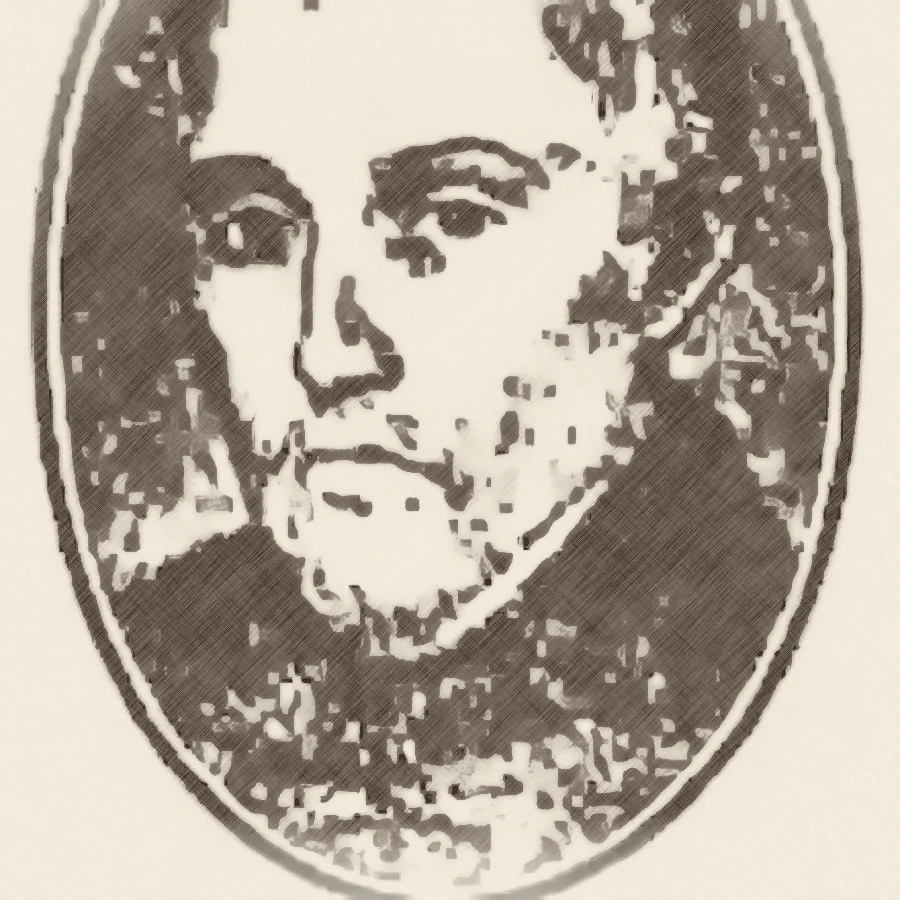
Tomás Luis de Victoria
A Spanish priest and composer, he brought remarkable expressive intensity to sacred polyphony.
A life and its times
The milestones of the life and work, the contemporaries and the major world events, on a single line of time.
A life at a glance
- 1548Birth
Born around 1548 in Ávila, Castile
- 1555Meanwhile
Andrea Amati makes the earliest known violins in Cremona (c. 1555)
- 1558Trainingabout age 10
Choirboy at Ávila cathedral
- 1565Journeyabout age 17
Goes to Rome to study at the Jesuit German College
- 1569Careerabout age 21
Organist and singer at Santa Maria di Monserrato
- 1572Workabout age 24
First book of motets, including O magnum mysterium
- 1572Meanwhile
St Bartholomew’s Day massacre
- 1575Careerabout age 27
Ordained a priest
- 1583Workabout age 35
Two books of Masses dedicated to King Philip II
- 1585Workabout age 37
Office for Holy Week
- 1587Milestoneabout age 39
Returns to Madrid as chaplain to Empress Maria at the Descalzas Reales convent
- 1588Meanwhile
Defeat of the Spanish Armada
- 1598Meanwhile
Edict of Nantes
- 1600Meanwhile
Shakespeare writes Hamlet (c. 1600)
- 1603Workabout age 55
Office for the Dead for the Empress’s funeral
- 1609Meanwhile
Galileo observes the sky with his telescope
- 1611Deathabout age 63
Dies in Madrid on 27 August
Listen
Excerpts from freely licensed recordings, with their performers and licences.
Excerpts last up to 90 seconds. Tomás Luis de Victoria’s compositions are in the public domain; each recording is streamed from Wikimedia Commons under the licence shown, credited to its performers or uploader.
Listen to complete works on Wikimedia Commons
Wikimedia Commons is a free media library: you will find the complete recordings there, with their reuse conditions.
- Complete recordingO vos omnes (Holy Week responsory)
- Complete recordingCaligaverunt oculi mei
- Complete recordingAmicus meus
- Search for the workOfficium defunctorum
- Search for the workO magnum mysterium
- Search for the workTenebrae Responsories
- Search for the workAve Maria
- Search for the workMissa O quam gloriosum
- Everything on CommonsAll recordings of Tomás Luis de Victoria
The life of Tomás Luis de Victoria
Tomás Luis de Victoria was born around 1548 in Ávila, Castile, into a large and devout family: he was the seventh of eleven children. His father died when he was only nine, and his uncle, a priest, took charge of his education. Around 1558 he became a choirboy at Ávila Cathedral, where he learned singing, organ and composition. Ávila was also the city of St Teresa, the great mystic who reformed the Carmelite order, and the fervour of his music has often been linked to that spiritual climate.
Around 1565, when his voice broke, he went to Rome on a grant from King Philip II. He studied at the Collegium Germanicum, founded by the Jesuits to train priests for the lands affected by the Reformation. There he probably met Palestrina, who was then teaching at the neighbouring Roman Seminary and whose influence is evident in his writing. By 1569 he was a singer and organist at Santa Maria di Monserrato, the church of the Aragonese community in Rome.
In 1572 he published his first book of motets, dedicated to Cardinal Otto von Truchsess, which already contains masterpieces such as O magnum mysterium and O quam gloriosum. He then succeeded Palestrina as choirmaster of the Roman Seminary and later became master at the Collegium Germanicum. Ordained priest in 1575, a few years later he joined the Congregation of the Oratory founded by St Philip Neri, known for its prayer meetings with music.
His Roman publications were very successful: books of masses, Magnificats and hymns. In 1583 he dedicated two books of masses to King Philip II and expressed his wish to return to Spain. In 1585 he published his Officium Hebdomadae Sanctae, the complete music for Holy Week, whose Tenebrae responsories, of overwhelming dramatic intensity, are regarded as one of the summits of sacred music.
In 1587 Victoria returned to Madrid, where he became chaplain to the Dowager Empress Maria of Austria, sister of Philip II and widow of Emperor Maximilian II, who had retired to the royal convent of the Descalzas Reales, a house of Poor Clares. He stayed there until his death, as choirmaster and later organist. The post gave him a quiet life far from the great courts and time to oversee the publication of his works in Rome, Venice and Madrid.
When the empress died in 1603 he composed for her funeral the six-voice Officium defunctorum, published in 1605, which he described as his “swan song”. This requiem, of grave and luminous beauty, is often regarded as his masterpiece. Unlike Palestrina or Lassus, Victoria wrote only sacred music, and only to Latin texts: he left no madrigals or secular songs.
His music is marked by intense, direct expression. He used bolder dissonances than Palestrina, harmonies that sometimes anticipate the Baroque, and a dramatic sense that follows every word of the text. His works are often shorter and more concentrated than those of his contemporaries. Victoria died in Madrid on 27 August 1611. He is now regarded as the greatest composer of the Spanish Renaissance and one of the major figures of European polyphony.
Works to know
- 1572
O magnum mysterium
Christmas motet full of wonder and tenderness.
Listen on Wikimedia Commons - 1572
Ave Maria
Luminous Marian motet.
Listen on Wikimedia Commons - 1583
Missa O quam gloriosum
Mass built on his own motet.
Listen on Wikimedia Commons - 1585
Tenebrae Responsories
Holy Week responsories, including O vos omnes.
Listen on Wikimedia Commons - 1605
Officium defunctorum
Six-voice Requiem, summit of Spanish polyphony.
Listen on Wikimedia Commons
Anecdotes
He was born in the same town as St Teresa of Ávila, the famous mystic.
He never wrote a single secular song — only sacred music.
He called his 1605 Requiem his “swan song”.
He ended his life as chaplain to an empress who had retired to a convent in Madrid.
Same era · Renaissance
 c. 1410 – 1497Renaissance
Johannes Ockeghem
A Franco-Flemish singer and composer, he developed remarkably sophisticated vocal counterpoint.
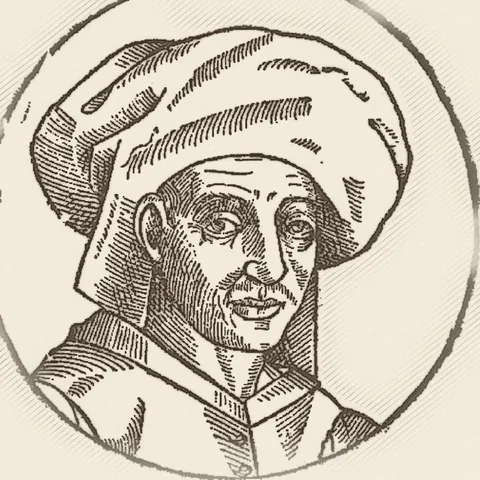 c. 1450 – 1521Renaissance
Josquin des Prez
His music lets voices converse with striking expressive clarity.
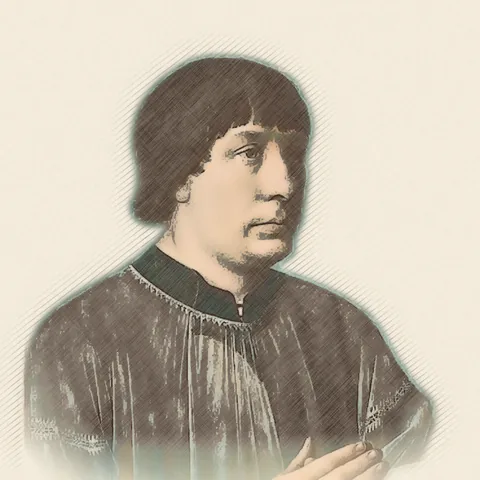 c. 1457 – 1505Renaissance
Jacob Obrecht
A Franco-Flemish composer celebrated for inventive polyphonic masses.
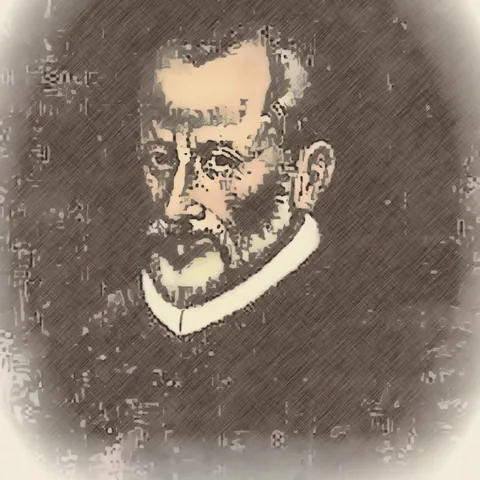 c. 1525 – 1594Renaissance
Giovanni Pierluigi da Palestrina
He epitomized balanced vocal polyphony in Renaissance sacred music.
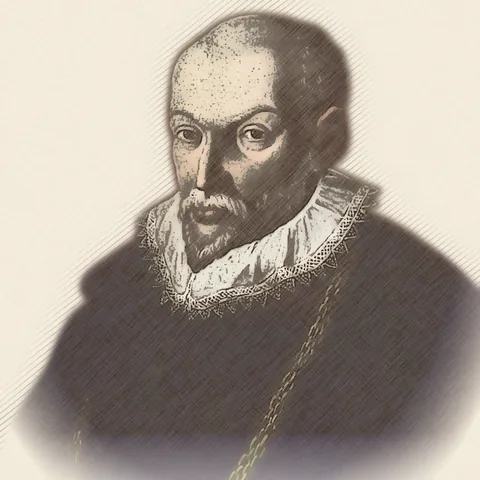 1532 – 1594Renaissance
Orlando di Lasso
A cosmopolitan musician based in Munich, he wrote in many languages and genres.
 c. 1540 – 1623Renaissance
William Byrd
An English Catholic composer, he wrote deeply expressive music amid religious tensions.