 Renaissance
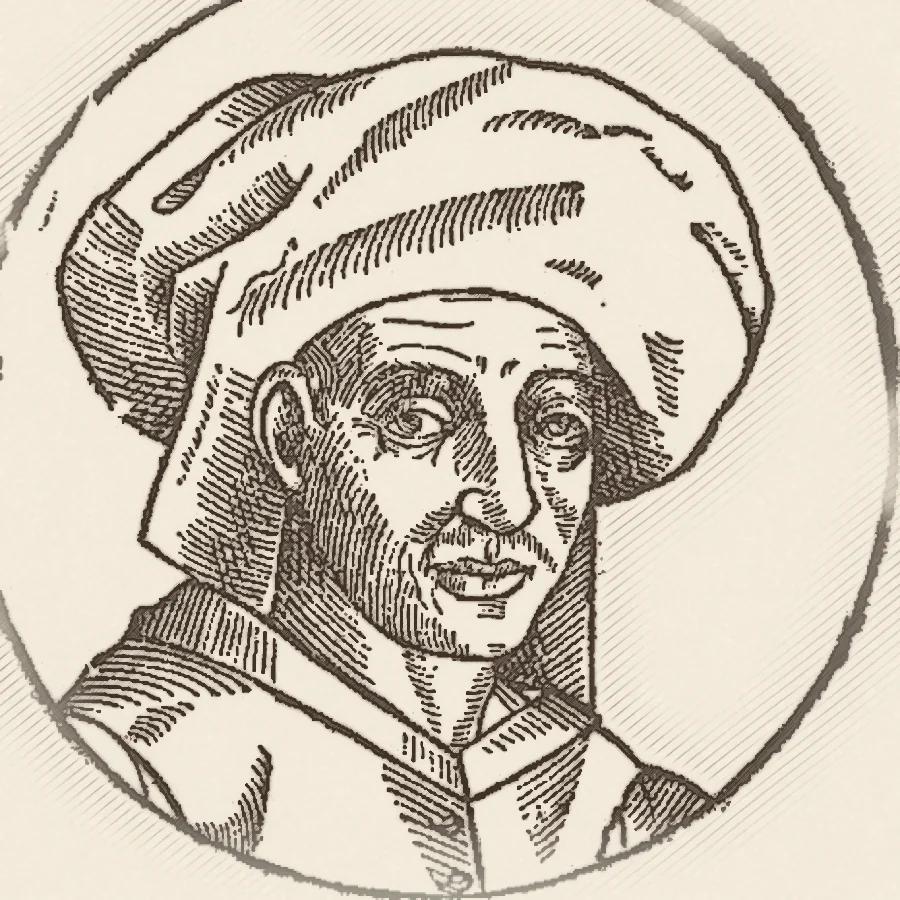
Josquin des Prez
His music lets voices converse with striking expressive clarity.
A life and its times
The milestones of the life and work, the contemporaries and the major world events, on a single line of time.
A life at a glance
- 1450Birth
Born around 1450–55 in what is now northern France
- 1453Meanwhile
Fall of Constantinople; end of the Hundred Years’ War
- 1455Meanwhile
Gutenberg prints his Bible
- 1477Careerabout age 27
Singer in René of Anjou’s chapel in Aix-en-Provence
- 1484Careerabout age 34
In the service of Cardinal Ascanio Sforza, in Milan then Rome
- 1489Careerabout age 39
Singer in the papal chapel; his name is carved in the Sistine Chapel choir loft
- 1492Meanwhile
Christopher Columbus reaches the Americas
- 1495Workabout age 45
Ave Maria… virgo serena spreads across Europe
- 1501Meanwhile
Petrucci publishes the first printed book of music in Venice
- 1502Workabout age 52
Petrucci publishes the first printed book of Masses by a single composer — his
- 1503Careerabout age 53
Chapel master to Duke Ercole d’Este in Ferrara
- 1503Meanwhile
Leonardo da Vinci begins the Mona Lisa
- 1504Milestoneabout age 54
Provost of the collegiate church of Condé-sur-l’Escaut
- 1512Meanwhile
Michelangelo completes the Sistine Chapel ceiling
- 1515Workabout age 65
Missa Pange lingua, one of his last Masses
- 1517Landmarkabout age 67
Luther launches the Reformation
- 1517Meanwhile
Luther’s 95 Theses: the Reformation begins
- 1519Meanwhile
Magellan sets off on the first voyage around the world
- 1521Deathabout age 71
Dies in Condé on 27 August
Listen
Excerpts from freely licensed recordings, with their performers and licences.
Excerpts last up to 90 seconds. Josquin des Prez’s compositions are in the public domain; each recording is streamed from Wikimedia Commons under the licence shown, credited to its performers or uploader.
Listen to complete works on Wikimedia Commons
Wikimedia Commons is a free media library: you will find the complete recordings there, with their reuse conditions.
- Complete recordingMille regretz (chanson)
- Complete recordingEl grillo (traditionally attributed frottola)
- Complete recordingTu pauperum refugium (motet)
- Search for the workAve Maria… virgo serena
- Search for the workMissa Pange lingua
- Search for the workMiserere mei, Deus
- Search for the workNymphes des bois
- Search for the workMissa Hercules dux Ferrariae
- Search for the workMille regretz
- Everything on CommonsAll recordings of Josquin des Prez
The life of Josquin des Prez
Josquin des Prez was born around 1450–55 in what is now northern France, probably in Picardy or Hainaut, near Saint-Quentin or Condé-sur-l’Escaut. His real name may have been Josse Lebloitte, known as des Prez. His beginnings are obscure: he was probably a choirboy, perhaps at Saint-Quentin. Yet he became the most famous composer of his age, admired in his lifetime as no musician before him.
The first certain record of his career shows him in 1477 at Aix-en-Provence, a singer in the chapel of René of Anjou, “Good King René”. When René died in 1480 the chapel passed to King Louis XI, and Josquin may have served at the French court. Around 1484 he was in Italy in the service of Cardinal Ascanio Sforza, brother of the Duke of Milan, whom he followed to Rome. In 1489 he joined the chapel of Pope Innocent VIII. His name, carved by himself into the wall of the singers’ gallery in the Sistine Chapel, was found during its restoration.
By the 1490s his works were already circulating throughout Europe. His motet Ave Maria… virgo serena, of exemplary clarity, became one of the most copied of the time. In 1503 Duke Ercole I d’Este of Ferrara hired him as choirmaster. One of the duke’s agents, hesitating between him and Heinrich Isaac, noted that Josquin composed better but wrote “when he wanted to and not when one wanted him to”, and asked for a higher salary. The duke nevertheless chose Josquin, who composed for him the Missa Hercules dux Ferrariae, whose theme is drawn from the vowels of the duke’s name, and the great Miserere mei, Deus.
In 1503 plague struck Ferrara. Josquin left the city in 1504 and settled in Condé-sur-l’Escaut, where he became provost of the collegiate church of Notre-Dame. He spent his last years there at the head of a large choir, while keeping links with the Habsburg court and with Margaret of Austria, governor of the Netherlands. He died at Condé on 27 August 1521, leaving his property to the church so that his motet Pater noster / Ave Maria would be sung in his memory.
His art achieved a perfect synthesis of northern polyphonic science and the Italian taste for clarity. Josquin developed imitation: each voice enters in turn with the same motif, giving the music a new transparency. He was also very attentive to words, seeking to convey the meaning and emotion of the text through painful harmonies for lament or lively rhythms for joy. The reformer Martin Luther, a great music lover, said of him: “Josquin is master of the notes; they must do as he wills, whereas other composers must do as the notes will.”
He left some eighteen masses, more than fifty motets and many songs. The Missa Pange lingua, one of his last, freely paraphrases a Gregorian hymn. His French songs, such as Mille regretz and Petite camusette, were arranged for lute, organ and other voices for decades. His Lament on the death of Ockeghem, Nymphes des bois, is one of the summits of funeral music.
Josquin also benefited from the birth of music printing: in 1502 the Venetian publisher Ottaviano Petrucci issued the first printed book devoted entirely to the masses of a single composer, and it was his. This circulation made him a true European celebrity. After his death so many works were wrongly attributed to him that it was joked he composed more dead than alive. For sixteenth-century humanists he was the Michelangelo of music.
Works to know
- 1485
Ave Maria… virgo serena
Crystal-clear four-voice motet — the hit of its day.
Listen on Wikimedia Commons - 1497
Nymphes des bois
Lament on the death of his master Ockeghem.
Listen on Wikimedia Commons - 1500
Mille regretz
Melancholy four-voice chanson.
Listen on Wikimedia Commons - 1503
Miserere mei, Deus
Psalm for Ferrara with a haunting refrain.
Listen on Wikimedia Commons - 1503
Missa Hercules dux Ferrariae
The duke’s name is turned into musical notes.
Listen on Wikimedia Commons - 1515
Missa Pange lingua
Mass on a Gregorian hymn, a summary of his art.
Listen on Wikimedia Commons
Anecdotes
His carved name ‘JOSQUINJ’ was found during the restoration of the Sistine Chapel.
He was the first composer to have a printed book of Masses all to himself.
For Duke Ercole d’Este he built the theme of a mass from the vowels of the duke’s name.
Martin Luther said he was “master of the notes”, while other composers were their servants.
Same era · Renaissance
 c. 1390 – 1453Renaissance
John Dunstaple
His English music helped spread a new harmonic language across Europe.
 c. 1397 – 1474Renaissance
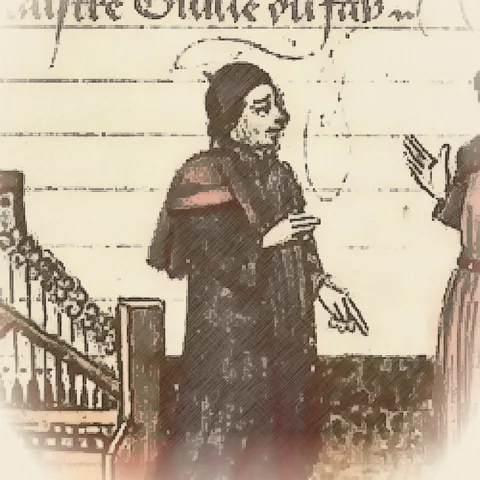
Guillaume Dufay
Working between France and Italy, he bridged medieval traditions and Renaissance style.
 c. 1410 – 1497Renaissance
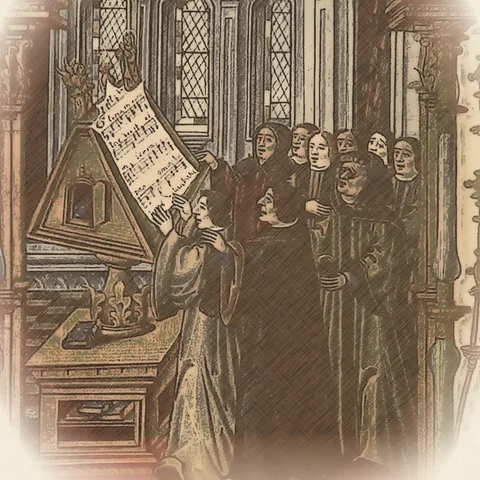
Johannes Ockeghem
A Franco-Flemish singer and composer, he developed remarkably sophisticated vocal counterpoint.
 c. 1457 – 1505Renaissance
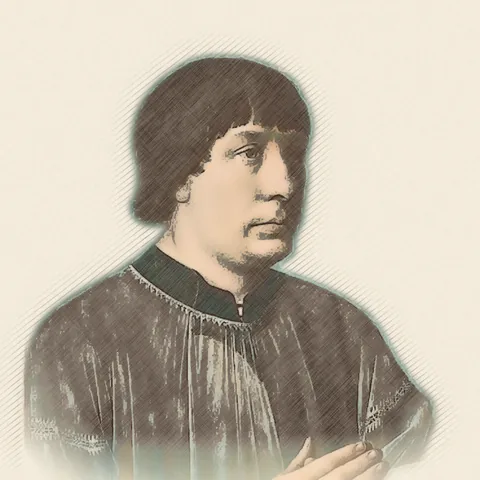
Jacob Obrecht
A Franco-Flemish composer celebrated for inventive polyphonic masses.
 c. 1525 – 1594Renaissance
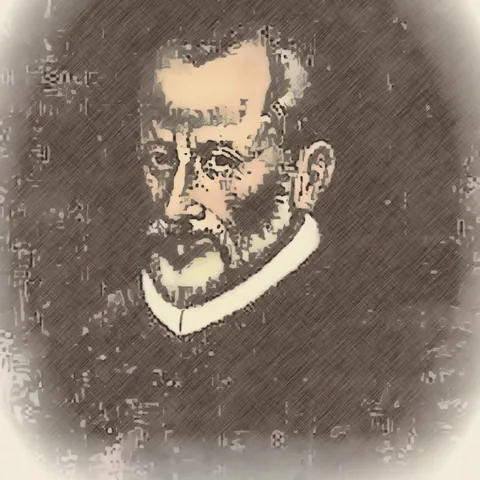
Giovanni Pierluigi da Palestrina
He epitomized balanced vocal polyphony in Renaissance sacred music.
 1532 – 1594Renaissance
Orlando di Lasso
A cosmopolitan musician based in Munich, he wrote in many languages and genres.