 Middle Ages
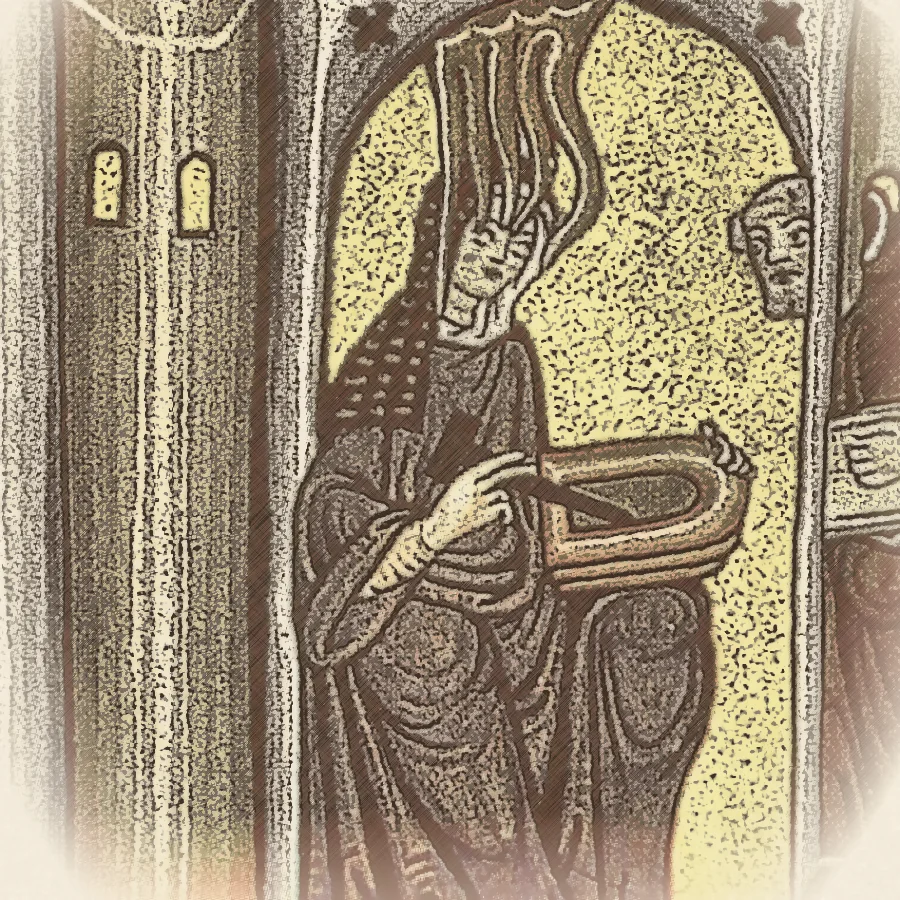
Hildegard von Bingen
Abbess, thinker and composer, she combined spiritual poetry with expansive melodic lines.
A life and its times
The milestones of the life and work, the contemporaries and the major world events, on a single line of time.
A life at a glance
And after his or her death: 1 landmark in the detailed timeline (2012).
- 1098Birth
Born in Bermersheim, the tenth child of a noble family
- 1098Meanwhile
Foundation of Cîteaux Abbey
- 1112Trainingage 14
Enters Disibodenberg monastery with Jutta of Sponheim
- 1136Careerage 38
Elected magistra of the community after Jutta’s death
- 1137Meanwhile
Eleanor of Aquitaine marries the future Louis VII
- 1141Workage 43
Begins Scivias, the account of her visions
- 1148Careerage 50
Pope Eugene III encourages the circulation of her writings
- 1150Milestoneage 52
Founds her own convent at Rupertsberg, near Bingen
- 1151Workage 53
Completes Scivias; musical drama Ordo Virtutum
- 1158Journeyage 60
First preaching tours through the Rhineland towns
- 1163Meanwhile
Construction of Notre-Dame de Paris begins
- 1165Milestoneage 67
Founds a second convent at Eibingen
- 1179Deathage 81
Dies at Rupertsberg on 17 September
- 2012Landmark833 years after death
Canonised and proclaimed Doctor of the Church
Listen
Excerpts from freely licensed recordings, with their performers and licences.
Excerpts last up to 90 seconds. Hildegard von Bingen’s compositions are in the public domain; each recording is streamed from Wikimedia Commons under the licence shown, credited to its performers or uploader.
Listen to complete works on Wikimedia Commons
Wikimedia Commons is a free media library: you will find the complete recordings there, with their reuse conditions.
- Complete recordingO frondens virga (antiphon)
- Complete recordingO frondens virga — another performance
- Search for the workOrdo Virtutum
- Search for the workSymphonia armonie celestium revelationum
- Search for the workO vis aeternitatis
- Search for the workO frondens virga
- Search for the workColumba aspexit
- Search for the workAve generosa
- Everything on CommonsAll recordings of Hildegard von Bingen
The life of Hildegard von Bingen
Hildegard was born in 1098 at Bermersheim in the Rhineland, the tenth child of a family of minor nobility. Her parents destined her for the religious life early on: at about eight she was entrusted to Jutta of Sponheim, a recluse living beside the Benedictine monastery of Disibodenberg. There she learned the Latin of the psalms, the chant of the Office and the rhythm of monastic life, and took her vows around 1112, as the small cell grew into a community of women.
From childhood Hildegard said she saw a “living light” that revealed images and words to her. For a long time she kept it secret. Elected magistra of the community on Jutta’s death in 1136, she received in 1141 what she described as a divine command to write. With the help of the monk Volmar she spent ten years on Scivias (“Know the Ways”), a vast account of twenty-six visions on creation, redemption and the end of time. In 1147–48 Pope Eugene III had part of the text read at the Synod of Trier and encouraged her to continue: the Rhineland nun became a recognised authority.
With this support Hildegard left Disibodenberg despite the monks’ opposition and around 1150 founded her own convent at Rupertsberg, opposite Bingen on the Rhine. In 1165 she opened a second at Eibingen on the other bank. An energetic abbess, she defended her sisters’ independence, negotiated with bishops and kept up a correspondence of several hundred letters with popes, the emperor Frederick Barbarossa, abbots and lay people seeking her advice.
Her music is inseparable from this community life. She composed more than seventy liturgical chants — antiphons, responsories, hymns, sequences — gathered under the title Symphonia armonie celestium revelationum (“Symphony of the Harmony of Celestial Revelations”). Her melodies are monophonic like plainchant but stand out for their very wide range, their soaring flights into the upper register and their long garlands of notes on a single syllable. She also wrote the Ordo Virtutum, a musical drama in which the Virtues fight over a soul against the Devil, who does not sing but speaks: it is one of the oldest works of sung theatre whose author we know.
Her activity went far beyond music. Hildegard wrote two more great books of visions, the Liber vitae meritorum and the Liber divinorum operum, treatises on medicine and natural history (Physica, Causae et curae) describing plants, stones and animals, and even invented a secret language, the Lingua ignota. Past the age of sixty she undertook preaching tours through the towns of the Rhineland and Swabia, something exceptional for a woman of her time.
For Hildegard, music was no ornament: it was the memory of the harmony humanity had known in paradise and lost through the Fall. To sing was to regain a little of that union with God. She defended this forcefully in 1178, when the prelates of Mainz placed her convent under interdict for burying an excommunicated nobleman: deprived of song for several months, her nuns could only say the Office in low voices. Hildegard then wrote a famous letter reminding them that those who silence sung praise deprive themselves of the music of heaven. The interdict was lifted a few months before her death. Her chants survive mainly in two manuscripts, the Dendermonde codex and the Wiesbaden “Riesencodex”, copied under her supervision or shortly after she died.
She died at Rupertsberg on 17 September 1179, aged eighty-one. Venerated locally for centuries, she was rediscovered in the twentieth century by musicians and the wider public: her chants have been recorded by many ensembles and reach far beyond specialist circles. In 2012 Pope Benedict XVI extended her cult to the universal Church and proclaimed her a Doctor of the Church, a title shared by very few women.
Works to know
- 1150
Symphonia armonie celestium revelationum
Collection of about 77 liturgical chants (antiphons, responsories, hymns).
Listen on Wikimedia Commons - 1150
O vis aeternitatis
Responsory with a vast, rippling melody.
Listen on Wikimedia Commons - 1150
O frondens virga
Radiant Marian antiphon, a perfect way into her style.
Listen on Wikimedia Commons - 1150
Columba aspexit
Sequence for Saint Maximin, with spectacular leaps.
Listen on Wikimedia Commons - 1150
Ave generosa
Hymn to the Virgin of rich poetic imagery.
Listen on Wikimedia Commons - 1151
Ordo Virtutum
Sung drama in which the Virtues fight for a soul — one of the earliest morality plays set to music.
Listen on Wikimedia Commons
Anecdotes
Hildegard invented a secret language of more than 1,000 words, the Lingua ignota.
She wrote one of the very first ‘operas’ in history: the Ordo Virtutum.
In the Ordo Virtutum every character sings except the Devil: he can only shout, because he is cut off from harmony.
She wrote several hundred letters to popes, emperors, kings and abbots.
Her medical books describe the properties of hundreds of plants, stones and animals.
Same era · Middle Ages
 c. 1135 – c. 1201Middle Ages
Léonin
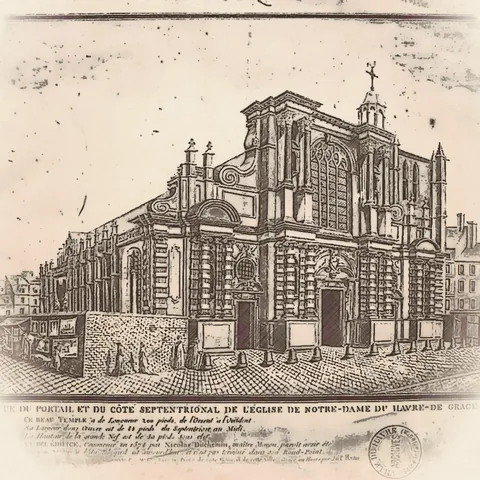
Associated with Notre-Dame in Paris, he is a foundational figure of polyphonic organum.
 c. 1160 – c. 1230Middle Ages
Pérotin
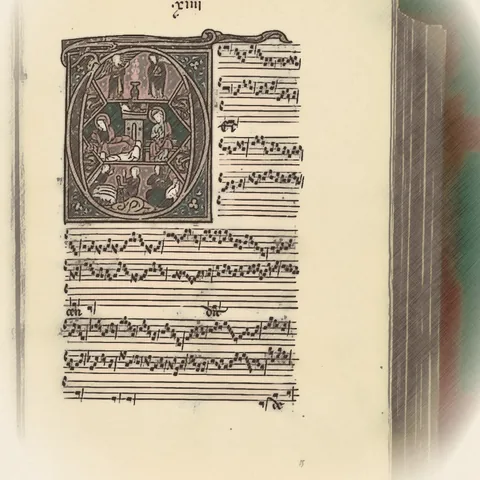
At Notre-Dame in Paris, he developed polyphony by combining independent vocal lines.
 1291 – 1361Middle Ages
Philippe de Vitry
Bishop, poet and theorist, he is associated with the fourteenth-century Ars nova.
 c. 1300 – 1377Middle Ages
Guillaume de Machaut
A poet and musician, he joined courtly song with sophisticated polyphonic writing.