 Middle Ages
Léonin
Associated with Notre-Dame in Paris, he is a foundational figure of polyphonic organum.
A life and its times
The milestones of the life and work, the contemporaries and the major world events, on a single line of time.
A life at a glance
And after his or her death: 1 landmark in the detailed timeline (1275).
- 1135Birth
Probable birth, most likely in Paris
- 1137Meanwhile
Eleanor of Aquitaine marries the future Louis VII
- 1150Trainingabout age 15
Studies at the Paris cathedral school
- 1163Landmarkabout age 28
Construction of Notre-Dame cathedral begins
- 1163Meanwhile
Construction of Notre-Dame de Paris begins
- 1165Careerabout age 30
Canon and poet active around Notre-Dame
- 1170Workabout age 35
Composes the organa of the Magnus liber organi
- 1180Workabout age 45
His Latin poems (Hystorie sacre gestas) circulate
- 1190Meanwhile
Philip Augustus builds the Paris city wall and the Louvre fortress
- 1198Landmarkabout age 63
Bishop Odo of Sully regulates polyphony at major feasts
- 1201Deathabout age 66
Probable death around 1201
- 1275Landmark74 years after death
An English writer (‘Anonymous IV’) calls him ‘optimus organista’
Listen
Excerpts from freely licensed recordings, with their performers and licences.
Excerpts last up to 90 seconds. Léonin’s compositions are in the public domain; each recording is streamed from Wikimedia Commons under the licence shown, credited to its performers or uploader.
Listen to complete works on Wikimedia Commons
Wikimedia Commons is a free media library: you will find the complete recordings there, with their reuse conditions.
The life of Léonin
Léonin is one of the very first European composers whose name we know, yet his life remains partly mysterious. Scholars usually identify him with Leonius, a poet and canon active in Paris in the second half of the twelfth century, born around 1135 and dead around 1201. He is thought to have been educated at the Paris cathedral school, one of the great intellectual centres of the age, before joining the clergy of Notre-Dame.
His name has come down to us thanks to an English theorist of the late thirteenth century whom musicologists call “Anonymous IV”. Writing about a century later, this witness describes him as “optimus organista”, the best composer of organum, and credits him with a great collection of polyphonic chants for the whole liturgical year: the Magnus liber organi, the “great book of organum”. He adds that the book was later revised and shortened by his successor, Pérotin.
Organum means adding one or more voices above a Gregorian chant. In Léonin’s music the liturgical melody is stretched into very long notes in the lower voice, while the upper voice unfolds long, supple, ornate vocalises above it: this is organum duplum, in two voices. In certain passages, called clausulae, the two voices instead move together in a tighter, more rhythmic way. This alternation gave the cathedral’s great feasts a new solemnity.
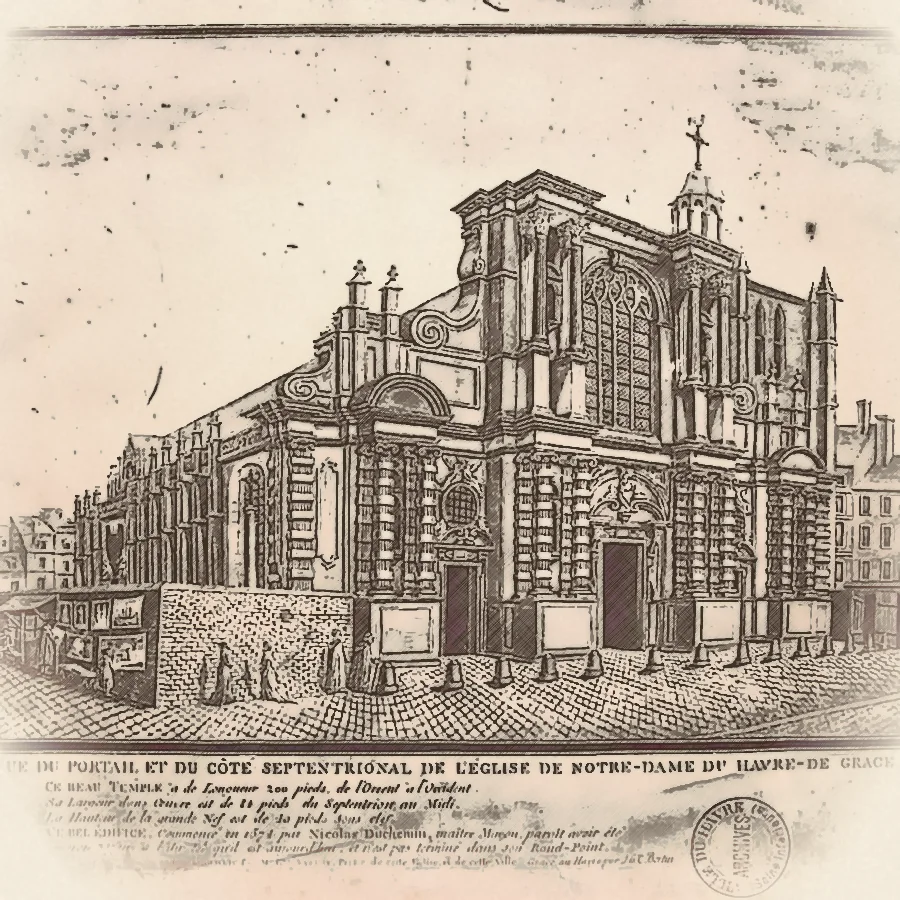
These innovations developed at the very moment Notre-Dame de Paris was being built, its construction beginning in 1163. Léonin’s music shares that impulse: like Gothic architecture, it reaches for height and breadth. It also relies on a decisive advance in notation, the rhythmic modes, which allowed long and short durations to be shown through groups of notes. It was one of the first steps towards the measured rhythm of Western music.
The Magnus liber organi has not survived in its original form: we know it through manuscripts copied in the thirteenth century, now kept in Florence, Wolfenbüttel and Madrid, which mix older pieces with later revisions. It is therefore impossible to attribute each organum to Léonin with certainty. Among the pieces tradition links to him are the Christmas Viderunt omnes and the Easter Alleluia Pascha nostrum.
To understand what people heard then, we must imagine the great resonant nave and a small group of soloists in the middle of the choir. Only the sections given to the soloists, in responsories and alleluias, were sung in polyphony; the rest of the chant remained Gregorian, in unison, taken up by the whole clergy. Léonin’s organum thus slotted into the liturgy as a festive moment, a burst of sound reserved for the most solemn days of the year: Christmas, Easter, Pentecost, the Assumption. The collection covers a complete cycle of some ninety pieces. Singers had to know the underlying Gregorian melody by heart and improvise part of the ornamentation: the boundary between written composition and oral practice was still blurred, and it is precisely Léonin’s work that began to fix on parchment what had previously been improvised.
Léonin is regarded as the first representative of what is called the Notre-Dame school, which made Paris the capital of European polyphony for more than a century. His organa, carried as far as Spain and Scotland, served as models for generations of singers. Without him, the history of music in several voices would probably not have taken the same path.
Works to know
- 1170
Magnus liber organi
The ‘Great Book of Organum’: two-voice settings for the whole church year.
Listen on Wikimedia Commons - 1170
Viderunt omnes (organum duplum)
Christmas gradual in which an ornate voice floats above sustained chant.
Listen on Wikimedia Commons - 1170
Alleluia Pascha nostrum
Easter organum alternating held notes and rhythmic passages.
Listen on Wikimedia Commons - 1170
Judaea et Jerusalem
Two-voice responsory for Christmas Eve.
Listen on Wikimedia Commons
Anecdotes
We know about Léonin thanks to notes written by an English student almost 80 years after his death!
A single note in the lower voice can last over a minute in his organa.
His music is known only through copies made decades after his death, now kept in Florence, Wolfenbüttel and Madrid.
Léonin was also a poet: he turned several books of the Bible into Latin verse.
Same era · Middle Ages
 1098 – 1179Middle Ages
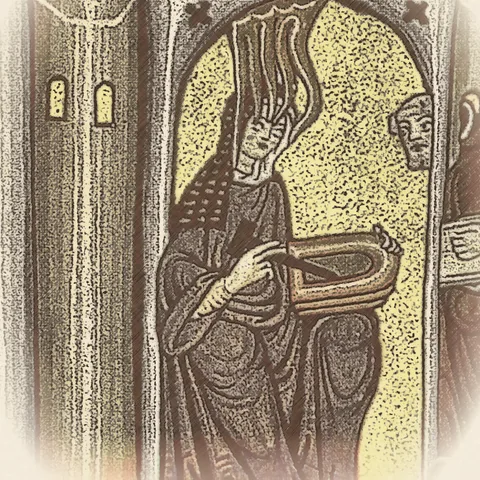
Hildegard von Bingen
Abbess, thinker and composer, she combined spiritual poetry with expansive melodic lines.
 c. 1160 – c. 1230Middle Ages
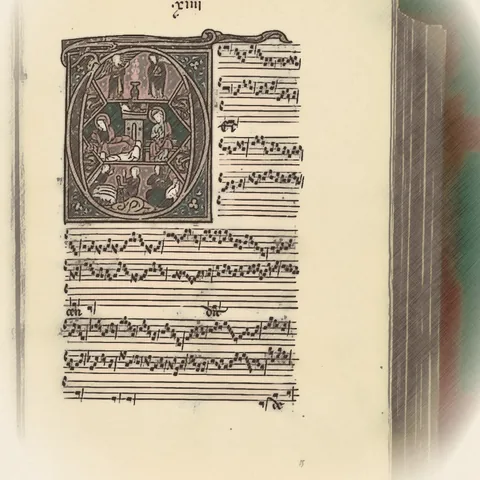
Pérotin
At Notre-Dame in Paris, he developed polyphony by combining independent vocal lines.
 1291 – 1361Middle Ages
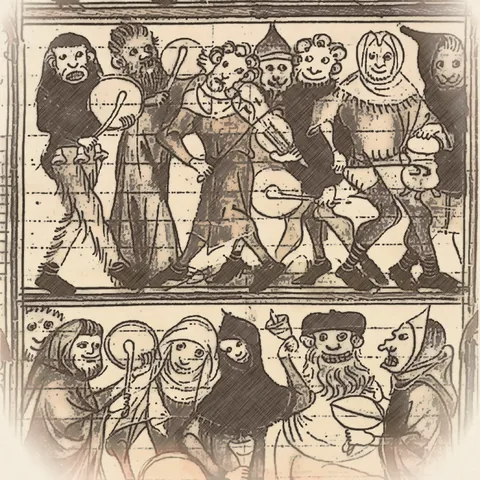
Philippe de Vitry
Bishop, poet and theorist, he is associated with the fourteenth-century Ars nova.
 c. 1300 – 1377Middle Ages
Guillaume de Machaut
A poet and musician, he joined courtly song with sophisticated polyphonic writing.