 Romantic
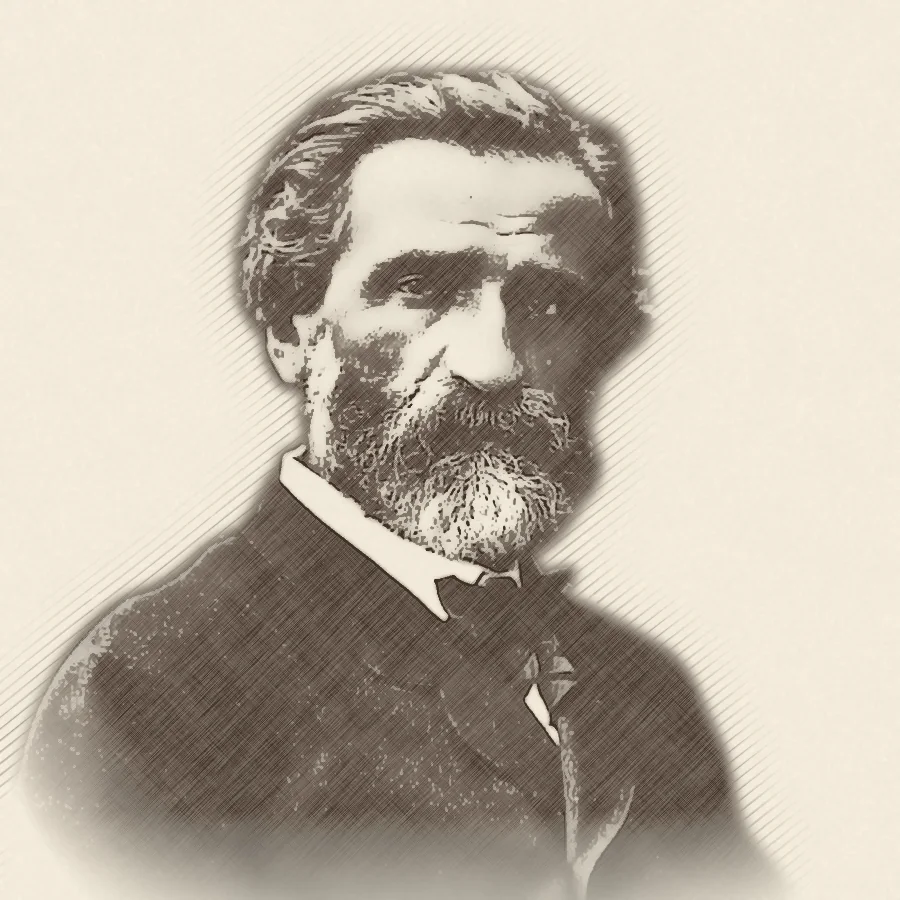
Giuseppe Verdi
His operas give unforgettable voice to human passions and conflicts.
A life and its times
The milestones of the life and work, the contemporaries and the major world events, on a single line of time.
A life at a glance
- 1813Birth
Born on 10 October in Le Roncole, son of an innkeeper
- 1816Meanwhile
Maelzel patents the metronome (1815–16)
- 1822Meanwhile
Champollion deciphers hieroglyphs
- 1823Trainingage 10
Studies in Busseto, supported by the merchant Antonio Barezzi
- 1830Meanwhile
July Revolution in France
- 1832Trainingage 19
Rejected by the Milan Conservatory; studies privately
- 1836Private lifeage 23
Marries Margherita Barezzi
- 1840Private lifeage 27
Loses his wife and two children within two years
- 1840Meanwhile
Adolphe Sax invents the saxophone (c. 1840)
- 1842Workage 29
Triumph of Nabucco at La Scala, with the chorus ‘Va, pensiero’
- 1851Workage 38
Rigoletto
- 1853Workage 40
Il trovatore and La traviata
- 1859Landmarkage 46
‘Viva VERDI’ becomes a slogan for Italian unity
- 1859Meanwhile
Darwin publishes On the Origin of Species
- 1861Careerage 48
Member of the first parliament of united Italy
- 1871Workage 58
Aida, premiered in Cairo
- 1874Workage 61
Messa da Requiem, in memory of Manzoni
- 1874Meanwhile
First exhibition of the Impressionist painters
- 1875Meanwhile
The Palais Garnier opera house opens in Paris
- 1887Workage 74
Otello
- 1889Meanwhile
The Eiffel Tower opens for the World’s Fair
- 1893Workage 80
Falstaff, a comedy written at 79
- 1899Careerage 86
Founds a retirement home for musicians in Milan
- 1901Deathage 88
Dies in Milan on 27 January; a huge crowd sings ‘Va, pensiero’
Listen
Excerpts from freely licensed recordings, with their performers and licences.
Excerpts last up to 90 seconds. Giuseppe Verdi’s compositions are in the public domain; each recording is streamed from Wikimedia Commons under the licence shown, credited to its performers or uploader.
Listen to complete works on Wikimedia Commons
Wikimedia Commons is a free media library: you will find the complete recordings there, with their reuse conditions.
- Complete recordingRigoletto — La donna è mobile
- Complete recordingIl trovatore — Di quella pira
- Complete recordingLa traviata — Prelude to Act III
- Complete recordingMessa da Requiem — Sanctus
- Search for the workLa traviata
- Search for the workAida
- Search for the workRigoletto
- Search for the workNabucco
- Search for the workMessa da Requiem
- Search for the workFalstaff
- Search for the workOtello
- Everything on CommonsAll recordings of Giuseppe Verdi
The life of Giuseppe Verdi
Giuseppe Verdi was born on 10 October 1813 at Le Roncole, a hamlet near Busseto in the Duchy of Parma, then under French rule. His parents ran an inn and a grocery. As a child he was fascinated by the village church organ, and at nine he became its organist. A wealthy Busseto merchant and music lover, Antonio Barezzi, noticed his talent, took him into his home and paid for his studies. Verdi studied with the music master Ferdinando Provesi and composed his first marches for the town band.
In 1832, thanks to a grant and Barezzi’s help, he went to study in Milan. But the Conservatory refused him: he was over the age limit, not an Austrian subject, and his piano technique was judged inadequate. Ironically, the Conservatory now bears his name. Verdi then studied privately with Vincenzo Lavigna, a former La Scala musician, who taught him counterpoint and took him to the opera. In 1836 he returned to Busseto as music master and married Margherita, Barezzi’s daughter.
In 1839 his first opera, Oberto, was premiered at La Scala with respectable success. But between 1838 and 1840 Verdi suffered a terrible tragedy: his two children and then his wife Margherita died of illness. Meanwhile he had to compose a comic opera, Un giorno di regno, which was a complete failure. In despair he decided to stop composing. It was the La Scala impresario Bartolomeo Merelli who slipped into his pocket a libretto on the biblical story of Nebuchadnezzar.
The libretto fell open at the lines “Va, pensiero, sull’ali dorate” (“Go, thought, on golden wings”), the chorus of the Hebrews exiled in Babylon longing for their homeland. Verdi was overwhelmed and went back to work. Nabucco, premiered at La Scala on 9 March 1842, was a triumph. The chorus “Va, pensiero” became the symbol of Italians dreaming of freedom from Austrian rule. In the following years, which Verdi called his “galley years”, he composed at a frantic pace, almost an opera a year.
The 1850s produced his famous “popular trilogy”: Rigoletto (1851), the story of a hunchbacked jester trying to protect his daughter, with the aria “La donna è mobile”; Il trovatore (1853), with its Anvil Chorus; and La traviata (1853), after Alexandre Dumas fils’s The Lady of the Camellias, at first a failure and then one of the most performed operas in the world. Verdi was then living with the soprano Giuseppina Strepponi, whom he married in 1859, and settled on his estate at Sant’Agata near Busseto, where he also devoted himself to farming.
His name became a political slogan: patriots wrote “Viva VERDI” on walls, secretly meaning “Viva Vittorio Emanuele Re d’Italia”, long live Victor Emmanuel, King of Italy. In 1861, after unification, Verdi was elected deputy to the first Italian Parliament at Cavour’s request. He then composed operas on a larger scale: La forza del destino for St Petersburg (1862), Don Carlos for the Paris Opéra (1867) and Aida (1871), commissioned for the new Cairo opera house, with its famous Triumphal March. In 1874 he wrote his Messa da Requiem in homage to the writer Alessandro Manzoni.
For sixteen years Verdi composed no opera. It was the composer and poet Arrigo Boito who persuaded him to take up his pen again: together they created Otello (1887), after Shakespeare, and then Falstaff (1893), a sparkling comedy written at seventy-nine. Generous, he founded in Milan the Casa di Riposo, a retirement home for elderly musicians, where he now lies. He died in Milan on 27 January 1901. When his body was transferred, a vast crowd spontaneously sang “Va, pensiero”.
Works to know
- 1842
Nabucco
The slaves’ chorus ‘Va, pensiero’ became an unofficial national anthem.
Listen on Wikimedia Commons - 1851
Rigoletto
A court jester, and the aria ‘La donna è mobile’.
Listen on Wikimedia Commons - 1853
La traviata
Violetta’s tragic fate, with the drinking song ‘Libiamo’.
Listen on Wikimedia Commons - 1871
Aida
Impossible love in ancient Egypt, with the Triumphal March.
Listen on Wikimedia Commons - 1874
Messa da Requiem
Theatrical Requiem with a terrifying Dies irae.
Listen on Wikimedia Commons - 1887
Otello
Drama of jealousy after Shakespeare.
Listen on Wikimedia Commons - 1893
Falstaff
Sparkling comedy after Shakespeare.
Listen on Wikimedia Commons
Anecdotes
‘Viva VERDI’ secretly meant ‘Long live Victor Emmanuel, King of Italy’.
Aida was commissioned for Egypt and premiered in Cairo in 1871.
The Milan Conservatory, which turned him down as a young man, now bears his name.
He wrote Falstaff, a sparkling comedy, at seventy-nine.
Same era · Romantic
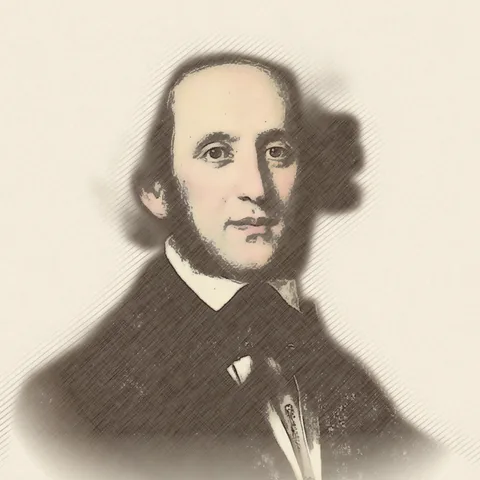 1809 – 1847Romantic
Felix Mendelssohn
A conductor and composer who revived Bach and wrote music of great clarity.
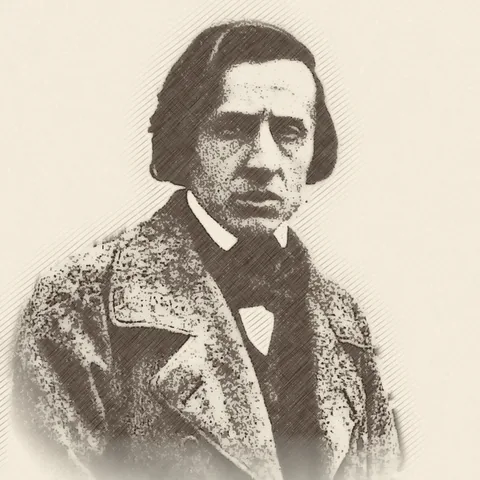 1810 – 1849Romantic
Frédéric Chopin
At the piano, he combined virtuosity, poetry and memories of Polish dance.
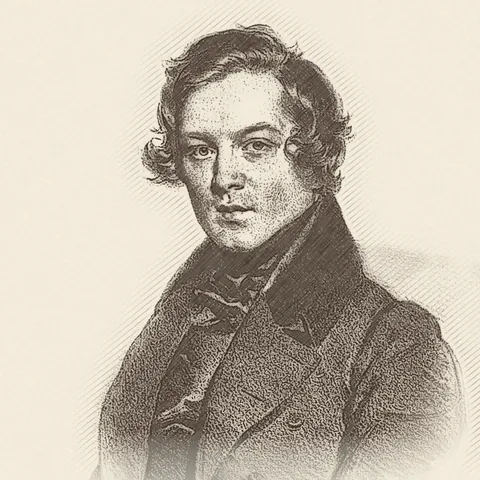 1810 – 1856Romantic
Robert Schumann
A composer and critic, he explored psychological contrasts in piano music.
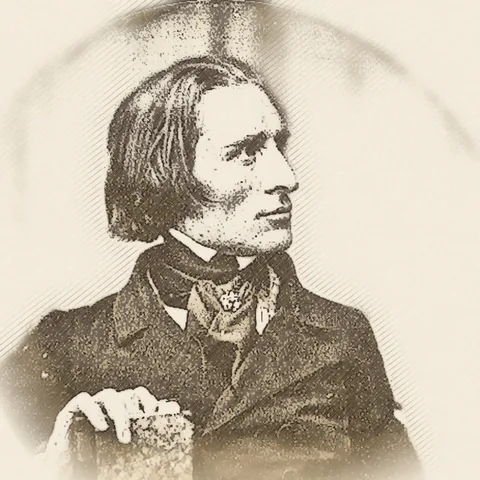 1811 – 1886Romantic
Franz Liszt
A star pianist, he invented new forms and developed the symphonic poem.
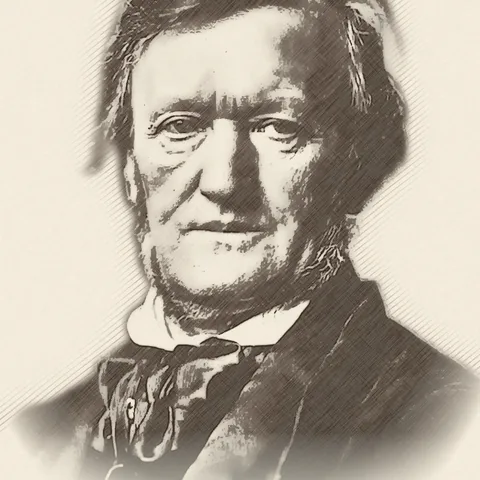 1813 – 1883Romantic
Richard Wagner
He envisioned music drama as a unity of orchestra, poetry and stagecraft.
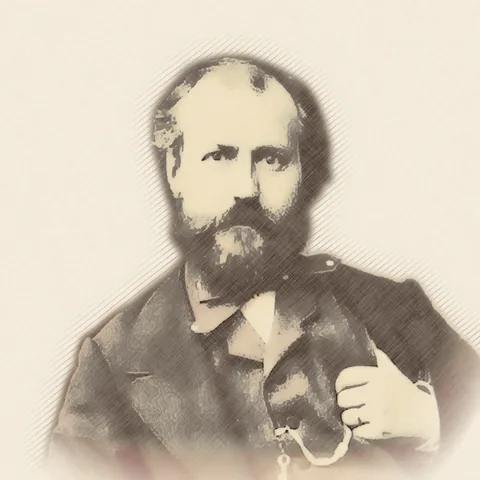 1818 – 1893Romantic
Charles Gounod
A French composer who shaped Romantic opera and sacred music.