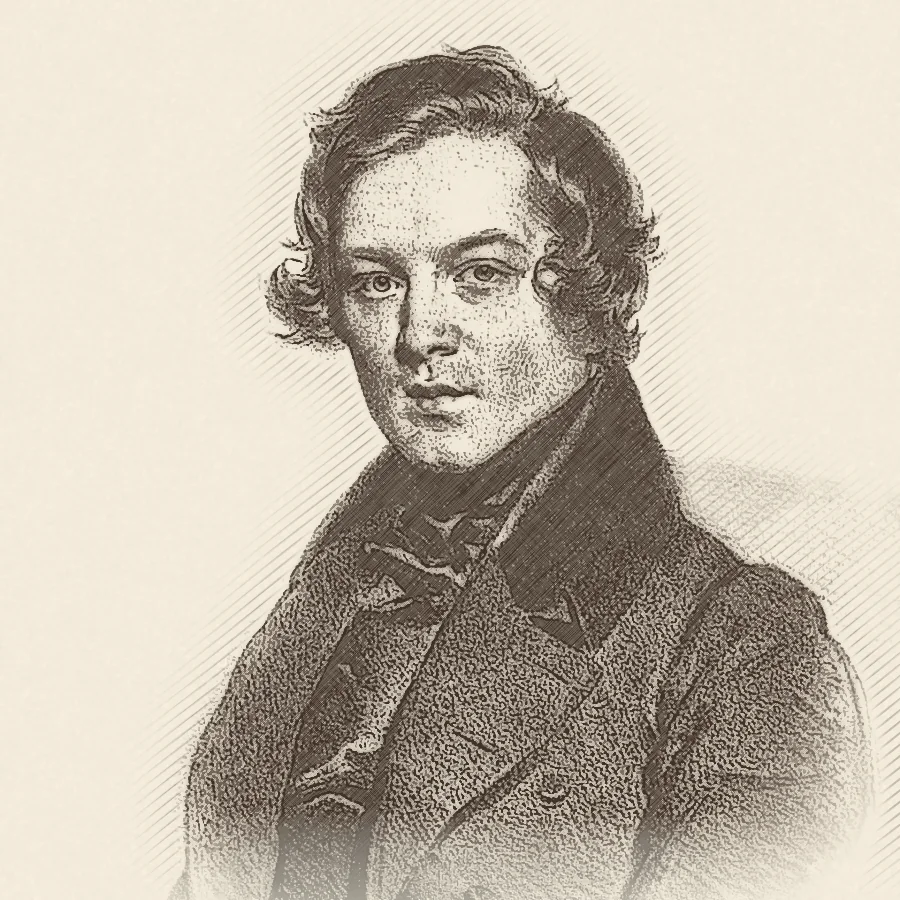
A life and its times
The milestones of the life and work, the contemporaries and the major world events, on a single line of time.
A life at a glance
- 1810Birth
Born in Zwickau on 8 June, son of a bookseller-publisher
- 1815Meanwhile
Battle of Waterloo
- 1816Meanwhile
Maelzel patents the metronome (1815–16)
- 1822Meanwhile
Champollion deciphers hieroglyphs
- 1825Meanwhile
First public passenger railway (England)
- 1828Trainingage 18
Studies law in Leipzig, then Heidelberg
- 1830Trainingage 20
Gives up law; piano lessons with Friedrich Wieck, Clara’s father
- 1830Meanwhile
July Revolution in France
- 1832Private lifeage 22
A hand injury ends his dream of being a pianist
- 1834Careerage 24
Founds the Neue Zeitschrift für Musik, a critical journal
- 1835Workage 25
Carnaval Op. 9
- 1838Workage 28
Scenes from Childhood and Kreisleriana
- 1839Meanwhile
Photography is invented (daguerreotype)
- 1840Private lifeage 30
Marries Clara Wieck after a lawsuit against her father; ‘year of song’
- 1840Meanwhile
Adolphe Sax invents the saxophone (c. 1840)
- 1841Workage 31
Symphony No. 1 ‘Spring’
- 1845Workage 35
Piano Concerto in A minor
- 1848Workage 38
Album for the Young
- 1848Meanwhile
Revolutions of 1848; slavery abolished in France
- 1850Careerage 40
Music director in Düsseldorf; ‘Rhenish’ Symphony
- 1853Private lifeage 43
Meets the young Brahms and introduces him to the world
- 1854Private lifeage 44
Seriously ill, he is cared for in a clinic at Endenich
- 1856Deathage 46
Dies at Endenich on 29 July
Listen
Excerpts from freely licensed recordings, with their performers and licences.
Excerpts last up to 90 seconds. Robert Schumann’s compositions are in the public domain; each recording is streamed from Wikimedia Commons under the licence shown, credited to its performers or uploader.
Listen to complete works on Wikimedia Commons
Wikimedia Commons is a free media library: you will find the complete recordings there, with their reuse conditions.
- Complete recordingScenes from Childhood — Träumerei
- Complete recordingScenes from Childhood — Of Foreign Lands and Peoples
- Complete recordingPiano Concerto in A minor — Allegro affettuoso
- Complete recordingLiederkreis Op. 39 — Mondnacht
- Search for the workScenes from Childhood (Kinderszenen)
- Search for the workPiano Concerto
- Search for the workCarnaval
- Search for the workDichterliebe (A Poet’s Love)
- Search for the workAlbum for the Young
- Search for the workSymphony No. 3 ‘Rhenish’
- Search for the workPiano Quintet
- Everything on CommonsAll recordings of Robert Schumann
The life of Robert Schumann
Robert Schumann was born on 8 June 1810 in Zwickau, Saxony. His father, August, was a bookseller, publisher and writer; he introduced his son to the great authors, especially Jean Paul and Byron, and encouraged his artistic tastes. Robert began piano at seven, composed his first pieces and organised a small orchestra with his schoolmates. He long hesitated between literature and music. In 1826 the death of his father and the suicide of his sister marked him deeply.
To obey his mother he went to study law in Leipzig in 1828, then in Heidelberg, but spent most of his time at the piano. In 1830, after hearing Paganini, he decided to become a pianist and persuaded his mother to let him study with Friedrich Wieck, a renowned Leipzig teacher, in whose house he lodged. Wieck’s daughter Clara, aged eleven, was already a prodigy pianist. But in 1832 Robert injured his right hand, perhaps with a device meant to strengthen his fingers: his dream of becoming a virtuoso was shattered, and he devoted himself to composition.
Schumann was also a brilliant writer. In 1834 he and friends founded the Neue Zeitschrift für Musik, a music journal he edited for ten years. He signed his reviews with imaginary names: Florestan, the impetuous, and Eusebius, the dreamer, representing the two sides of his personality, members of a fictitious brotherhood, the “Davidsbündler”, who fought the philistines. In 1831 he introduced Chopin with a famous phrase: “Hats off, gentlemen, a genius!”
His early works are almost all for piano: Papillons, Carnaval (1835), a suite of little musical portraits, Kreisleriana and Kinderszenen (1838), with the famous Träumerei. From 1835 Robert and Clara fell in love. Friedrich Wieck fiercely opposed their union and forbade his daughter to see him. The lovers had to take the matter to court, and they were finally able to marry on 12 September 1840, the day before Clara’s twenty-first birthday.
1840 was his “year of song”: he composed some 140 songs, including the cycles Dichterliebe, Frauenliebe und -leben and the Liederkreis on poems by Eichendorff. Encouraged by Clara, he then turned to the orchestra: Symphony No. 1, “Spring” (1841), then chamber music, with the magnificent Piano Quintet (1842), and the Piano Concerto in A minor (1845), premiered by Clara. The couple had eight children. For them Robert composed the Album for the Young (1848).
Since his youth Schumann had suffered from health problems and periods of great nervous exhaustion. In 1850 he became music director of the city of Düsseldorf, where he composed the “Rhenish” Symphony, inspired by the Rhine and Cologne Cathedral. But he was ill at ease as a conductor, and relations with the musicians deteriorated. In 1853 he was visited by a twenty-year-old composer, Johannes Brahms, whom he introduced to the world in an enthusiastic article entitled “New Paths”.
In February 1854 his health collapsed: he heard sounds that tormented him and threw himself into the Rhine. Rescued by boatmen, he asked to be treated and entered a clinic at Endenich near Bonn. He spent the last two years of his life there, while Clara, supported by Brahms, continued her concerts to support the family. He died at Endenich on 29 July 1856, aged forty-six. Clara devoted the rest of her life to making his music known.
Works to know
- 1835
Carnaval
Musical masked ball of 21 portraits.
Listen on Wikimedia Commons - 1838
Scenes from Childhood (Kinderszenen)
13 childhood memories for piano, including the famous ‘Träumerei’.
Listen on Wikimedia Commons - 1840
Dichterliebe (A Poet’s Love)
Cycle of 16 songs on poems by Heine.
Listen on Wikimedia Commons - 1842
Piano Quintet
Radiant chamber music.
Listen on Wikimedia Commons - 1845
Piano Concerto
Romantic concerto written for Clara.
Listen on Wikimedia Commons - 1848
Album for the Young
43 pieces for his children, including ‘The Happy Farmer’.
Listen on Wikimedia Commons - 1850
Symphony No. 3 ‘Rhenish’
Portrait of the Rhine landscapes.
Listen on Wikimedia Commons
Anecdotes
He wrote his music reviews under two invented names: Florestan and Eusebius.
In 1840, the year of his wedding, he composed about 140 songs!
He introduced Chopin to German readers with the words: “Hats off, gentlemen, a genius!”
Robert and Clara had to go to court to win the right to marry.
Same era · Romantic
 1805 – 1847Romantic
Fanny Mendelssohn
A composer and pianist who wrote hundreds of works despite social constraints.
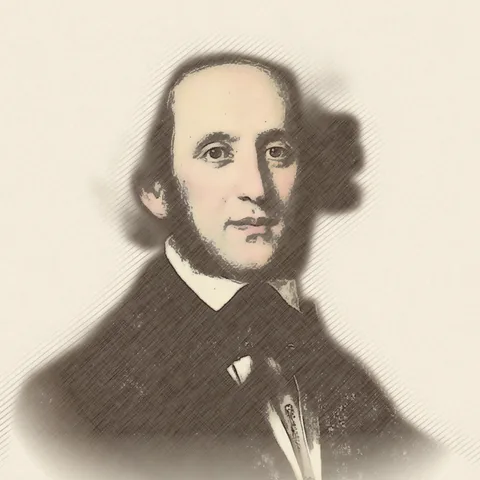 1809 – 1847Romantic
Felix Mendelssohn
A conductor and composer who revived Bach and wrote music of great clarity.
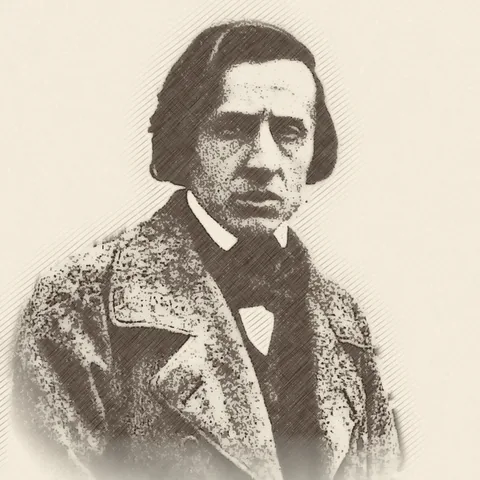 1810 – 1849Romantic
Frédéric Chopin
At the piano, he combined virtuosity, poetry and memories of Polish dance.
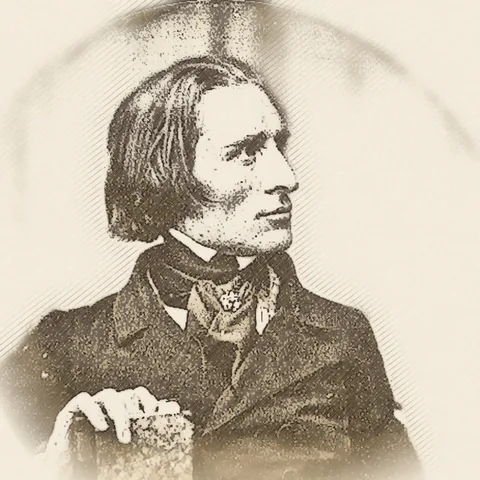 1811 – 1886Romantic
Franz Liszt
A star pianist, he invented new forms and developed the symphonic poem.
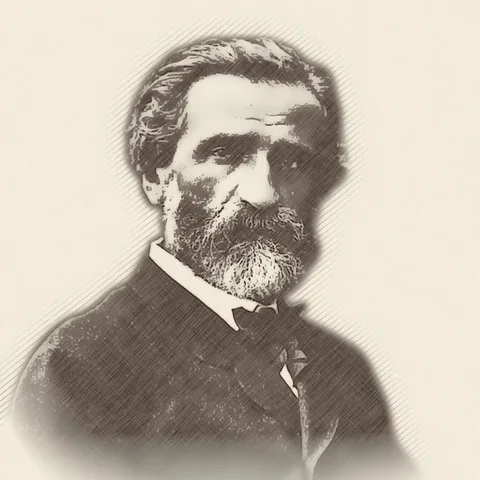 1813 – 1901Romantic
Giuseppe Verdi
His operas give unforgettable voice to human passions and conflicts.
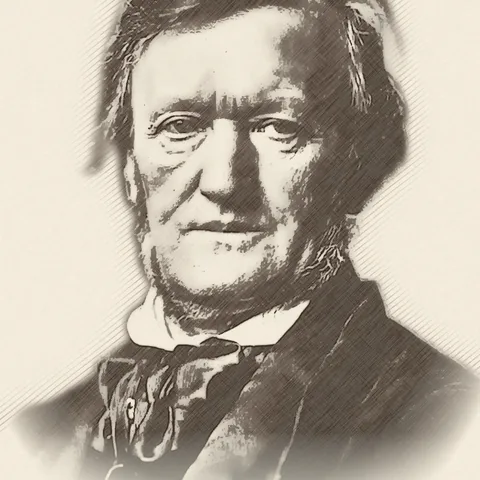 1813 – 1883Romantic
Richard Wagner
He envisioned music drama as a unity of orchestra, poetry and stagecraft.