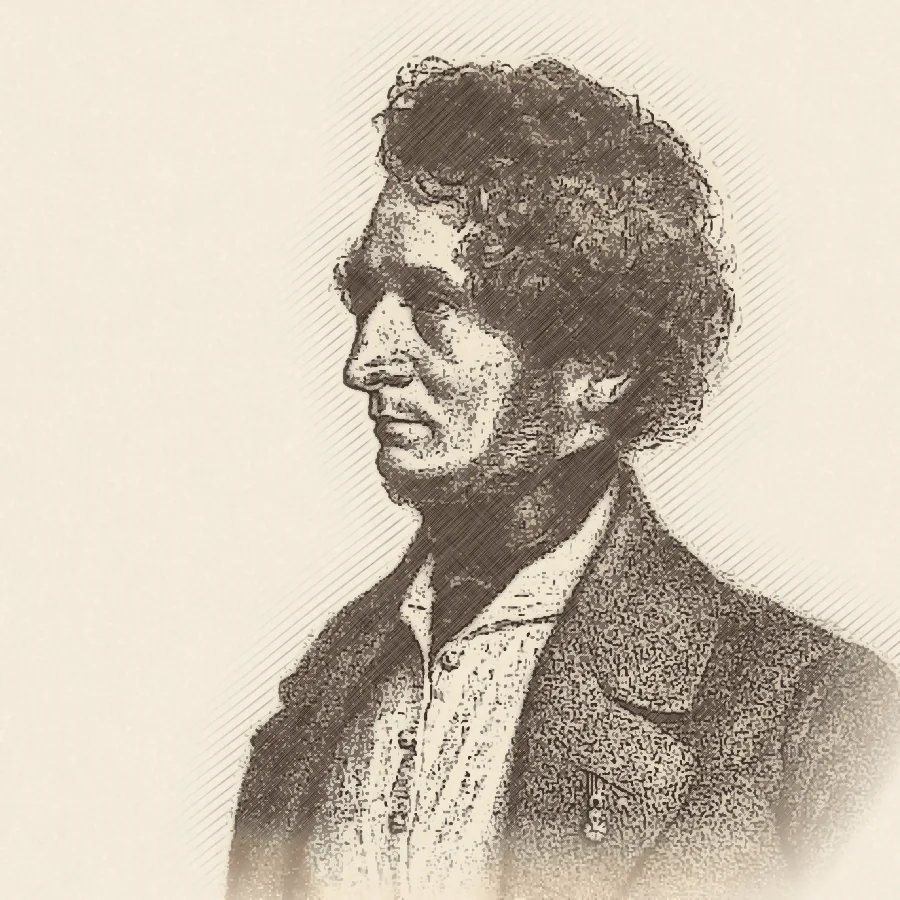
 Romantic
Hector Berlioz
He imagined spectacular orchestras and told stories through instrumental colors.
A life and its times
The milestones of the life and work, the contemporaries and the major world events, on a single line of time.
A life at a glance
- 1803Birth
Born on 11 December in La Côte-Saint-André, son of a doctor
- 1804Meanwhile
Napoleon crowned emperor
- 1815Trainingage 12
Teaches himself flute, guitar and harmony
- 1816Meanwhile
Maelzel patents the metronome (1815–16)
- 1821Milestoneage 18
Goes to Paris to study medicine… which he abandons for music
- 1822Meanwhile
Champollion deciphers hieroglyphs
- 1826Trainingage 23
Enters the Conservatoire (Lesueur, Reicha)
- 1827Private lifeage 24
Falls for the actress Harriet Smithson in Hamlet
- 1830Workage 27
Symphonie fantastique; wins the Prix de Rome
- 1830Meanwhile
July Revolution in France
- 1833Private lifeage 30
Marries Harriet Smithson
- 1834Workage 31
Harold in Italy, for Paganini
- 1837Workage 34
Grande Messe des morts (Requiem)
- 1839Workage 36
Roméo et Juliette, dramatic symphony
- 1839Meanwhile
Photography is invented (daguerreotype)
- 1840Meanwhile
Adolphe Sax invents the saxophone (c. 1840)
- 1844Workage 41
Treatise on Instrumentation and Orchestration
- 1846Workage 43
La Damnation de Faust
- 1847Journeyage 44
Conducting tours in Germany and Russia
- 1858Workage 55
Completes Les Troyens
- 1859Meanwhile
Darwin publishes On the Origin of Species
- 1869Deathage 66
Dies in Paris on 8 March
- 1869Meanwhile
The Suez Canal opens
Listen
Excerpts from freely licensed recordings, with their performers and licences.
Excerpts last up to 90 seconds. Hector Berlioz’s compositions are in the public domain; each recording is streamed from Wikimedia Commons under the licence shown, credited to its performers or uploader.
Listen to complete works on Wikimedia Commons
Wikimedia Commons is a free media library: you will find the complete recordings there, with their reuse conditions.
- Complete recordingSymphonie fantastique — II. A Ball
- Complete recordingSymphonie fantastique — IV. March to the Scaffold
- Complete recordingRoman Carnival Overture
- Search for the workSymphonie fantastique
- Search for the workLa Damnation de Faust
- Search for the workLes Troyens
- Search for the workRequiem
- Search for the workHarold in Italy
- Search for the workRoman Carnival
- Search for the workL’Enfance du Christ
- Everything on CommonsAll recordings of Hector Berlioz
The life of Hector Berlioz
Hector Berlioz was born on 11 December 1803 at La Côte-Saint-André in the Isère, the son of a cultivated doctor, Louis Berlioz. He grew up far from the great musical centres and never really learned the piano. His father taught him Latin, geography and literature and introduced him to Virgil: the story of Dido and Aeneas overwhelmed him from childhood. He taught himself the flute, the guitar and the rules of harmony from treatises, and composed his first romances.
In 1821 his father sent him to Paris to study medicine. But the sight of the dissecting rooms disgusted him, and he spent his evenings at the Opéra, where he passionately discovered the works of Gluck. Against the wishes of his parents, who cut off his allowance, he abandoned medicine for music. He studied with the composer Jean-François Lesueur, then entered the Conservatoire in 1826, where he also attended Anton Reicha’s classes. He earned his living singing in a theatre chorus.
In 1827 he attended a performance of Hamlet by an English company and fell madly in love with the Irish actress Harriet Smithson, who played Ophelia. She did not even know he existed. This passion inspired the Symphonie fantastique of 1830, subtitled “Episode in the Life of an Artist”: a young musician, desperate with love, poisons himself with opium and dreams he witnesses his own execution, then a witches’ sabbath. The beloved is represented by a melody that returns in every movement, the “idée fixe”. It was a revolution in orchestral music.
That same year, at his fifth attempt, he won the Prix de Rome and stayed in Italy at the Villa Medici. Back in Paris he finally married Harriet Smithson in 1833, but the marriage was unhappy and the couple separated some years later. In 1834 Paganini commissioned a work for viola from him: the result was Harold in Italy, inspired by Byron. In 1837 the government commissioned the Grande Messe des morts, which uses a huge orchestra, four brass ensembles placed at the four corners and sixteen timpani.
Berlioz struggled for recognition in France, where his music was thought too loud and too strange. His opera Benvenuto Cellini was a failure in 1838. To earn a living he became a music critic, notably for the Journal des débats, where he wrote brilliant and often funny articles. He composed the dramatic symphony Roméo et Juliette (1839) and in 1844 published his Treatise on Instrumentation and Orchestration, which describes every instrument of the orchestra and became a reference for composers worldwide.
He was, however, very successful abroad as a conductor: Germany, Austria, Russia, England. He was one of the first great modern conductors. In 1846 he composed La Damnation de Faust, after Goethe, poorly received in Paris. He then wrote L’Enfance du Christ (1854), which finally brought him success in France, and spent several years on his grand opera Les Troyens, after Virgil, completed in 1858. He never saw it staged complete: only part was performed in 1863.
His last years were darkened by bereavement: the deaths of Harriet, then of his second wife Marie Recio, and finally of his son Louis, a sailor, in 1867. Exhausted and ill, he died in Paris on 8 March 1869 and was buried in Montmartre Cemetery. His Memoirs, published after his death, are one of the great autobiographical texts of Romanticism. Long misunderstood in France, Berlioz is now regarded as one of the greatest French composers and the genius of the Romantic orchestra.
Works to know
- 1830
Symphonie fantastique
An artist’s feverish dream of love, with a march to the scaffold and a witches’ sabbath.
Listen on Wikimedia Commons - 1834
Harold in Italy
Symphony with solo viola.
Listen on Wikimedia Commons - 1837
Requiem
Requiem for 4 brass bands, 16 timpani and a huge choir.
Listen on Wikimedia Commons - 1844
Roman Carnival
Sparkling overture.
Listen on Wikimedia Commons - 1846
La Damnation de Faust
Dramatic legend featuring the Hungarian March.
Listen on Wikimedia Commons - 1854
L’Enfance du Christ
Tender, poetic oratorio.
Listen on Wikimedia Commons - 1858
Les Troyens
Epic opera on the fall of Troy and Dido.
Listen on Wikimedia Commons
Anecdotes
His Requiem uses 16 timpani and 4 brass bands!
He wrote a book explaining how to use every instrument of the orchestra.
He had to compete five times for the Prix de Rome before winning it in 1830.
He could barely play the piano: he composed at the guitar.
Same era · Romantic
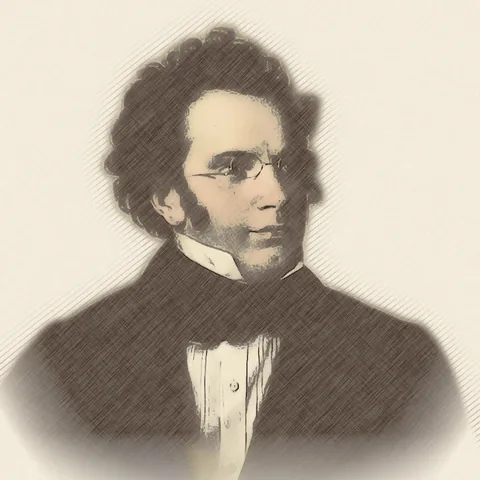 1797 – 1828Romantic
Franz Schubert
His songs transform poetry into intimate and expressive musical storytelling.
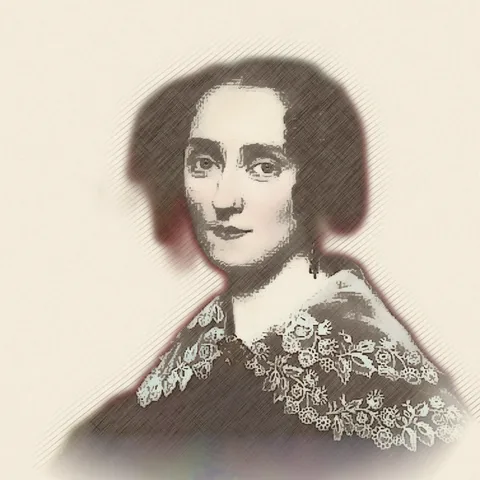 1804 – 1875Romantic
Louise Farrenc
A pianist, composer and Paris Conservatoire professor, she championed instrumental music.
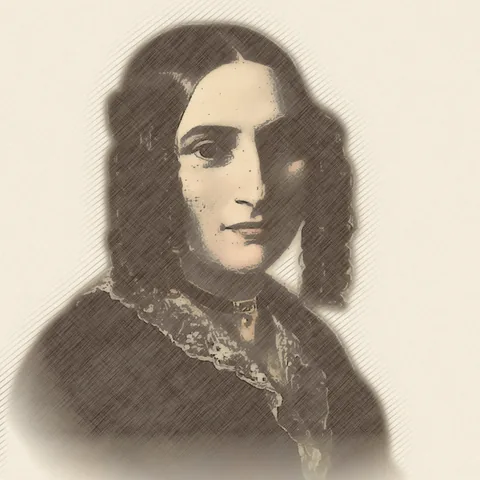 1805 – 1847Romantic
Fanny Mendelssohn
A composer and pianist who wrote hundreds of works despite social constraints.
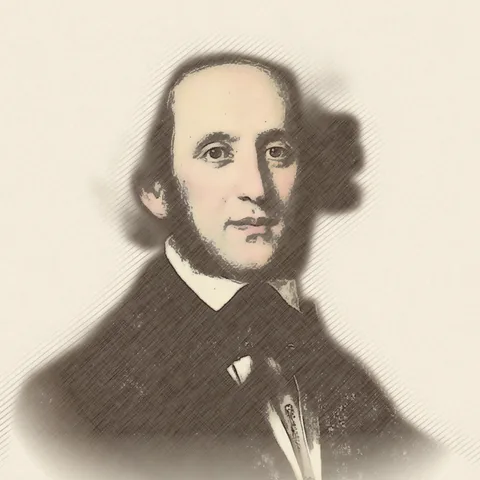 1809 – 1847Romantic
Felix Mendelssohn
A conductor and composer who revived Bach and wrote music of great clarity.
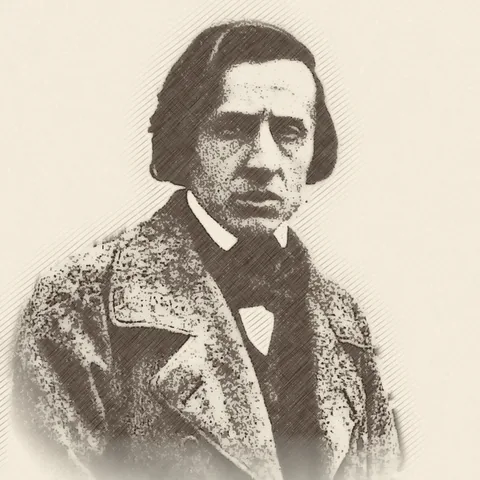 1810 – 1849Romantic
Frédéric Chopin
At the piano, he combined virtuosity, poetry and memories of Polish dance.
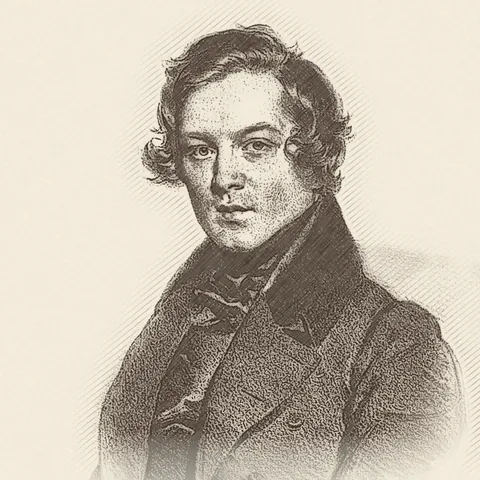 1810 – 1856Romantic
Robert Schumann
A composer and critic, he explored psychological contrasts in piano music.