 Baroque
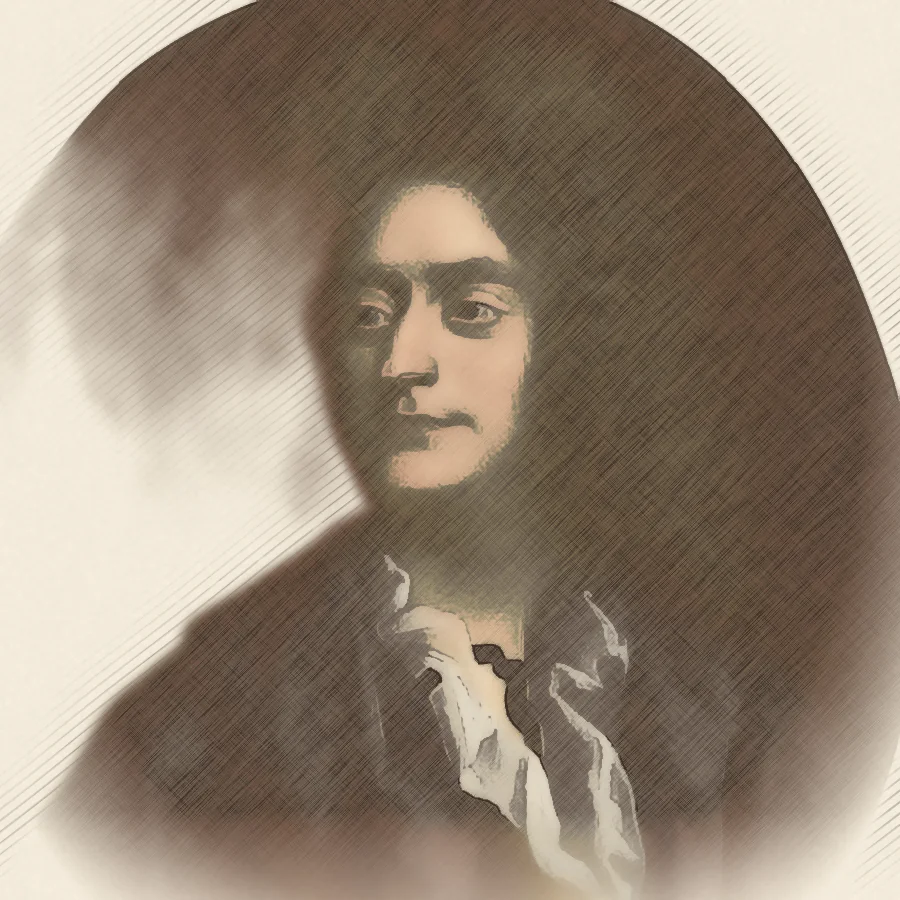
Henry Purcell
His stage music blends melodic subtlety and emotional force.
A life and its times
The milestones of the life and work, the contemporaries and the major world events, on a single line of time.
A life at a glance
- 1659Birth
Born in Westminster, London
- 1660Landmarkage 1
The monarchy is restored: Charles II becomes king
- 1666Meanwhile
Great Fire of London
- 1668Trainingage 9
Choirboy at the Chapel Royal
- 1669Meanwhile
The Royal Academy of Music (Paris Opera) is founded
- 1677Careerage 18
Composer for Charles II’s violins
- 1679Careerage 20
Organist of Westminster Abbey
- 1680Private lifeage 21
Marries Frances
- 1682Careerage 23
Organist of the Chapel Royal
- 1682Meanwhile
The French court moves to Versailles
- 1685Workage 26
Anthem My heart is inditing for the coronation of James II
- 1687Meanwhile
Newton publishes the laws of gravitation
- 1689Workage 30
Dido and Aeneas
- 1691Workage 32
King Arthur, semi-opera
- 1692Workage 33
The Fairy-Queen
- 1695Workage 36
Music for the Funeral of Queen Mary
- 1695Deathage 36
Dies on 21 November; buried in Westminster Abbey
Listen
Excerpts from freely licensed recordings, with their performers and licences.
Excerpts last up to 90 seconds. Henry Purcell’s compositions are in the public domain; each recording is streamed from Wikimedia Commons under the licence shown, credited to its performers or uploader.
Listen to complete works on Wikimedia Commons
Wikimedia Commons is a free media library: you will find the complete recordings there, with their reuse conditions.
- Complete recordingMusic for the Funeral of Queen Mary — March
- Complete recordingToccata in A major (harpsichord)
- Complete recordingIn Nomine a 7 (viols)
- Wikimedia Commons fileHenry Purcell (1659-1695) – In Nomine à7, Z.747 for Treble, Tenor & Bass Viols
- Search for the workDido and Aeneas
- Search for the workThe Fairy-Queen
- Search for the workKing Arthur
- Search for the workMusic for the Funeral of Queen Mary
- Search for the workAbdelazer
- Search for the workCome, Ye Sons of Art
- Everything on CommonsAll recordings of Henry Purcell
The life of Henry Purcell
Henry Purcell was born in 1659 in Westminster, in the heart of London, into a family of musicians. The following year, 1660, the monarchy was restored and Charles II took the throne after the austere years of Cromwell’s Puritan regime, during which church music and theatre had been banned. Purcell’s father, a singer in the Chapel Royal, died in 1664, and the boy was probably brought up by his uncle Thomas, also a court musician.
Around 1668 Henry became a chorister of the Chapel Royal, where he studied with Henry Cooke, then Pelham Humfrey, who had studied in France and Italy, and John Blow. He learned singing, organ, composition and the care of instruments. When his voice broke in 1673 he became assistant to the keeper of the king’s instruments. In 1677, aged eighteen, he succeeded Matthew Locke as composer for the king’s violins.
In 1679 he succeeded his teacher John Blow as organist of Westminster Abbey, and in 1682 became one of the organists of the Chapel Royal. Around 1680 he married Frances, with whom he had six children, only two of whom survived. He composed many anthems for the Anglican liturgy, welcome odes for the king, viol fantasias of great harmonic daring and trio sonatas inspired by the Italian style.
Purcell served three successive monarchs: Charles II; James II, for whose coronation in 1685 he wrote the anthem My heart is inditing; and William III and Mary II, who took the throne in 1689 after the “Glorious Revolution”. He composed six birthday odes for Queen Mary, including Come, Ye Sons of Art (1694), and odes for St Cecilia, patron saint of music, such as Hail, bright Cecilia (1692).
In 1689 he composed Dido and Aeneas, probably for a girls’ school in Chelsea, although the exact date and circumstances are debated. This hour-long opera, to a libretto by Nahum Tate after Virgil, is regarded as the first great English opera. It ends with Dido’s famous lament, When I am laid in earth, built on a repeated descending chromatic bass of overwhelming tragic intensity.
In the 1690s Purcell turned to the theatre, composing music for more than forty plays. He wrote “semi-operas”, a typically English genre combining spoken drama with grand musical scenes: Dioclesian (1690), King Arthur (1691), to a text by John Dryden, with its famous Frost Scene in which the Cold Genius sings shivering, The Fairy-Queen (1692), after Shakespeare’s A Midsummer Night’s Dream, and The Indian Queen (1695). His incidental music for Abdelazer contains a rondeau that became famous.
At the end of 1694 Queen Mary died of smallpox. For her funeral in March 1695 Purcell composed music of sober grandeur, with a march and canzona for slide trumpets. A few months later, on 21 November 1695, he died in turn, aged thirty-six, probably of illness. His funeral music for the queen was played at his own funeral. He was buried in Westminster Abbey, at the foot of the organ. Nicknamed “Orpheus Britannicus”, he remains the greatest English composer before the twentieth century.
Works to know
- 1689
Dido and Aeneas
Brief, poignant opera with Dido’s famous lament.
Listen on Wikimedia Commons - 1691
King Arthur
Semi-opera with the striking ‘Cold Song’.
Listen on Wikimedia Commons - 1692
The Fairy-Queen
Fairy spectacle after Shakespeare.
Listen on Wikimedia Commons - 1694
Come, Ye Sons of Art
Birthday ode for Queen Mary.
Listen on Wikimedia Commons - 1695
Music for the Funeral of Queen Mary
Funeral march with trumpets and drums.
Listen on Wikimedia Commons - 1695
Abdelazer
Suite whose Rondeau inspired Britten.
Listen on Wikimedia Commons
Anecdotes
The music he wrote for the queen’s funeral was played at his own funeral a few months later.
Benjamin Britten used a Purcell theme for his Young Person’s Guide to the Orchestra.
In King Arthur the Cold Genius sings shivering, with trembling notes.
He is buried in Westminster Abbey, at the foot of the organ he played.
Same era · Baroque
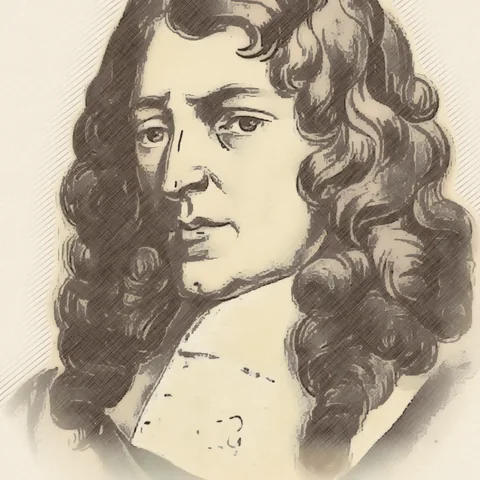 1643 – 1704Baroque
Marc-Antoine Charpentier
A French composer of sacred and theatre music, he mastered Italian style.
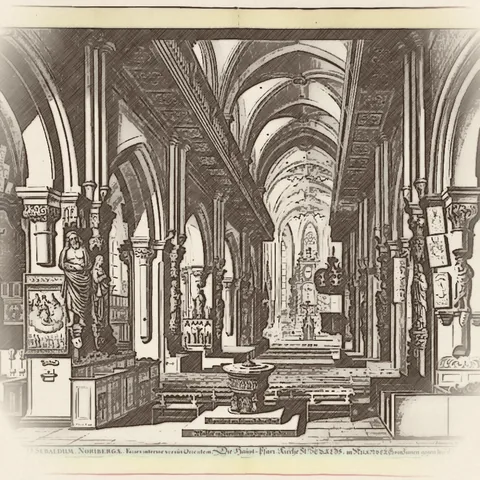 1653 – 1706Baroque
Johann Pachelbel
A German organist who influenced the south German keyboard tradition.
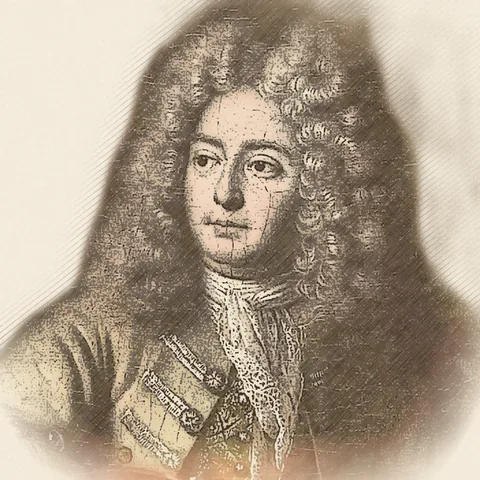 1656 – 1728Baroque
Marin Marais
A court musician under Louis XIV, he elevated the viola da gamba as a solo instrument.
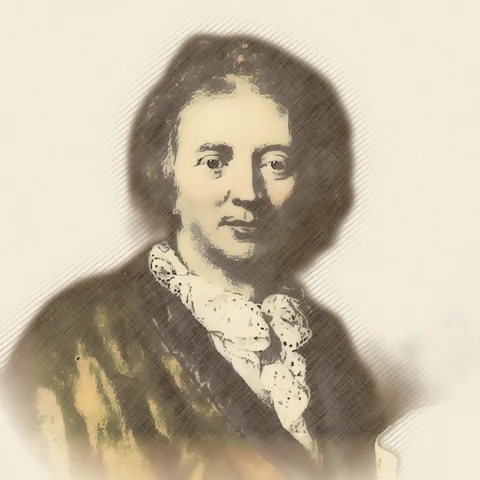 1668 – 1733Baroque
François Couperin
A French court harpsichordist, he blended French elegance and Italian influences.
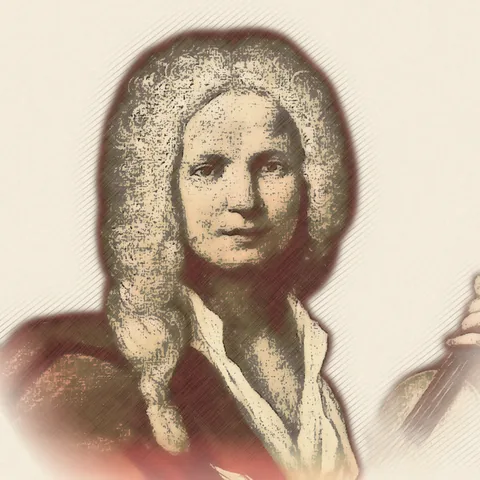 1678 – 1741Baroque
Antonio Vivaldi
A Venetian violinist and priest, he reshaped the concerto through contrast and virtuosity.
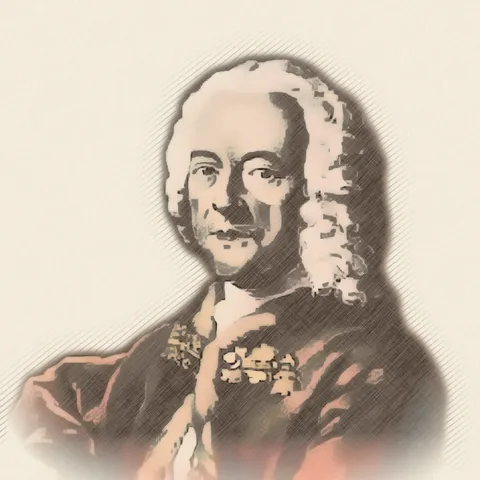 1681 – 1767Baroque
Georg Philipp Telemann
A prolific composer, he led Hamburg's musical life and combined European styles.