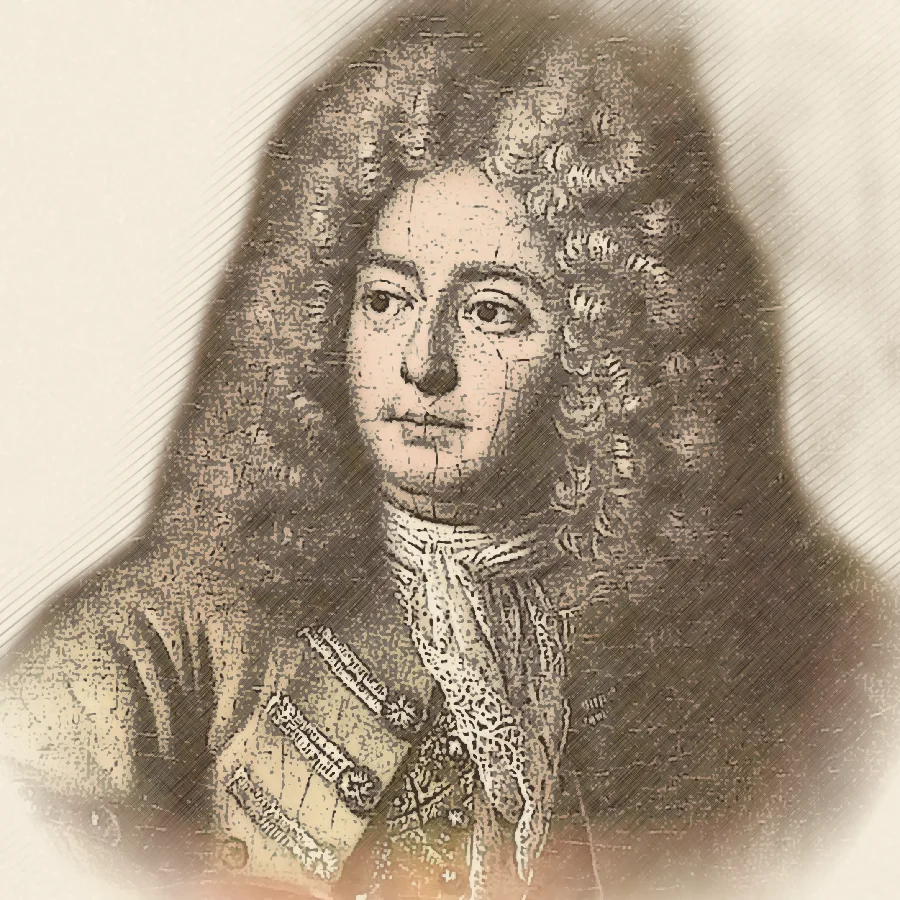
 Baroque
Marin Marais
A court musician under Louis XIV, he elevated the viola da gamba as a solo instrument.
A life and its times
The milestones of the life and work, the contemporaries and the major world events, on a single line of time.
A life at a glance
And after his or her death: 1 landmark in the detailed timeline (1991).
- 1656Birth
Born in Paris on 31 May, a shoemaker’s son
- 1666Meanwhile
Great Fire of London
- 1667Trainingage 11
Choirboy at Saint-Germain-l’Auxerrois
- 1669Meanwhile
The Royal Academy of Music (Paris Opera) is founded
- 1675Trainingage 19
Pupil of the viol player Monsieur de Sainte-Colombe
- 1676Private lifeage 20
Marries Catherine Damicourt; they will have 19 children
- 1679Careerage 23
Viol player of the King’s Chamber Music
- 1682Landmarkage 26
The court moves to Versailles
- 1682Meanwhile
The French court moves to Versailles
- 1686Workage 30
First book of viol pieces
- 1687Meanwhile
Newton publishes the laws of gravitation
- 1700Meanwhile
Bartolomeo Cristofori invents the piano in Florence (c. 1700)
- 1701Workage 45
Second book, with the Couplets de folies
- 1706Workage 50
Alcyone, an opera with its famous storm
- 1715Meanwhile
Death of Louis XIV
- 1719Meanwhile
Defoe publishes Robinson Crusoe
- 1723Workage 67
La Gamme et autres morceaux de symphonie
- 1725Workage 69
Fifth book, with the ‘Tableau de l’opération de la taille’
- 1728Deathage 72
Dies in Paris on 15 August
- 1991Landmark263 years after death
The film Tous les matins du monde brings him back to fame
Listen
Excerpts from freely licensed recordings, with their performers and licences.
Excerpts last up to 90 seconds. Marin Marais’s compositions are in the public domain; each recording is streamed from Wikimedia Commons under the licence shown, credited to its performers or uploader.
Listen to complete works on Wikimedia Commons
Wikimedia Commons is a free media library: you will find the complete recordings there, with their reuse conditions.
- Complete recordingThe Bells of Sainte-Geneviève-du-Mont (1723)
- Complete recordingChaconne — First Book of Viol Pieces
- Wikimedia Commons fileMarin Marais - Pièces a Une Viole du Premier Livre (1686)
- Search for the workLes Folies d’Espagne
- Search for the workThe Bells of Sainte-Geneviève
- Search for the workAlcyone
- Search for the workTableau de l’opération de la taille
- Search for the workPièces de viole, Book I
- Search for the workLe Badinage
- Everything on CommonsAll recordings of Marin Marais
The life of Marin Marais
Marin Marais was born in Paris on 31 May 1656, the son of a humble shoemaker. Thanks to an uncle who was a priest, he became a choirboy at the church of Saint-Germain-l’Auxerrois, opposite the Louvre, where he received a solid musical training. There he met Michel-Richard de Lalande, the future great court composer. When his voice broke he devoted himself to the bass viol, a bowed string instrument held between the legs, much prized in France at that time.
Around 1675 he became the pupil of Monsieur de Sainte-Colombe, the greatest viol player of his day, a solitary and mysterious man credited with adding a seventh low string to the instrument. According to Titon du Tillet, the master dismissed his pupil after a few months, judging he had nothing more to teach him. Yet Marais kept listening to him in secret, hidden beneath the hut where Sainte-Colombe played in his garden. This relationship inspired Pascal Quignard’s novel and the film Tous les matins du monde (1991), which brought Marais back to wide public attention.
In 1676 he married Catherine Damicourt, with whom he had nineteen children, several of whom became musicians. The same year he joined the Opéra orchestra, directed by Lully, who became his composition teacher. In 1679 Marais was appointed ordinaire de la musique de la Chambre du roi for the viol, a post he held for nearly fifty years. He played for Louis XIV at Versailles, where the court settled in 1682, and often conducted the Opéra orchestra.
Marais wrote mainly for his instrument. His five books of viol pieces, published between 1686 and 1725, contain nearly six hundred pieces: preludes, dances, portraits and descriptive pieces. In the second book (1701), the Couplets de folies, on the famous Folies d’Espagne theme, offer thirty-two virtuoso variations. His music exploits every resource of the viol: deep low sounds, chords and delicate ornaments that Marais notated with unprecedented precision.
He was also an opera composer. His Alcyone (1706) contains a famous storm scene: to imitate wind and waves Marais used double basses, drum rolls and agitated strings, an effect that greatly impressed the audience. The storm music was played for decades, even outside the opera. He also wrote Ariane et Bacchus, Alcide and Sémélé.
Marais loved descriptive music. In La Sonnerie de Sainte-Geneviève-du-Mont (1723), violin, viol and harpsichord imitate the bells of a Paris church tirelessly ringing three notes. Even more surprising, the Tableau de l’opération de la taille (1725) describes in music a surgical operation to remove a bladder stone, with a text marking each stage: the sight of the apparatus, the incision, the insertion of the forceps and finally the patient being carried back to bed.
Late in life Marais retired and handed his post to his son Roland. He lived in a house in the faubourg Saint-Marceau, tended his garden and still gave a few lessons. He died in Paris on 15 August 1728. His death coincided with the decline of the viola da gamba, soon to be dethroned by the cello. He remains the greatest composer for the instrument and one of the masters of French music of the Grand Siècle.
Works to know
- 1686
Pièces de viole, Book I
First of five books for viola da gamba.
Listen on Wikimedia Commons - 1701
Les Folies d’Espagne
32 virtuoso variations on a famous tune.
Listen on Wikimedia Commons - 1706
Alcyone
Tragédie en musique with a spectacular orchestral storm.
Listen on Wikimedia Commons - 1717
Le Badinage
Graceful piece from the fourth book.
Listen on Wikimedia Commons - 1723
The Bells of Sainte-Geneviève
Trio imitating the bells of a Paris church.
Listen on Wikimedia Commons - 1725
Tableau de l’opération de la taille
Narrative piece depicting a surgical operation!
Listen on Wikimedia Commons
Anecdotes
He had 19 children!
One of his pieces tells the story of a surgical operation, from the patient’s fear to the final relief.
He secretly listened to his teacher Sainte-Colombe, hidden under his garden hut.
For the storm in his opera Alcyone he used double basses and drums to imitate wind and waves.
Same era · Baroque
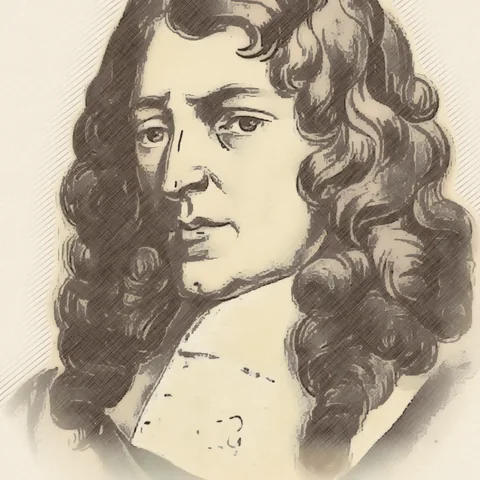
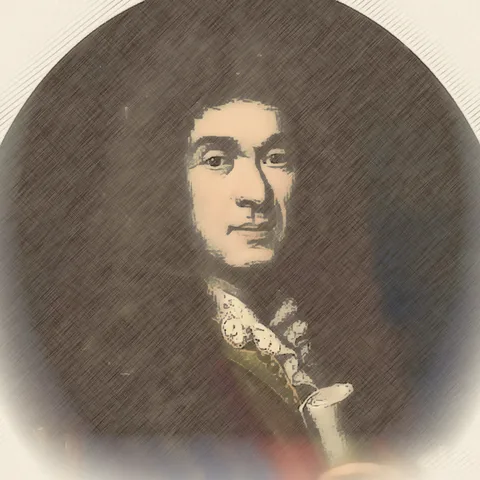 1632 – 1687Baroque
Jean-Baptiste Lully
At Louis XIV's court, he shaped French opera and ballet music.
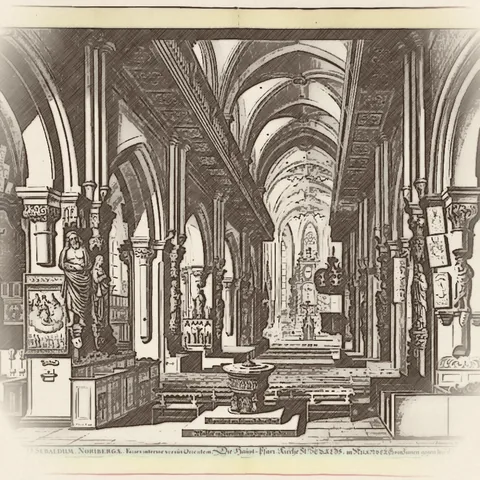
 1643 – 1704Baroque
Marc-Antoine Charpentier
A French composer of sacred and theatre music, he mastered Italian style.
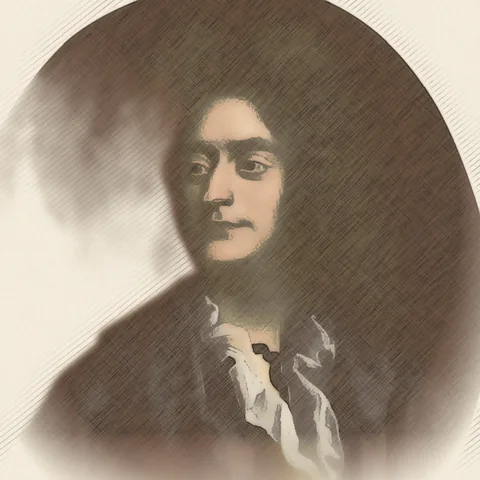
 1653 – 1706Baroque
Johann Pachelbel
A German organist who influenced the south German keyboard tradition.
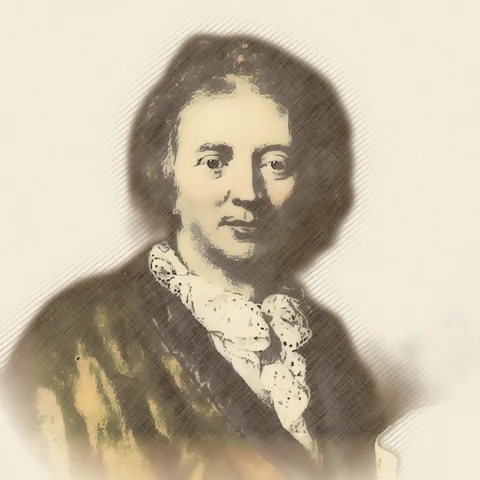
 1659 – 1695Baroque
Henry Purcell
His stage music blends melodic subtlety and emotional force.
 1668 – 1733Baroque
François Couperin
A French court harpsichordist, he blended French elegance and Italian influences.
 1678 – 1741Baroque
Antonio Vivaldi
A Venetian violinist and priest, he reshaped the concerto through contrast and virtuosity.