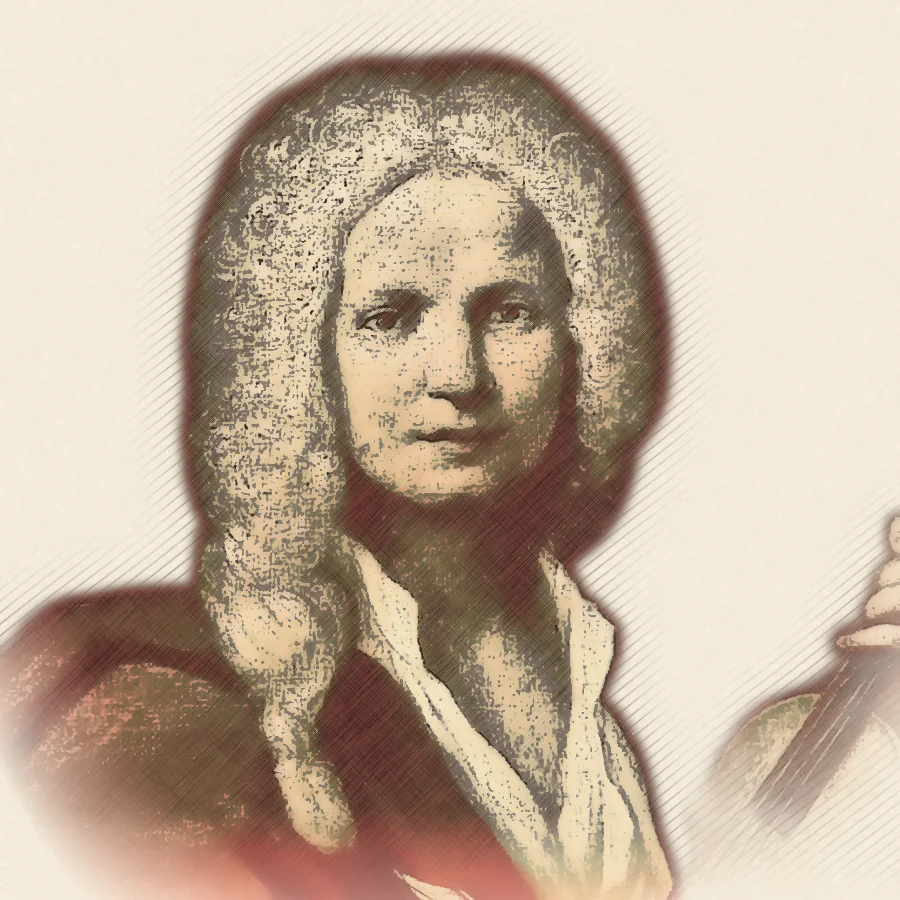
A life and its times
The milestones of the life and work, the contemporaries and the major world events, on a single line of time.
A life at a glance
And after his or her death: 1 landmark in the detailed timeline (1926).
- 1678Birth
Born in Venice on 4 March; his father is a violinist at St Mark’s
- 1682Meanwhile
The French court moves to Versailles
- 1687Meanwhile
Newton publishes the laws of gravitation
- 1700Meanwhile
Bartolomeo Cristofori invents the piano in Florence (c. 1700)
- 1703Careerage 25
Ordained a priest — nicknamed ‘the Red Priest’
- 1703Careerage 25
Violin master at the Ospedale della Pietà, a girls’ orphanage
- 1711Workage 33
L’estro armonico, Op. 3, published in Amsterdam — a European success
- 1713Workage 35
First opera, Ottone in villa
- 1715Meanwhile
Death of Louis XIV
- 1716Workage 38
Juditha triumphans, oratorio
- 1718Careerage 40
Chapel master at the court of Mantua
- 1719Meanwhile
Defoe publishes Robinson Crusoe
- 1725Workage 47
Publication of The Four Seasons (Op. 8)
- 1728Journeyage 50
Meets Emperor Charles VI, an admirer
- 1740Journeyage 62
Leaves for Vienna hoping for the emperor’s patronage
- 1741Deathage 63
Dies poor in Vienna on 28 July
- 1926Landmark185 years after death
Rediscovery of his manuscripts in Turin
Listen
Excerpts from freely licensed recordings, with their performers and licences.
Excerpts last up to 90 seconds. Antonio Vivaldi’s compositions are in the public domain; each recording is streamed from Wikimedia Commons under the licence shown, credited to its performers or uploader.
Listen to complete works on Wikimedia Commons
Wikimedia Commons is a free media library: you will find the complete recordings there, with their reuse conditions.
- Complete recordingThe Four Seasons — Spring, I. Allegro
- Complete recordingThe Four Seasons — Summer, III. Presto (the storm)
- Complete recordingThe Four Seasons — Autumn, I. Allegro
- Complete recordingThe Four Seasons — Winter, I. Allegro non molto
- Search for the workThe Four Seasons
- Search for the workGloria RV 589
- Search for the workL’estro armonico
- Search for the workJuditha triumphans
- Search for the workOrlando furioso
- Search for the workStabat Mater
- Everything on CommonsAll recordings of Antonio Vivaldi
The life of Antonio Vivaldi
Antonio Vivaldi was born in Venice on 4 March 1678. According to tradition an earthquake shook the city that day, and the frail newborn was baptised at once by the midwife. His father, Giovanni Battista, a barber turned violinist at St Mark’s Basilica, taught him the violin. Like his father, Antonio had red hair, a feature that would earn him his nickname. Destined for the Church, he began his religious studies at fifteen while pursuing music.
Ordained priest in 1703, he was immediately nicknamed “il Prete rosso”, the Red Priest. But he stopped saying Mass almost at once, citing a “tightness of the chest”, probably a form of asthma, that kept him from standing long at the altar. That same year he was hired as violin master at the Ospedale della Pietà, one of the four great orphanages of Venice, which took in abandoned girls. The most gifted received a musical training of the highest level.
Vivaldi remained linked to the Pietà for nearly forty years, with interruptions. He taught there, led the orchestra and composed for the Sunday concerts, which drew visitors from all over Europe. The young musicians, hidden behind grilles, played every instrument with a virtuosity that astonished travellers. It was for them that Vivaldi wrote many of his concertos, for violin but also for cello, flute, oboe, bassoon, mandolin and viola d’amore.
In 1711 the publication in Amsterdam of L’estro armonico, Op. 3, a set of twelve concertos, brought him European fame. Johann Sebastian Bach transcribed several of them for harpsichord and organ. Vivaldi established the three-movement solo concerto, fast–slow–fast, with orchestral ritornellos alternating with virtuoso solo passages. This model was imitated throughout Europe.
Vivaldi also took up opera, beginning with Ottone in villa in 1713. By his own count he wrote some fifty — more than forty are documented — and became impresario of several Venetian theatres, including the Sant’Angelo. From 1718 to 1720 he was maestro di cappella to Prince Philip of Hesse-Darmstadt, governor of Mantua. He travelled to Rome, where he played for the pope, then to Vienna and Prague. He was often accompanied by the singer Anna Girò and her sister, which caused gossip, though Vivaldi insisted it was only friendship.
In 1725 Il cimento dell’armonia e dell’inventione, Op. 8, appeared, opening with The Four Seasons. Each concerto comes with a sonnet, perhaps by Vivaldi himself, describing what the music imitates: birdsong in spring, the summer storm, the autumn hunt, the icy cold and chattering teeth of winter. It is one of the first famous examples of programme music. He also wrote sacred music, such as the Gloria RV 589 and the oratorio Juditha triumphans (1716).
In the 1730s fashions changed and Vivaldi’s style came to seem old-fashioned in Venice. In 1740 he left for Vienna, hoping for the protection of Emperor Charles VI, who had admired and honoured him. But the emperor died shortly after his arrival. Vivaldi died in poverty in Vienna on 28 July 1741 and was buried in a paupers’ cemetery. Forgotten for nearly two centuries, he was rediscovered in the twentieth, notably thanks to manuscripts found in Turin from 1926 onwards. The Four Seasons is now one of the most performed works in the world.
Works to know
- 1711
L’estro armonico
Twelve concertos that conquered Europe; Bach transcribed several.
Listen on Wikimedia Commons - 1715
Gloria RV 589
Jubilant choral work written for the girls of the Pietà.
Listen on Wikimedia Commons - 1716
Juditha triumphans
Martial oratorio with colourful orchestration.
Listen on Wikimedia Commons - 1720
Stabat Mater
Meditation for alto voice and strings.
Listen on Wikimedia Commons - 1725
The Four Seasons
Four violin concertos painting spring, summer, autumn and winter.
Listen on Wikimedia Commons - 1727
Orlando furioso
Opera on the madness of the knight Orlando.
Listen on Wikimedia Commons
Anecdotes
Vivaldi wrote more than 500 concertos!
In ‘Winter’ you can hear people’s teeth chattering with cold.
He stopped saying Mass because of a “tightness of the chest”, probably asthma.
Bach transcribed several of his concertos for keyboard and organ to study them.
Same era · Baroque
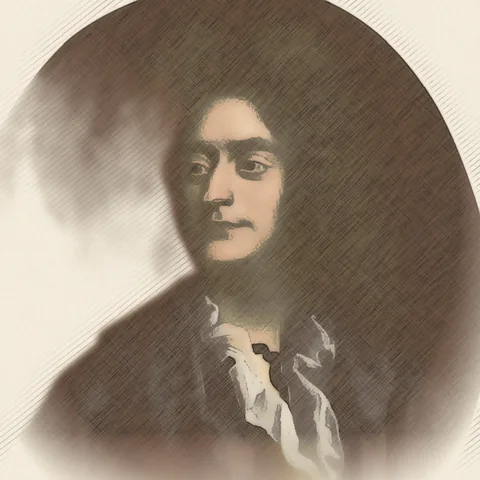 1659 – 1695Baroque
Henry Purcell
His stage music blends melodic subtlety and emotional force.
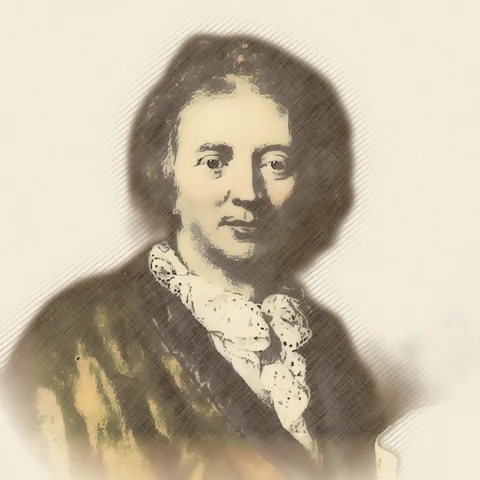 1668 – 1733Baroque
François Couperin
A French court harpsichordist, he blended French elegance and Italian influences.
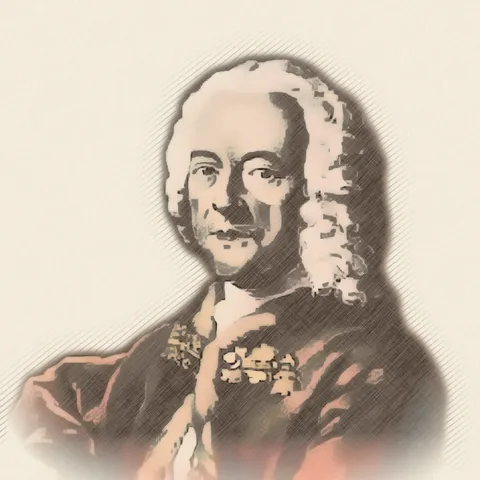 1681 – 1767Baroque
Georg Philipp Telemann
A prolific composer, he led Hamburg's musical life and combined European styles.
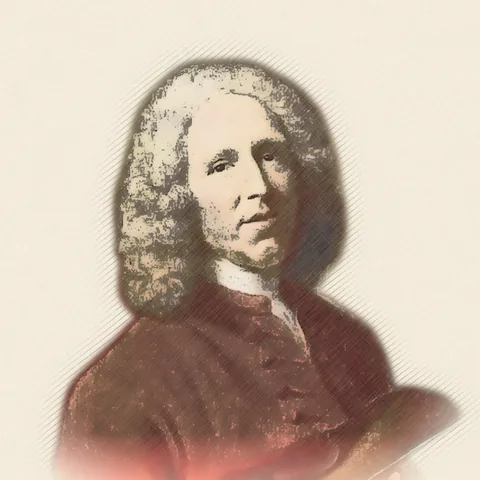 1683 – 1764Baroque
Jean-Philippe Rameau
A harmony theorist and man of the theatre, he brought bold colors to French orchestration.
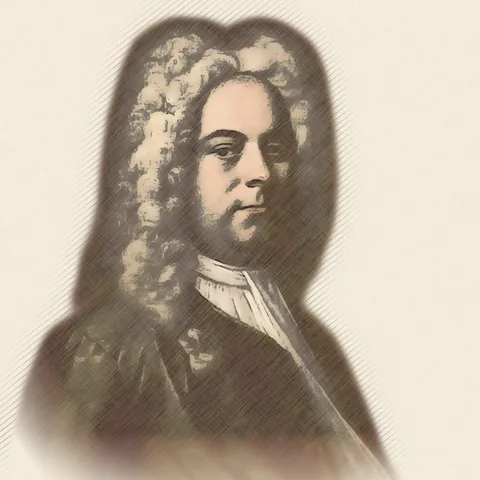 1685 – 1759Baroque
Georg Friedrich Haendel
Born in Germany and active in London, he excelled in oratorio and public spectacle.
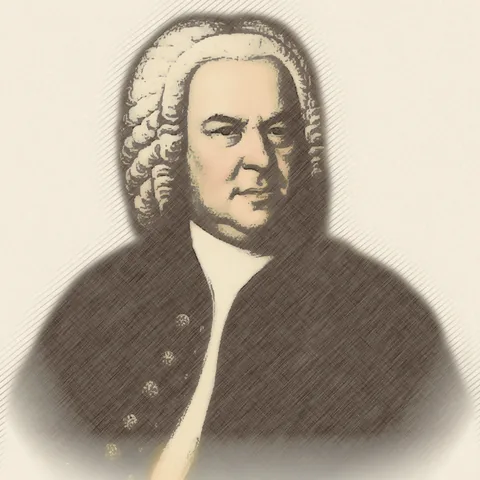 1685 – 1750Baroque
Johann Sebastian Bach
An organist and master of counterpoint, he built musical structures of exceptional depth.