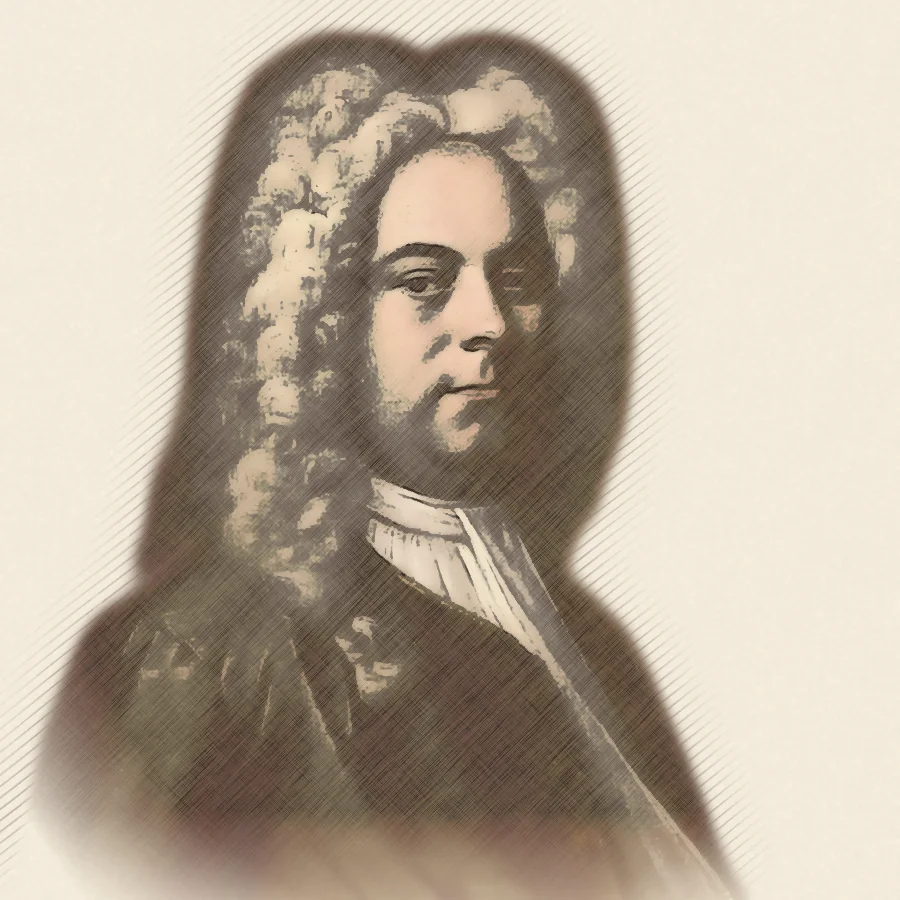
 Baroque
Georg Friedrich Haendel
Born in Germany and active in London, he excelled in oratorio and public spectacle.
A life and its times
The milestones of the life and work, the contemporaries and the major world events, on a single line of time.
A life at a glance
- 1685Birth
Born in Halle on 23 February, son of a barber-surgeon
- 1687Meanwhile
Newton publishes the laws of gravitation
- 1700Meanwhile
Bartolomeo Cristofori invents the piano in Florence (c. 1700)
- 1702Careerage 17
Organist of Halle cathedral while studying law
- 1703Milestoneage 18
Violinist at the Hamburg opera
- 1706Journeyage 21
Travels in Italy: Florence, Rome, Naples, Venice
- 1709Workage 24
Triumph of Agrippina in Venice
- 1711Workage 26
Rinaldo, the first Italian opera written for London
- 1712Milestoneage 27
Settles permanently in London
- 1715Meanwhile
Death of Louis XIV
- 1717Workage 32
Water Music on the Thames for King George I
- 1719Meanwhile
Defoe publishes Robinson Crusoe
- 1724Workage 39
Giulio Cesare
- 1727Careerage 42
Becomes British; coronation anthems for George II
- 1741Workage 56
Composes Messiah in about 24 days
- 1742Workage 57
Messiah premiered in Dublin
- 1749Workage 64
Music for the Royal Fireworks
- 1751Private lifeage 66
Gradually loses his sight
- 1751Meanwhile
First volume of Diderot and d’Alembert’s Encyclopédie
- 1752Meanwhile
Franklin studies lightning with a kite
- 1755Meanwhile
The Lisbon earthquake
- 1759Deathage 74
Dies in London on 14 April; buried in Westminster Abbey
Listen
Excerpts from freely licensed recordings, with their performers and licences.
Excerpts last up to 90 seconds. Georg Friedrich Haendel’s compositions are in the public domain; each recording is streamed from Wikimedia Commons under the licence shown, credited to its performers or uploader.
Listen to complete works on Wikimedia Commons
Wikimedia Commons is a free media library: you will find the complete recordings there, with their reuse conditions.
- Complete recordingMessiah — Hallelujah Chorus
- Complete recordingWater Music — Overture (Suite in F)
- Complete recordingThe Harmonious Blacksmith (Suite No. 5)
- Complete recordingSerse — Ombra mai fu (Enrico Caruso)
- Search for the workMessiah
- Search for the workWater Music
- Search for the workMusic for the Royal Fireworks
- Search for the workZadok the Priest
- Search for the workGiulio Cesare
- Search for the workSerse (‘Ombra mai fu’)
- Search for the workThe Harmonious Blacksmith
- Everything on CommonsAll recordings of Georg Friedrich Haendel
The life of Georg Friedrich Haendel
Georg Friedrich Händel was born in Halle, Saxony, on 23 February 1685, less than a month before Johann Sebastian Bach, born less than a hundred and fifty kilometres away. His father, a barber-surgeon over sixty, wanted him to become a lawyer and frowned on his passion for music. According to one anecdote, the boy hid a small clavichord in the attic to practise at night. The Duke of Saxe-Weissenfels, having heard him play the organ, persuaded his father to let him take lessons with Friedrich Wilhelm Zachow, organist in Halle.
In 1702 he enrolled at the University of Halle to study law while becoming organist of the cathedral. But in 1703 he left for Hamburg, the great city of German opera, where he played violin and harpsichord in the orchestra. There he befriended the composer Johann Mattheson, with whom he once fought a duel after a quarrel: a button on his coat stopped Mattheson’s blade, and the two men made up. In 1705 he staged his first opera, Almira.
In 1706 he left for Italy, where he stayed almost four years: Florence, Rome, Naples and Venice. In Rome, where opera was then banned by the pope, he composed cantatas, oratorios and the psalm Dixit Dominus. He met Corelli and Alessandro and Domenico Scarlatti, with whom he is said to have held a friendly contest: Scarlatti won on the harpsichord, Handel on the organ. In 1709 his opera Agrippina triumphed in Venice; the audience shouted “Viva il caro Sassone!” — “Long live the dear Saxon!”
In 1710 he became Kapellmeister to the Elector of Hanover but almost immediately left for London, where in 1711 he premiered Rinaldo, the first Italian opera written specially for the English stage, with the famous aria Lascia ch’io pianga. He settled in London for good in 1712. When the Elector of Hanover became King George I of Great Britain in 1714, the situation might have been awkward, but Handel regained his favour. In 1717 he composed the Water Music, played on a barge following the king’s boat on the Thames.
For twenty years Handel was the master of Italian opera in London. He ran the Royal Academy of Music, engaged the greatest singers in Europe, including the famous castrati, and composed some forty operas, such as Giulio Cesare (1724), Rodelinda, Alcina and Serse, which opens with the aria Ombra mai fu. Naturalised British in 1727 as George Frideric Handel, that same year he composed four anthems for the coronation of George II, including Zadok the Priest, sung at every British coronation since.
In the 1730s the fashion for Italian opera declined in London and Handel came close to bankruptcy. He turned to oratorio in English, unstaged, on biblical subjects: Saul, Israel in Egypt, Samson, Judas Maccabaeus. In 1741 he composed Messiah in about twenty-four days. It was first performed in Dublin on 13 April 1742 for charity. Its Hallelujah has become one of the most famous choruses in the world. In 1749 he wrote the Music for the Royal Fireworks to celebrate the Peace of Aix-la-Chapelle.
From 1751 his sight gradually failed and he became almost blind despite several operations by a surgeon who also operated on Bach. Yet he continued to conduct his oratorios and play the organ. He died in London on 14 April 1759, rich and famous. He was buried in Westminster Abbey before thousands of people. Beethoven considered him “the greatest composer who ever lived”.
Works to know
- 1717
Water Music
Suites played on a barge following the king on the Thames.
Listen on Wikimedia Commons - 1720
The Harmonious Blacksmith
Air with variations for harpsichord.
Listen on Wikimedia Commons - 1724
Giulio Cesare
Opera about Julius Caesar and Cleopatra.
Listen on Wikimedia Commons - 1727
Zadok the Priest
Anthem sung at every British coronation since 1727.
Listen on Wikimedia Commons - 1738
Serse (‘Ombra mai fu’)
Opera opening with a famous aria sung… to a tree.
Listen on Wikimedia Commons - 1741
Messiah
Oratorio whose ‘Hallelujah’ chorus brings audiences to their feet.
Listen on Wikimedia Commons - 1749
Music for the Royal Fireworks
Open-air music for a grand fireworks display.
Listen on Wikimedia Commons
Anecdotes
Messiah was composed in only about 24 days!
In ‘Ombra mai fu’, King Xerxes sings… to thank a tree for its shade.
His anthem Zadok the Priest has been sung at every British coronation since 1727.
In a duel with his friend Mattheson, a button on his coat stopped the blade.
Same era · Baroque
 1668 – 1733Baroque
François Couperin
A French court harpsichordist, he blended French elegance and Italian influences.
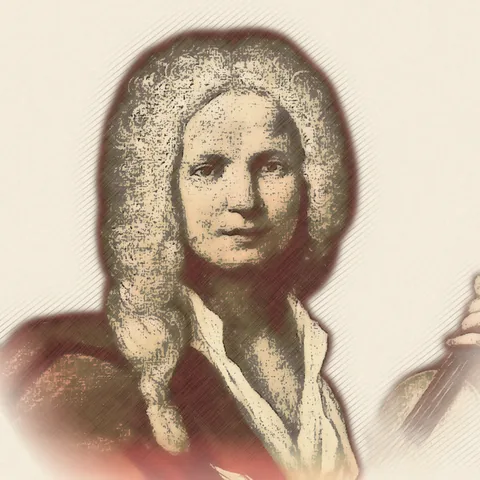 1678 – 1741Baroque
Antonio Vivaldi
A Venetian violinist and priest, he reshaped the concerto through contrast and virtuosity.
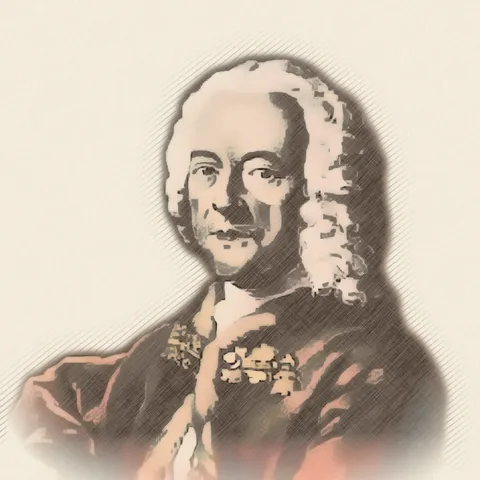 1681 – 1767Baroque
Georg Philipp Telemann
A prolific composer, he led Hamburg's musical life and combined European styles.
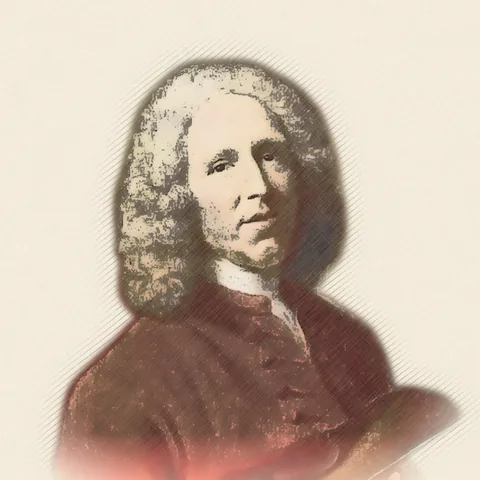 1683 – 1764Baroque
Jean-Philippe Rameau
A harmony theorist and man of the theatre, he brought bold colors to French orchestration.
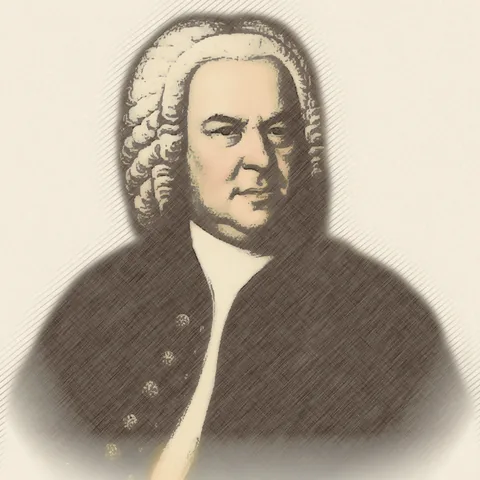 1685 – 1750Baroque
Johann Sebastian Bach
An organist and master of counterpoint, he built musical structures of exceptional depth.
 1710 – 1736Baroque
Jean-Baptiste Pergolèse
An Italian composer who died young and shaped comic opera and sacred music.