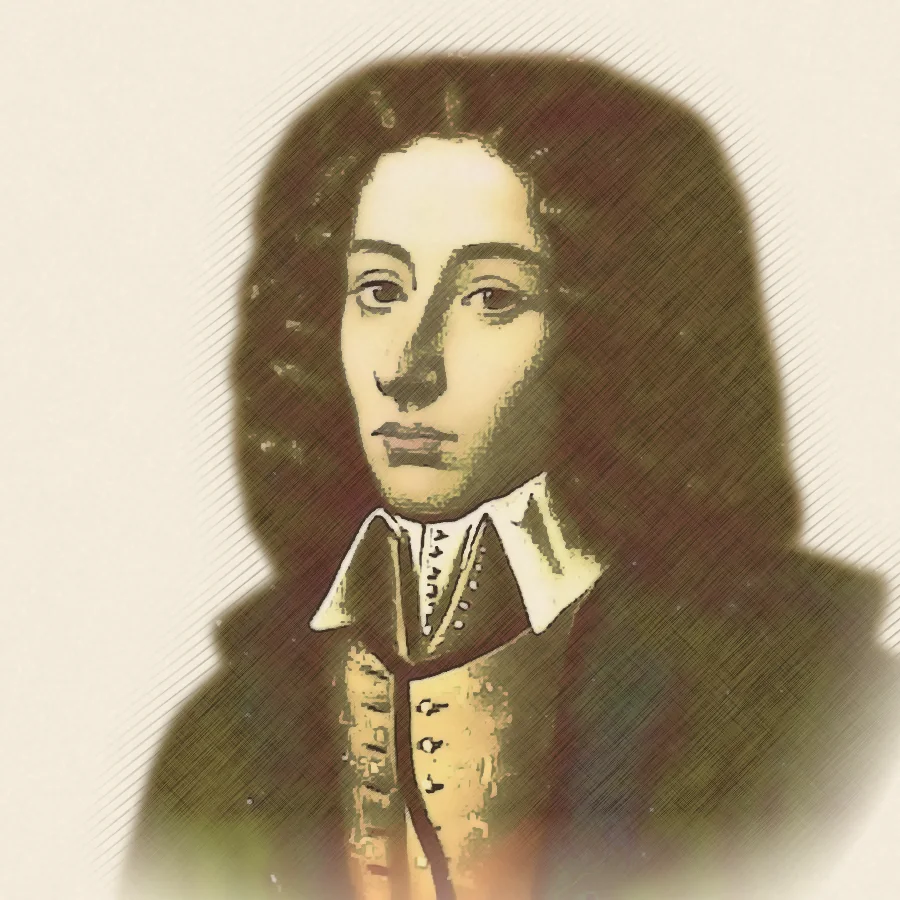
 Baroque
Jean-Baptiste Pergolèse
An Italian composer who died young and shaped comic opera and sacred music.
A life and its times
The milestones of the life and work, the contemporaries and the major world events, on a single line of time.
A life at a glance
And after his or her death: 1 landmark in the detailed timeline (1752).
- 1710Birth
Born in Jesi on 4 January
- 1715Meanwhile
Death of Louis XIV
- 1719Meanwhile
Defoe publishes Robinson Crusoe
- 1720Trainingage 10
Enters the Poveri di Gesù Cristo conservatory in Naples
- 1731Workage 21
First works performed: a sacred drama and an opera
- 1732Careerage 22
Chapel master to Prince Ferdinando Colonna Stigliano
- 1733Workage 23
La serva padrona, comic intermezzo
- 1735Workage 25
L’Olimpiade, premiered in Rome
- 1736Milestoneage 26
Ill with tuberculosis, withdraws to the Franciscan monastery in Pozzuoli
- 1736Workage 26
Stabat Mater, completed shortly before his death
- 1736Deathage 26
Dies in Pozzuoli on 16 March, aged 26
- 1752Landmark16 years after death
La serva padrona sparks the Querelle des Bouffons in Paris
Listen
Excerpts from freely licensed recordings, with their performers and licences.
Excerpts last up to 90 seconds. Jean-Baptiste Pergolèse’s compositions are in the public domain; each recording is streamed from Wikimedia Commons under the licence shown, credited to its performers or uploader.
Listen to complete works on Wikimedia Commons
Wikimedia Commons is a free media library: you will find the complete recordings there, with their reuse conditions.
- Complete recordingViolin Concerto in B-flat — 1st movement (mandolin transcription)
- Complete recordingFlute Concerto in G (traditional attribution)
- Wikimedia Commons filePergolesi - Concerto per violino in si bemolle maggiore - primo movimento (Trascrizione per mandolino)
- Search for the workStabat Mater
- Search for the workLa serva padrona
- Search for the workL’Olimpiade
- Search for the workLo frate ’nnamorato
- Search for the workSalve Regina in C minor
- Everything on CommonsAll recordings of Jean-Baptiste Pergolèse
The life of Jean-Baptiste Pergolèse
Giovanni Battista Draghi was born on 4 January 1710 in Jesi, a small town in the Marche in central Italy. His family, originally from Pergola, was nicknamed “Pergolesi”, the name under which he would become famous. The child was frail — he limped, perhaps because of tuberculosis of the bone — and several of his siblings died in infancy. He first studied music in his home town, where a local nobleman noticed his talent for the violin.
Around 1720, thanks to this patron, he was sent to Naples, then the musical capital of Italy, to study at the conservatory of the Poveri di Gesù Cristo, one of the city’s four conservatories. These institutions, originally orphanages, trained young musicians who sang in churches and processions. Pergolesi studied violin, singing and composition there with renowned masters such as Gaetano Greco, Leonardo Vinci and Francesco Durante. He stood out as a virtuoso violinist and improviser.
In 1731 he completed his studies with the premiere of a sacred drama, Li prodigi della divina grazia nella conversione di San Guglielmo, then of his first opera, Salustia. His beginnings were difficult: the leading singer died during rehearsals and the work had little success. But in 1732 he became maestro di cappella to Prince Ferdinando Colonna Stigliano, equerry to the Viceroy of Naples, and had his first real success with Lo frate ’nnamorato, a comedy in Neapolitan dialect.
That same year, after a violent earthquake struck Naples, he composed a solemn mass for the services of intercession. In 1733, to accompany his serious opera Il prigionier superbo, he wrote two short comic intermezzos to be played between the acts: La serva padrona, “The Maid as Mistress”. The story is simple: the cunning maid Serpina manages to get her grumpy old master Uberto to marry her, helped by a mute valet. This little masterpiece of liveliness soon eclipsed the opera it accompanied.
In 1734 Pergolesi was appointed deputy maestro di cappella of the city of Naples. He composed sacred music, such as the Salve Regina in C minor, and new operas. In January 1735 his opera L’Olimpiade, to a libretto by Metastasio, was premiered in Rome but poorly received: according to an anecdote, a spectator threw an orange at the composer. The work was nonetheless admired later.
Suffering from tuberculosis, Pergolesi withdrew in early 1736 to the Franciscan monastery at Pozzuoli near Naples, by the sea. There he completed his Stabat Mater for soprano, alto and strings, commissioned by a Neapolitan confraternity to replace Alessandro Scarlatti’s. This work, of intense sorrow and poignant tenderness, was his last. He died on 16 March 1736, aged only twenty-six, and was buried in a common grave at Pozzuoli Cathedral.
His fame exploded after his death. The Stabat Mater became the most printed work of the eighteenth century; Bach arranged it to a German text. In 1752 a performance of La serva padrona in Paris sparked the “Querelle des Bouffons”, pitting supporters of natural, lively Italian opera against those of Rameau’s French opera. Publishers then wrongly attributed many works to him. In 1920 Stravinsky drew on music thought to be his for his ballet Pulcinella.
Works to know
- 1732
Lo frate ’nnamorato
Comedy in Neapolitan dialect.
Listen on Wikimedia Commons - 1733
La serva padrona
A cunning maid ends up marrying her master — comic opera in miniature.
Listen on Wikimedia Commons - 1734
Salve Regina in C minor
Antiphon for voice and strings.
Listen on Wikimedia Commons - 1735
L’Olimpiade
Opera seria set at the ancient Olympic Games.
Listen on Wikimedia Commons - 1736
Stabat Mater
Moving dialogue for soprano and alto — the most printed sacred work of the 18th century.
Listen on Wikimedia Commons
Anecdotes
Many ‘Pergolesi’ pieces were actually written by other composers!
His little comic opera caused a huge argument in Paris, 16 years after his death.
At the premiere of his opera L’Olimpiade in Rome, a spectator is said to have thrown an orange at him.
Stravinsky wrote his ballet Pulcinella using music thought to be by Pergolesi.
Same era · Baroque
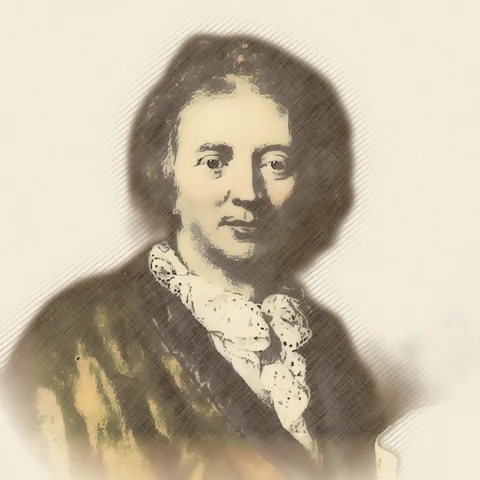 1668 – 1733Baroque
François Couperin
A French court harpsichordist, he blended French elegance and Italian influences.
 1678 – 1741Baroque
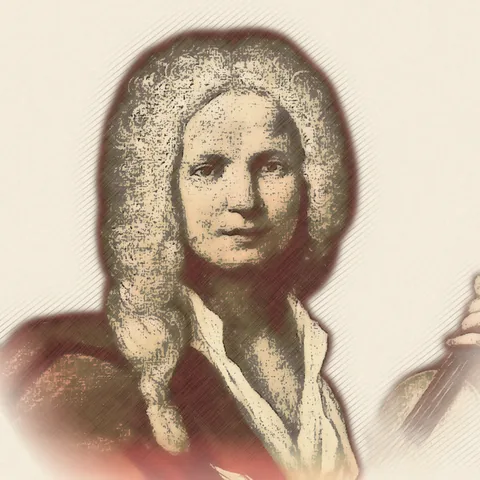
Antonio Vivaldi
A Venetian violinist and priest, he reshaped the concerto through contrast and virtuosity.
 1681 – 1767Baroque
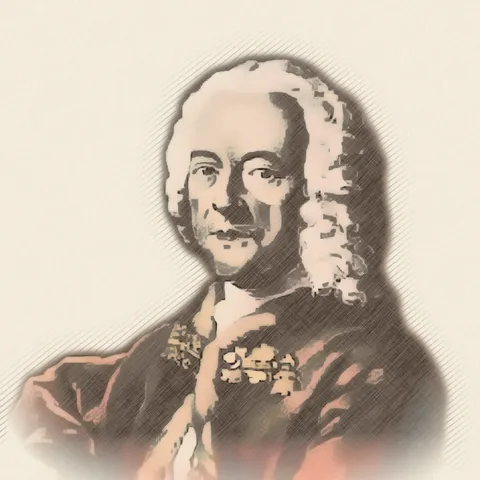
Georg Philipp Telemann
A prolific composer, he led Hamburg's musical life and combined European styles.
 1683 – 1764Baroque
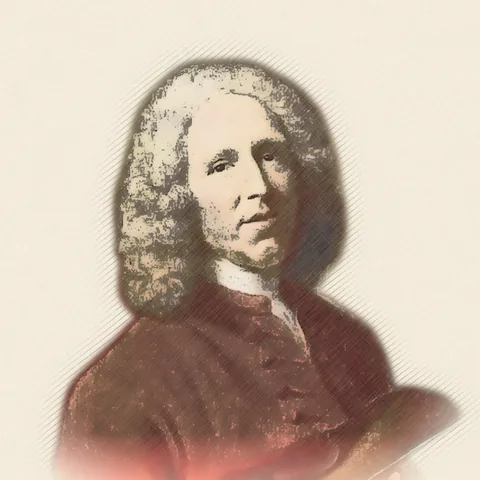
Jean-Philippe Rameau
A harmony theorist and man of the theatre, he brought bold colors to French orchestration.
 1685 – 1759Baroque
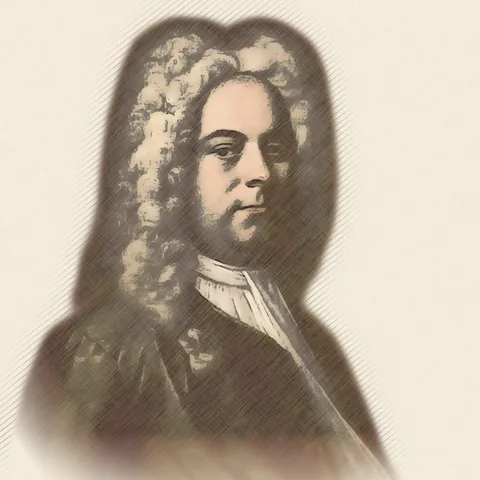
Georg Friedrich Haendel
Born in Germany and active in London, he excelled in oratorio and public spectacle.
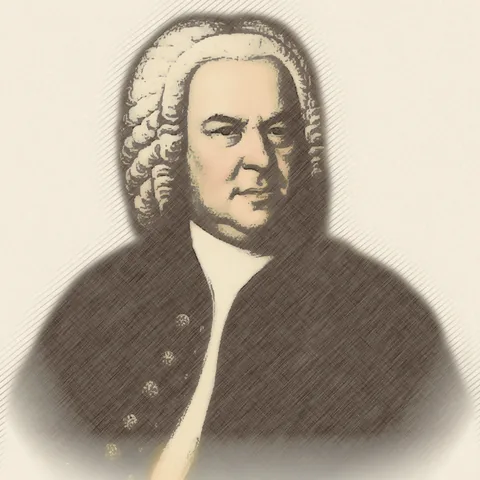 1685 – 1750Baroque
Johann Sebastian Bach
An organist and master of counterpoint, he built musical structures of exceptional depth.