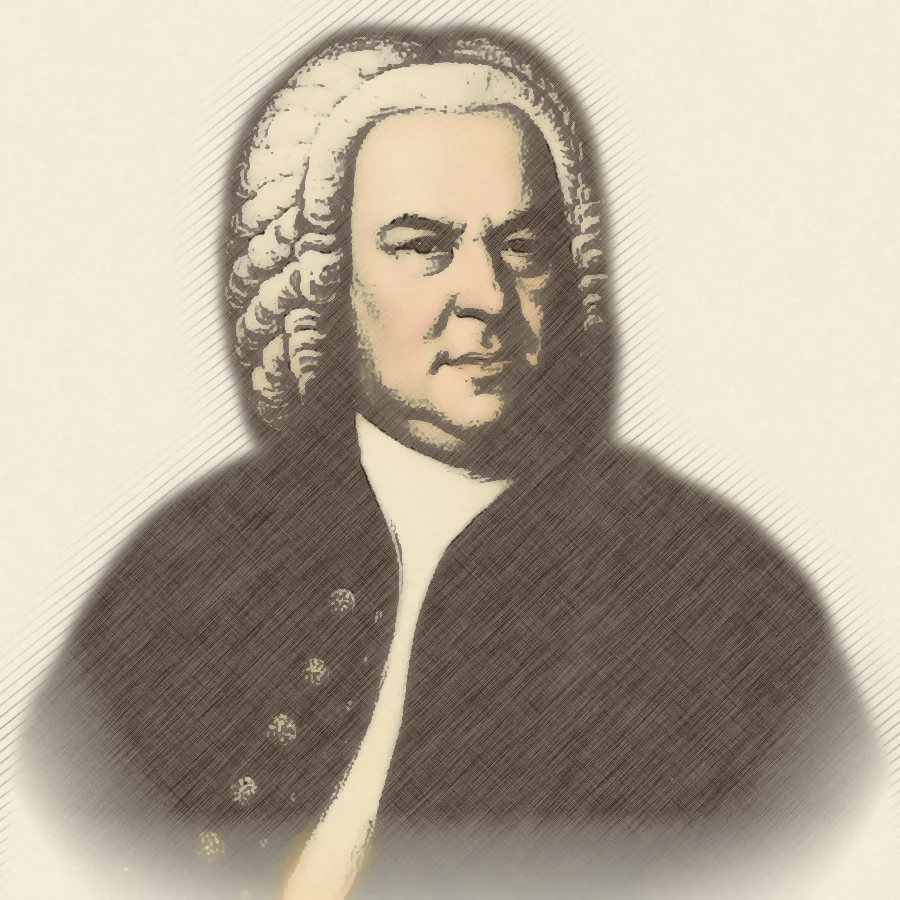
 Baroque
Johann Sebastian Bach
An organist and master of counterpoint, he built musical structures of exceptional depth.
A life and its times
The milestones of the life and work, the contemporaries and the major world events, on a single line of time.
A life at a glance
And after his or her death: 1 landmark in the detailed timeline (1829).
- 1685Birth
Born in Eisenach on 21 March into a large family of musicians
- 1687Meanwhile
Newton publishes the laws of gravitation
- 1695Private lifeage 10
Orphaned at 10, taken in by his elder brother in Ohrdruf
- 1700Trainingage 15
Pupil at St Michael’s School in Lüneburg
- 1700Meanwhile
Bartolomeo Cristofori invents the piano in Florence (c. 1700)
- 1703Careerage 18
Organist in Arnstadt
- 1705Journeyage 20
Walks about 400 km to hear the organist Buxtehude in Lübeck
- 1707Private lifeage 22
Organist in Mühlhausen; marries his cousin Maria Barbara
- 1708Careerage 23
Organist then Konzertmeister at the Weimar court
- 1715Meanwhile
Death of Louis XIV
- 1717Careerage 32
Kapellmeister in Köthen (after a month in jail in Weimar)
- 1719Meanwhile
Defoe publishes Robinson Crusoe
- 1721Workage 36
Brandenburg Concertos; marries Anna Magdalena
- 1722Workage 37
The Well-Tempered Clavier, Book I
- 1723Milestoneage 38
Cantor of St Thomas in Leipzig until his death
- 1727Workage 42
St Matthew Passion
- 1734Workage 49
Christmas Oratorio
- 1741Workage 56
Goldberg Variations
- 1747Journeyage 62
Improvises for Frederick the Great: The Musical Offering
- 1749Workage 64
Completes the Mass in B minor
- 1750Deathage 65
Dies in Leipzig on 28 July
- 1829Landmark79 years after death
Mendelssohn revives the St Matthew Passion
Listen
Excerpts from freely licensed recordings, with their performers and licences.
Excerpts last up to 90 seconds. Johann Sebastian Bach’s compositions are in the public domain; each recording is streamed from Wikimedia Commons under the licence shown, credited to its performers or uploader.
Listen to complete works on Wikimedia Commons
Wikimedia Commons is a free media library: you will find the complete recordings there, with their reuse conditions.
- Complete recordingThe Well-Tempered Clavier — Prelude in C major, BWV 846
- Complete recordingGoldberg Variations — Aria
- Complete recordingCello Suite No. 1 — Prelude
- Complete recordingCantata BWV 147 — Jesu, Joy of Man’s Desiring
- Complete recordingPrelude in A minor, BWV 543 (Silbermann organ)
- Wikimedia Commons filePrelude 1, Just intonation
- Search for the workSt Matthew Passion
- Search for the workBrandenburg Concertos
- Search for the workThe Well-Tempered Clavier
- Search for the workGoldberg Variations
- Search for the workMass in B minor
- Search for the workCello Suites
- Search for the workJesu, Joy of Man’s Desiring (BWV 147)
- Search for the workChristmas Oratorio
- Everything on CommonsAll recordings of Johann Sebastian Bach
The life of Johann Sebastian Bach
Johann Sebastian Bach was born in Eisenach, Thuringia, on 21 March 1685, into the greatest family of musicians in history: for more than a century the Bachs had been organists, cantors and town musicians throughout the region, so much so that in some towns “a Bach” meant “a musician”. His father, Johann Ambrosius, was a town musician and probably taught him the violin. But Johann Sebastian lost his mother at nine and his father at ten.
Orphaned, he was taken in by his elder brother Johann Christoph, organist at Ohrdruf and a former pupil of Pachelbel, who taught him keyboard. According to an anecdote, the boy copied by moonlight, at night, a book of music his brother had forbidden him to use. In 1700, at fifteen, he won a place as a chorister at St Michael’s School in Lüneburg, where he discovered a rich music library and heard great organists such as Georg Böhm.
In 1703 he became organist in Arnstadt. In 1705 he obtained four weeks’ leave to hear the famous organist Dietrich Buxtehude in Lübeck: he walked some four hundred kilometres and stayed nearly four months, earning reproaches on his return. In 1707 he became organist in Mühlhausen and married his cousin Maria Barbara Bach, with whom he had seven children, including Wilhelm Friedemann and Carl Philipp Emanuel, future great composers.
From 1708 to 1717 he was organist and later Konzertmeister at the court of Weimar, where he composed much of his organ music, probably including the famous Toccata and Fugue in D minor. When he wanted to leave for a better post, the duke had him imprisoned for a month for insubordination. In 1717 he finally became Kapellmeister to Prince Leopold of Anhalt-Köthen, a Calvinist prince who needed no church music. Bach therefore composed mainly instrumental music: the Brandenburg Concertos (1721), the Suites for solo cello, the Sonatas and Partitas for solo violin and the first book of The Well-Tempered Clavier (1722).
In 1720, returning from a journey, he learned that Maria Barbara had died and was already buried. The following year he married Anna Magdalena Wilcke, a twenty-year-old singer, with whom he had thirteen children, including Johann Christian, who made his career in London. In 1723 he became Cantor of St Thomas’s School and director of music for the city of Leipzig, a post he held until his death. He had to provide a cantata every Sunday for the city’s churches: he composed several annual cycles, of which more than two hundred cantatas survive.
In Leipzig he composed his greatest sacred works: the St John Passion (1724), the St Matthew Passion (1727), the Christmas Oratorio (1734) and the Mass in B minor, completed in 1749. He also directed the Collegium musicum, which gave concerts at Zimmermann’s coffee house, for which he wrote the Coffee Cantata. He published the Goldberg Variations (1741) and, after improvising in 1747 before King Frederick II of Prussia on a theme the king gave him, The Musical Offering. His last years were devoted to The Art of Fugue, left unfinished.
Suffering from a serious eye disease, in 1750 he underwent two disastrous operations by the English surgeon John Taylor. He died in Leipzig on 28 July 1750. After his death his music was considered old-fashioned, but it continued to be studied by Mozart, Beethoven and the great composers. In 1829 Felix Mendelssohn conducted the St Matthew Passion in Berlin, launching the Bach revival. He is now regarded as one of the greatest composers of all time.
Works to know
- 1720
Cello Suites
Six suites, the cellist’s bible.
Listen on Wikimedia Commons - 1721
Brandenburg Concertos
Six concertos, each with different instrumental colours.
Listen on Wikimedia Commons - 1722
The Well-Tempered Clavier
48 preludes and fugues in every key.
Listen on Wikimedia Commons - 1723
Jesu, Joy of Man’s Desiring (BWV 147)
Chorale known throughout the world.
Listen on Wikimedia Commons - 1727
St Matthew Passion
Vast fresco for two choirs and two orchestras.
Listen on Wikimedia Commons - 1734
Christmas Oratorio
Six joyful cantatas for the holidays.
Listen on Wikimedia Commons - 1741
Goldberg Variations
An aria and 30 variations — a keyboard cathedral.
Listen on Wikimedia Commons - 1749
Mass in B minor
A summation of his sacred art.
Listen on Wikimedia Commons
Anecdotes
Bach had 20 children, four of whom became famous composers.
A duke put him in jail for a month because he wanted to change jobs!
A recording of his music is travelling through space aboard the Voyager probes.
He walked about 400 km to hear the organist Buxtehude in Lübeck.
Same era · Baroque
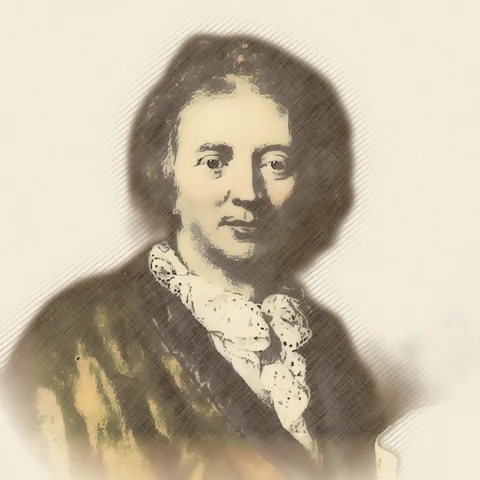 1668 – 1733Baroque
François Couperin
A French court harpsichordist, he blended French elegance and Italian influences.
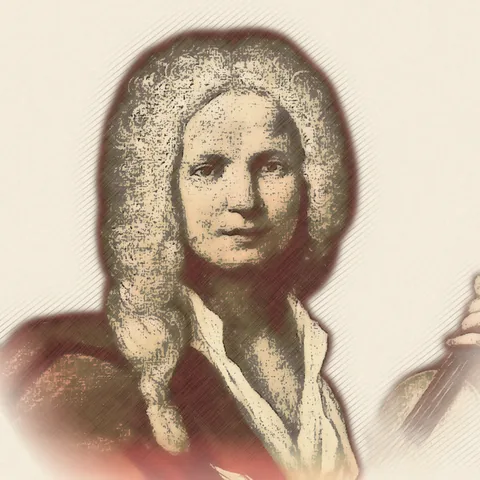 1678 – 1741Baroque
Antonio Vivaldi
A Venetian violinist and priest, he reshaped the concerto through contrast and virtuosity.
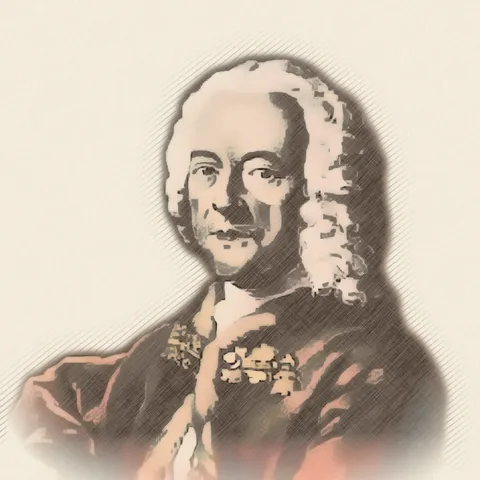 1681 – 1767Baroque
Georg Philipp Telemann
A prolific composer, he led Hamburg's musical life and combined European styles.
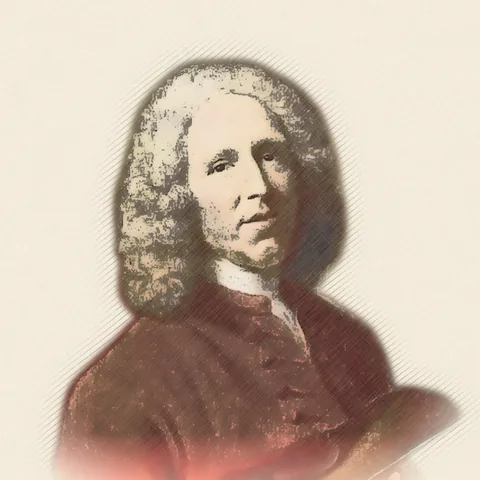 1683 – 1764Baroque
Jean-Philippe Rameau
A harmony theorist and man of the theatre, he brought bold colors to French orchestration.
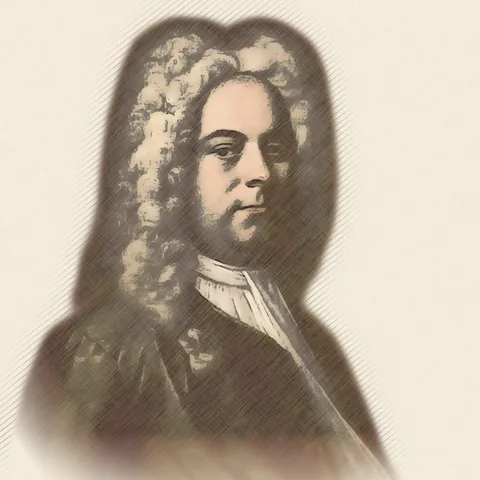 1685 – 1759Baroque
Georg Friedrich Haendel
Born in Germany and active in London, he excelled in oratorio and public spectacle.
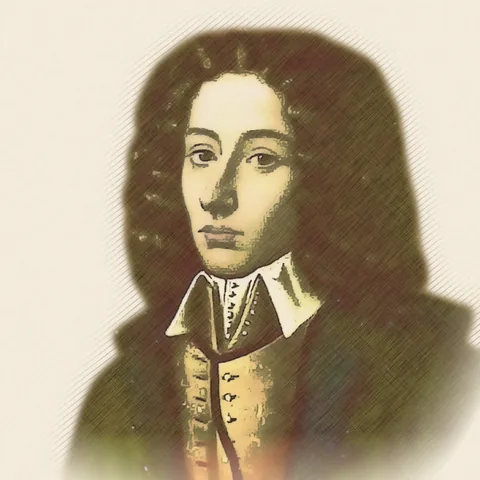 1710 – 1736Baroque
Jean-Baptiste Pergolèse
An Italian composer who died young and shaped comic opera and sacred music.