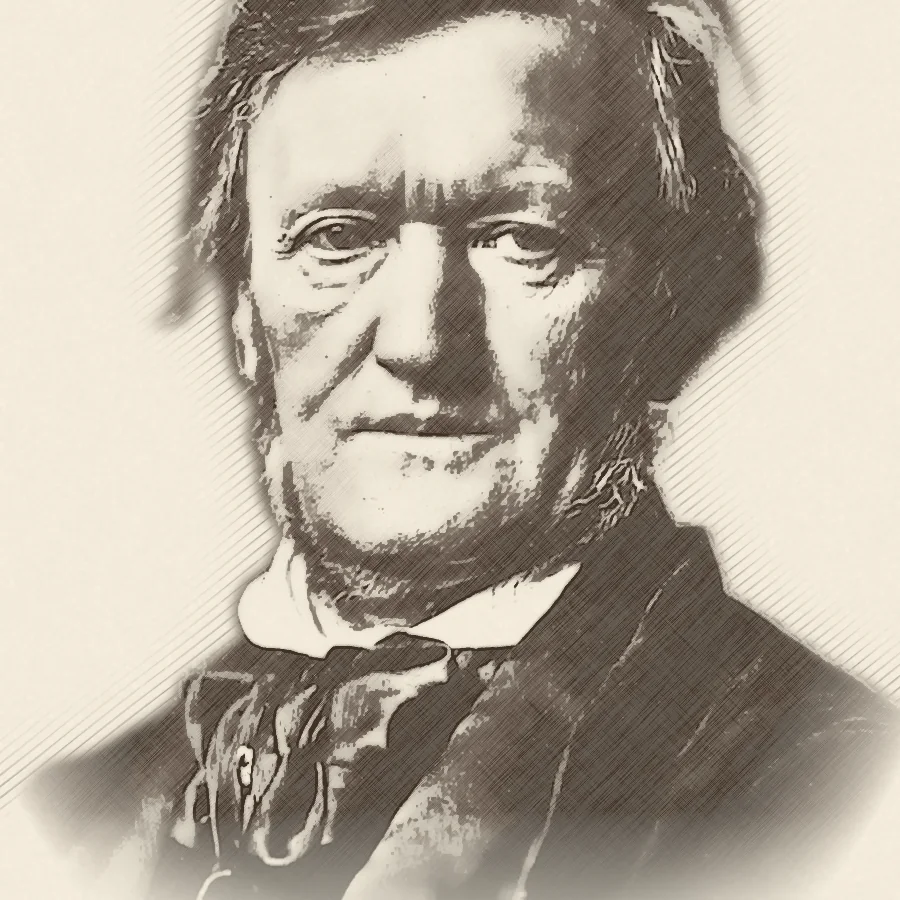
 Romantic
Richard Wagner
He envisioned music drama as a unity of orchestra, poetry and stagecraft.
A life and its times
The milestones of the life and work, the contemporaries and the major world events, on a single line of time.
A life at a glance
- 1813Birth
Born in Leipzig on 22 May
- 1816Meanwhile
Maelzel patents the metronome (1815–16)
- 1822Meanwhile
Champollion deciphers hieroglyphs
- 1830Meanwhile
July Revolution in France
- 1831Trainingage 18
Studies music at Leipzig University
- 1836Private lifeage 23
Marries the actress Minna Planer
- 1839Journeyage 26
Flees creditors in Riga; a stormy sea crossing inspires The Flying Dutchman
- 1840Meanwhile
Adolphe Sax invents the saxophone (c. 1840)
- 1842Workage 29
Success of Rienzi in Dresden
- 1843Careerage 30
Saxon court Kapellmeister; The Flying Dutchman
- 1845Workage 32
Tannhäuser
- 1848Meanwhile
Revolutions of 1848; slavery abolished in France
- 1849Journeyage 36
Takes part in the Dresden uprising and must flee to Switzerland
- 1850Workage 37
Liszt premieres Lohengrin in Weimar
- 1853Workage 40
Begins the music of The Ring of the Nibelung
- 1864Careerage 51
Young King Ludwig II of Bavaria becomes his patron
- 1865Workage 52
Premiere of Tristan und Isolde in Munich
- 1865Meanwhile
End of the American Civil War; slavery abolished in the USA
- 1868Workage 55
Die Meistersinger von Nürnberg
- 1870Private lifeage 57
Marries Cosima, Liszt’s daughter
- 1874Meanwhile
First exhibition of the Impressionist painters
- 1875Meanwhile
The Palais Garnier opera house opens in Paris
- 1876Careerage 63
Opening of the Bayreuth Festspielhaus with the complete Ring
- 1882Workage 69
Parsifal
- 1883Deathage 70
Dies in Venice on 13 February
Listen
Excerpts from freely licensed recordings, with their performers and licences.
Excerpts last up to 90 seconds. Richard Wagner’s compositions are in the public domain; each recording is streamed from Wikimedia Commons under the licence shown, credited to its performers or uploader.
Listen to complete works on Wikimedia Commons
Wikimedia Commons is a free media library: you will find the complete recordings there, with their reuse conditions.
- Complete recordingDie Walküre — Ride of the Valkyries
- Complete recordingLohengrin — Bridal Chorus
- Complete recordingDie Meistersinger — Prize Song (Leo Slezak)
- Search for the workThe Ring of the Nibelung
- Search for the workDie Walküre (Ride)
- Search for the workTristan und Isolde
- Search for the workLohengrin
- Search for the workThe Flying Dutchman
- Search for the workDie Meistersinger
- Search for the workSiegfried Idyll
- Everything on CommonsAll recordings of Richard Wagner
The life of Richard Wagner
Richard Wagner was born in Leipzig on 22 May 1813, a few months before the great Battle of the Nations between Napoleon and the Allies around the city. His father died soon after, and his mother married the actor and painter Ludwig Geyer. Richard grew up in a theatrical milieu: several of his sisters became actresses or singers. At first he was passionate about literature and theatre, Shakespeare and Greek tragedy, and at fifteen wrote an enormous tragedy. It was on discovering Beethoven, especially Fidelio and the Ninth Symphony, that he decided to become a composer.
He learned music largely on his own, then studied composition in Leipzig with Christian Theodor Weinlig. From 1833 he was chorus master and then conductor in small German theatres: Würzburg, Magdeburg, Königsberg, Riga. In 1836 he married the actress Minna Planer. Riddled with debt, he fled Riga in 1839 with Minna and their dog. The crossing to London on a small sailing ship, caught in a violent storm, later inspired The Flying Dutchman. He then spent three years of poverty in Paris.
In 1842 his opera Rienzi was a great success in Dresden, and the following year Wagner was appointed Kapellmeister to the Saxon court. There he premiered The Flying Dutchman (1843) and Tannhäuser (1845) and composed Lohengrin. But in 1849 he took an active part in the revolutionary uprising in Dresden alongside the Russian anarchist Bakunin. Wanted by the police, he had to flee into exile in Zurich, Switzerland. It was his friend Liszt who premiered Lohengrin in Weimar in 1850, in the composer’s absence.
In exile Wagner wrote many essays on art, developing his idea of the “total work of art” (Gesamtkunstwerk), uniting poetry, music, drama and stage design. He wanted to replace traditional opera, with its separate arias, with a continuous “music drama” in which the orchestra plays an essential role. He used the leitmotif, a short musical motif associated with a character, object or idea, which returns and is transformed throughout the work. In 1853 he began the music of The Ring of the Nibelung, a cycle of four operas inspired by Germanic and Norse myths.
He interrupted this work to compose Tristan und Isolde, inspired partly by his love for Mathilde Wesendonck, wife of a wealthy patron. The work, with its chromatic harmonies that seem never to resolve, overturned musical language. But Wagner, always in debt, was on the brink of ruin. In 1864 the young King Ludwig II of Bavaria, aged eighteen and passionate about his music, summoned him to Munich, paid his debts and became his patron. Tristan was premiered in Munich in 1865, followed by Die Meistersinger von Nürnberg in 1868.
Wagner then had an affair with Cosima, Liszt’s daughter and wife of the conductor Hans von Bülow, his most loyal interpreter. The scandal forced him to leave Munich. He settled at Tribschen in Switzerland, where he married Cosima in 1870; for her birthday he composed the Siegfried Idyll, played as a surprise one morning on the staircase of their house. He dreamed of a theatre built specially for his works. With the support of Ludwig II and subscribers, he had the Festspielhaus built at Bayreuth in Bavaria, with the orchestra hidden beneath the stage.
The theatre opened in August 1876 with the first complete performance of The Ring of the Nibelung, about fifteen hours of music over four evenings, before the German emperor and musicians from all over the world. Wagner then composed Parsifal, premiered at Bayreuth in 1882. He died of a heart attack in Venice on 13 February 1883. His work profoundly transformed music, but his antisemitic writings, and later the Nazi regime’s use of his music, make him a highly controversial figure. The Bayreuth Festival still takes place today.
Works to know
- 1843
The Flying Dutchman
A cursed captain roams the seas.
Listen on Wikimedia Commons - 1848
Lohengrin
The swan knight, with the famous Bridal Chorus.
Listen on Wikimedia Commons - 1856
Die Walküre (Ride)
The Ride of the Valkyries, a heavenly gallop of warrior maidens.
Listen on Wikimedia Commons - 1859
Tristan und Isolde
Love opera whose opening chord upended harmony.
Listen on Wikimedia Commons - 1868
Die Meistersinger
Singing contest in Renaissance Nuremberg.
Listen on Wikimedia Commons - 1870
Siegfried Idyll
Birthday gift played on the staircase for Cosima.
Listen on Wikimedia Commons - 1874
The Ring of the Nibelung
Four operas (about 15 hours) on the Rhine’s cursed gold.
Listen on Wikimedia Commons
Anecdotes
The Ring of the Nibelung lasts about 15 hours, performed over four evenings.
He invented an instrument: the ‘Wagner tuba’.
For his wife Cosima’s birthday he had the Siegfried Idyll played as a surprise on the staircase of their house.
In his Bayreuth theatre the orchestra is hidden under the stage so the audience cannot see it.
Same era · Romantic
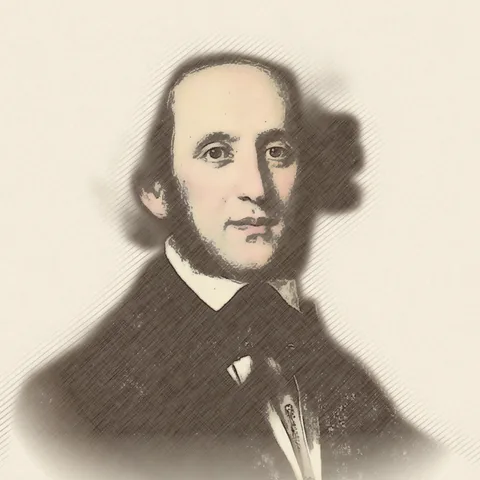 1809 – 1847Romantic
Felix Mendelssohn
A conductor and composer who revived Bach and wrote music of great clarity.
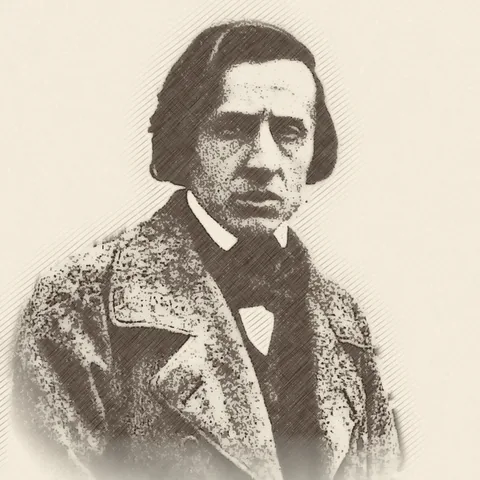 1810 – 1849Romantic
Frédéric Chopin
At the piano, he combined virtuosity, poetry and memories of Polish dance.
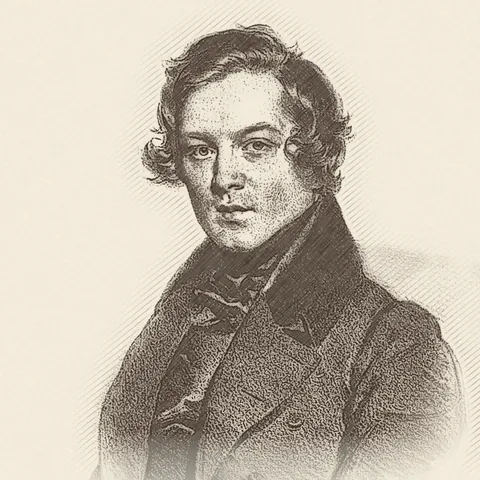 1810 – 1856Romantic
Robert Schumann
A composer and critic, he explored psychological contrasts in piano music.
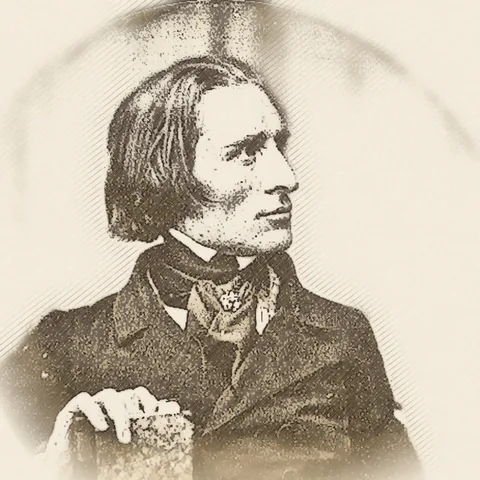 1811 – 1886Romantic
Franz Liszt
A star pianist, he invented new forms and developed the symphonic poem.
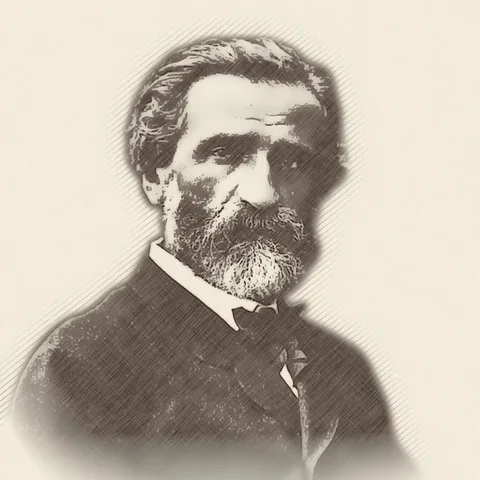 1813 – 1901Romantic
Giuseppe Verdi
His operas give unforgettable voice to human passions and conflicts.
 1818 – 1893Romantic
Charles Gounod
A French composer who shaped Romantic opera and sacred music.