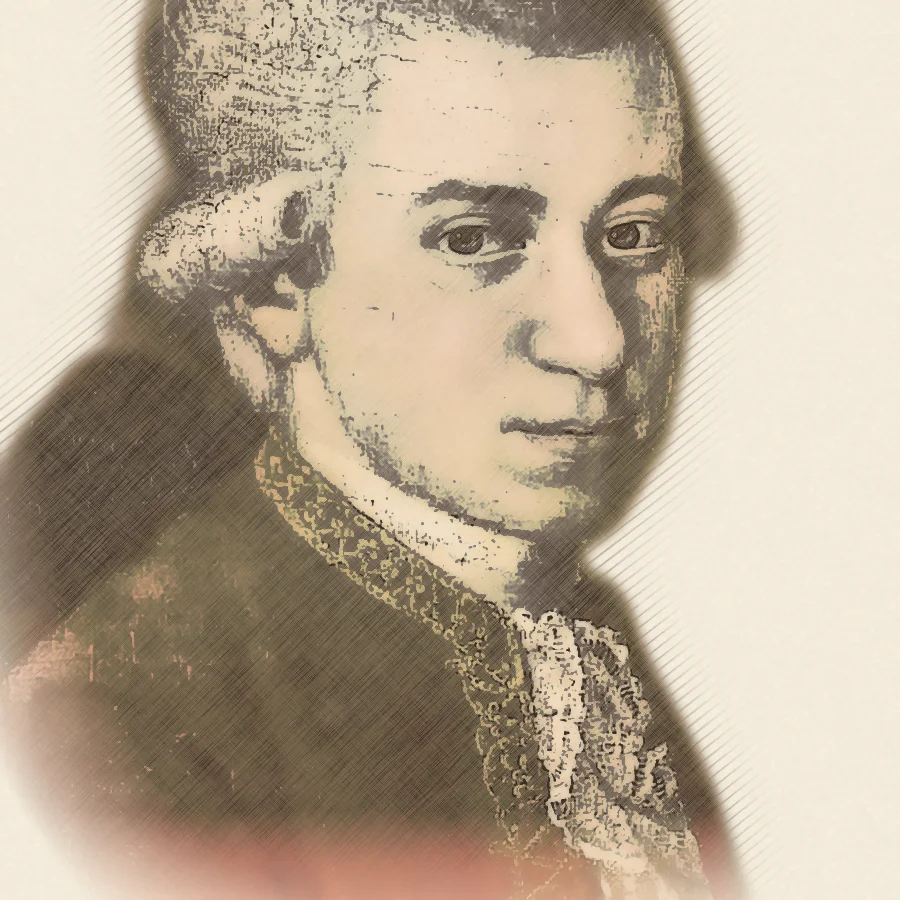
 Classical
Wolfgang Amadeus Mozart
A child prodigy who mastered opera and symphony, he combined grace with emotional depth.
A life and its times
The milestones of the life and work, the contemporaries and the major world events, on a single line of time.
A life at a glance
- 1756Birth
Born in Salzburg on 27 January
- 1761Workage 5
Composes his first pieces at 5
- 1762Journeyage 6
Plays for Empress Maria Theresa in Vienna
- 1763Journeyage 7
Grand European tour: Paris, London, The Hague… (3 years)
- 1764Workage 8
First symphony, in London, aged 8
- 1769Meanwhile
James Watt’s improved steam engine
- 1770Journeyage 14
In Italy: writes down Allegri’s Miserere from memory; decorated by the Pope
- 1773Careerage 17
Musician to Archbishop Colloredo in Salzburg
- 1776Meanwhile
United States Declaration of Independence
- 1778Private lifeage 22
His mother dies in Paris during a journey
- 1778Meanwhile
La Scala opera house opens in Milan
- 1781Milestoneage 25
Breaks with the archbishop and settles in Vienna as a freelancer
- 1782Private lifeage 26
Marries Constanze Weber; The Abduction from the Seraglio
- 1783Meanwhile
First manned flight in a hot-air balloon
- 1786Workage 30
The Marriage of Figaro
- 1787Workage 31
Don Giovanni in Prague; Eine kleine Nachtmusik
- 1788Workage 32
His last three symphonies in one summer (Nos. 39, 40, 41)
- 1789Landmarkage 33
French Revolution
- 1789Meanwhile
Storming of the Bastille: the French Revolution
- 1791Workage 35
The Magic Flute; Clarinet Concerto; unfinished Requiem
- 1791Deathage 35
Dies in Vienna on 5 December, aged 35
Listen
Excerpts from freely licensed recordings, with their performers and licences.
Excerpts last up to 90 seconds. Wolfgang Amadeus Mozart’s compositions are in the public domain; each recording is streamed from Wikimedia Commons under the licence shown, credited to its performers or uploader.
Listen to complete works on Wikimedia Commons
Wikimedia Commons is a free media library: you will find the complete recordings there, with their reuse conditions.
- Complete recordingEine kleine Nachtmusik — Allegro
- Complete recordingSonata No. 11 — Turkish March
- Complete recordingSymphony No. 41 “Jupiter” — Finale
- Complete recordingRequiem — Lacrimosa (1960)
- Search for the workThe Magic Flute
- Search for the workEine kleine Nachtmusik
- Search for the workRequiem
- Search for the workSymphony No. 40
- Search for the workThe Marriage of Figaro
- Search for the workSonata No. 11 ‘Alla turca’
- Search for the workDon Giovanni
- Search for the workClarinet Concerto
- Everything on CommonsAll recordings of Wolfgang Amadeus Mozart
The life of Wolfgang Amadeus Mozart
Wolfgang Amadeus Mozart was born in Salzburg on 27 January 1756. His father, Leopold, a violinist at the prince-archbishop’s court, was a renowned teacher and author of a famous violin method. He quickly discovered his son’s extraordinary gifts: at three Wolfgang copied on the keyboard the lessons of his elder sister Maria Anna, known as Nannerl; at five he composed his first little minuets. Leopold decided to devote his life to the education and careers of his two prodigy children.
From 1762 the family went on tour: Munich, then Vienna, where Wolfgang played for Empress Maria Theresa and, it is said, jumped on her lap. From 1763 to 1766 a grand journey of three and a half years took them to Paris, London, The Hague and many European cities. The child played blindfolded, improvised on given themes and sight-read. In London he met Johann Christian Bach, Johann Sebastian’s youngest son, who influenced him deeply, and composed his first symphony at eight.
Between 1769 and 1773 he made three journeys to Italy with his father. In Rome in 1770 he heard Allegri’s Miserere in the Sistine Chapel, whose score was kept secret, and wrote it out from memory after a single hearing. The pope made him a Knight of the Golden Spur. In Milan he composed and conducted his first operas, such as Mitridate, at fourteen. Back in Salzburg he entered the service of the new prince-archbishop, Hieronymus Colloredo, authoritarian and indifferent to his genius.
Stifled in Salzburg, Mozart left in 1777 to seek a post in Mannheim and Paris, accompanied by his mother. The journey was a failure: no court hired him, and his mother died in Paris in July 1778. Back in Salzburg he composed the Coronation Mass and the opera Idomeneo, premiered in Munich in 1781. That same year, after a violent quarrel with Colloredo — he was literally dismissed with a “kick” from the chamberlain — he settled in Vienna as a freelance musician, a rare thing at the time.
In Vienna Mozart lived on teaching, concerts — for which he wrote his great piano concertos — and publications. In 1782 he married Constanze Weber despite his father’s opposition and triumphed with The Abduction from the Seraglio. He became friends with Haydn, to whom he dedicated six quartets. His collaboration with the librettist Lorenzo Da Ponte produced three operatic masterpieces: The Marriage of Figaro (1786), Don Giovanni (1787), premiered in Prague to huge acclaim, and Così fan tutte (1790).
Despite his fame Mozart had financial difficulties, due to wars that curtailed musical life and a costly lifestyle. He wrote to friends to borrow money. He nonetheless composed tirelessly: in the summer of 1788 he wrote his last three symphonies in a few weeks, including No. 40 in G minor and No. 41, the “Jupiter”. He also composed Eine kleine Nachtmusik (1787), the “Alla turca” Sonata and dozens of chamber-music masterpieces.
The year 1791 was incredibly productive: The Magic Flute, a popular German opera premiered in a suburban theatre; La clemenza di Tito for the emperor’s coronation in Prague; the Clarinet Concerto; and a Requiem commissioned anonymously by a count who wanted to pass it off as his own. Ill, Mozart died in Vienna on 5 December 1791, aged thirty-five, leaving the Requiem unfinished; his pupil Franz Xaver Süssmayr completed it. He left more than six hundred works, listed in the Köchel catalogue.
Works to know
- 1783
Sonata No. 11 ‘Alla turca’
With the famous Turkish March.
Listen on Wikimedia Commons - 1786
The Marriage of Figaro
Comedy in which servants outwit their master.
Listen on Wikimedia Commons - 1787
Eine kleine Nachtmusik
Serenade for strings, one of the best-known pieces in the world.
Listen on Wikimedia Commons - 1787
Don Giovanni
Opera about a seducer punished by a statue.
Listen on Wikimedia Commons - 1788
Symphony No. 40
G minor symphony, feverish and unforgettable.
Listen on Wikimedia Commons - 1791
The Magic Flute
Fairy-tale opera with the Queen of the Night and the bird-catcher Papageno.
Listen on Wikimedia Commons - 1791
Requiem
Unfinished Mass for the dead, surrounded by legends.
Listen on Wikimedia Commons - 1791
Clarinet Concerto
His last concerto, luminous and gentle.
Listen on Wikimedia Commons
Anecdotes
At 14 he wrote down a secret Vatican piece from memory after hearing it once.
Mozart loved puns, billiards and animals — he had a starling that whistled one of his tunes!
As a child he played the keyboard blindfolded or with a cloth laid over the keys.
He composed his first symphony at eight, in London.
Same era · Classical
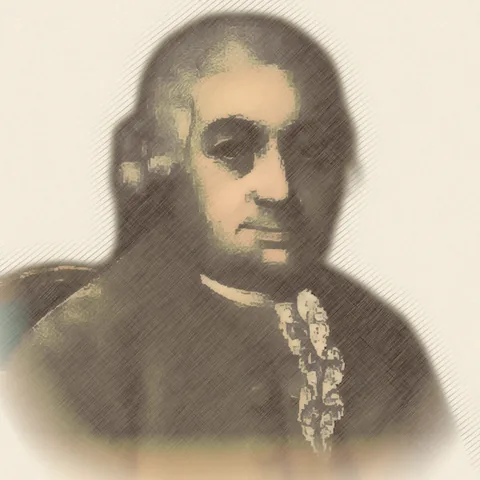 1714 – 1788Classical
Carl Philipp Emanuel Bach
Son of J. S. Bach, he helped shape an expressive transitional style.
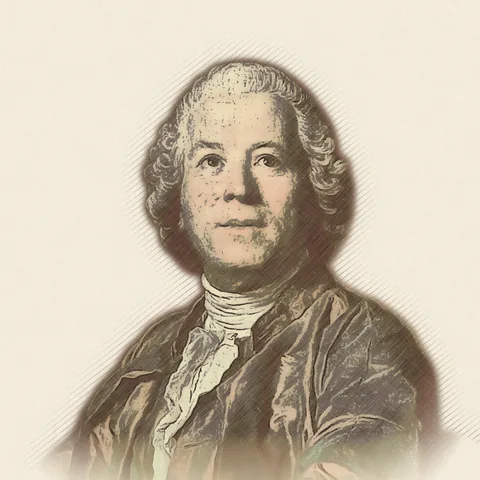 1714 – 1787Classical
Christoph Willibald Gluck
He reformed opera by prioritizing drama over vocal display.
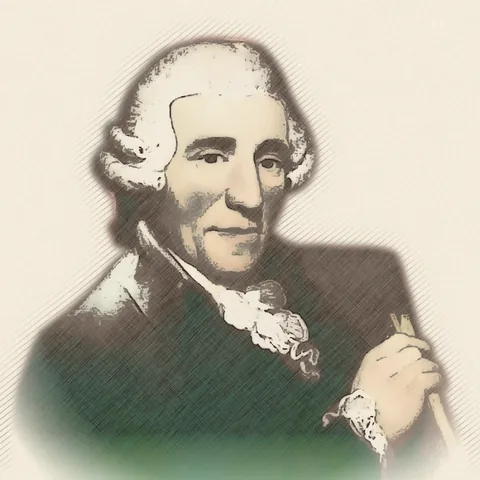 1732 – 1809Classical
Joseph Haydn
A major figure in symphony and quartet, he combined invention, humor and balance.
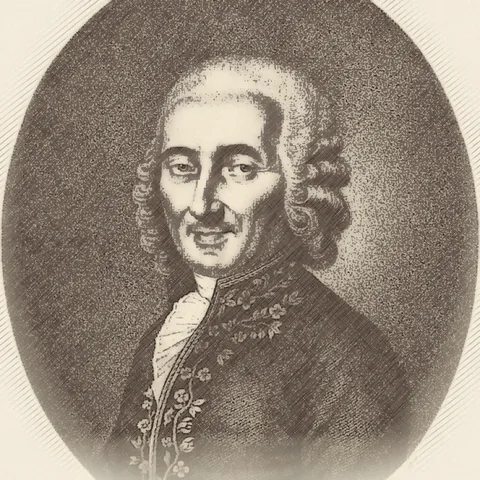 1743 – 1805Classical
Luigi Boccherini
A virtuoso cellist who greatly expanded classical chamber music.
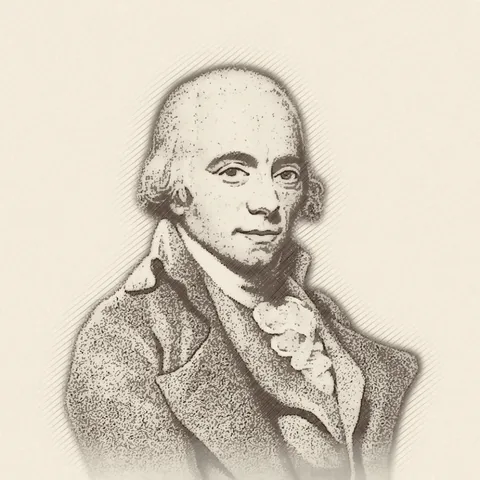 1752 – 1832Classical
Muzio Clementi
Pianist, publisher and piano maker, he shaped modern piano technique.