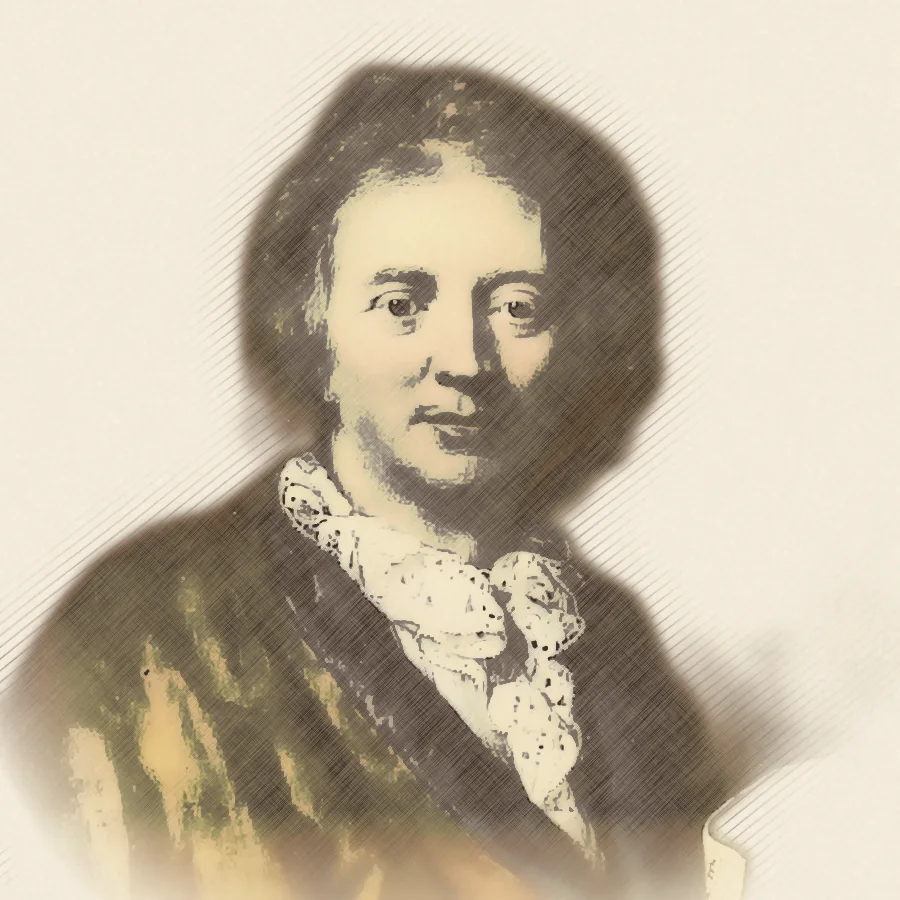
 Baroque
François Couperin
A French court harpsichordist, he blended French elegance and Italian influences.
A life and its times
The milestones of the life and work, the contemporaries and the major world events, on a single line of time.
A life at a glance
- 1668Birth
Born in Paris on 10 November into a dynasty of organists
- 1669Meanwhile
The Royal Academy of Music (Paris Opera) is founded
- 1679Private lifeage 11
Death of his father Charles, organist of Saint-Gervais
- 1682Meanwhile
The French court moves to Versailles
- 1685Careerage 17
Takes over as organist of Saint-Gervais at 17
- 1687Meanwhile
Newton publishes the laws of gravitation
- 1689Private lifeage 21
Marries Marie-Anne Ansault
- 1690Workage 22
Pièces d’orgue: two organ Masses
- 1693Careerage 25
Organist of Louis XIV’s Chapel Royal
- 1700Meanwhile
Bartolomeo Cristofori invents the piano in Florence (c. 1700)
- 1713Workage 45
First book of harpsichord pieces
- 1715Landmarkage 47
Death of Louis XIV
- 1715Meanwhile
Death of Louis XIV
- 1716Workage 48
L’Art de toucher le clavecin, his famous method
- 1717Workage 49
Second book, including Les Barricades mystérieuses
- 1719Meanwhile
Defoe publishes Robinson Crusoe
- 1722Workage 54
Concerts royaux
- 1725Workage 57
Apotheosis of Lully, uniting French and Italian tastes
- 1730Workage 62
Fourth and final harpsichord book
- 1733Deathage 65
Dies in Paris on 11 September
Listen
Excerpts from freely licensed recordings, with their performers and licences.
Excerpts last up to 90 seconds. François Couperin’s compositions are in the public domain; each recording is streamed from Wikimedia Commons under the licence shown, credited to its performers or uploader.
Listen to complete works on Wikimedia Commons
Wikimedia Commons is a free media library: you will find the complete recordings there, with their reuse conditions.
- Complete recordingLes Barricades mystérieuses
- Complete recordingLe Tic-toc-choc ou les Maillotins (piano, M. Meyer)
- Complete recordingPrelude, La Tromba, Air du diable
- Wikimedia Commons fileFrancois Couperin L'Art de toucher le Clavecin
- Search for the workLes Barricades mystérieuses
- Search for the workL’Art de toucher le clavecin
- Search for the workLeçons de ténèbres
- Search for the workConcerts royaux
- Search for the workLe Tic-toc-choc
- Search for the workLes Nations
- Everything on CommonsAll recordings of François Couperin
The life of François Couperin
François Couperin was born in Paris on 10 November 1668 into a true musical dynasty. His uncle Louis Couperin, who died a few years before his birth, had been one of the greatest harpsichordists of his time, and since 1653 the family had held the organ loft of the church of Saint-Gervais in Paris. His father Charles, organist there, died in 1679, when François was only ten. The parish council decided to reserve the post for him until he turned eighteen; in the meantime Michel-Richard de Lalande filled in.
Trained by the organist Jacques Thomelin, young Couperin progressed so fast that he officially took over the Saint-Gervais organ in 1685, aged seventeen. He would soon be called “Couperin le Grand” to distinguish him from other family members. In 1689 he married Marie-Anne Ansault, with whom he had several children, including Marguerite-Antoinette, who became a court harpsichordist. In 1690 he published his Pièces d’orgue, two masses — one for parishes and one for convents — which are among the summits of French organ music.
In 1693 Louis XIV chose him as one of the four organists of the Chapel Royal, each serving one quarter of the year. Couperin also became harpsichord teacher to the royal children, notably the Duke of Burgundy, the king’s grandson. He was ennobled in 1696. He often played at the “Sunday concerts” held in the king’s apartments at Versailles, for which he composed the Concerts royaux, published in 1722.
Couperin was above all a master of the harpsichord. Between 1713 and 1730 he published four books of Pièces de clavecin, some 250 pieces grouped into twenty-seven “ordres”, or suites. Each piece bears a poetic, mysterious or humorous title: Les Barricades mystérieuses, Le Tic-toc-choc ou les Maillotins, Les Moissonneurs, Le Rossignol en amour, Les Ombres errantes. They are often little portraits of people at court or scenes from daily life.
In 1716 he published L’Art de toucher le clavecin, a method explaining how to place the hands, how to finger passages, how to perform ornaments and even how to sit and keep a pleasant expression while playing. Johann Sebastian Bach knew and admired the book. Couperin stresses the need to play with delicacy and expression, since the harpsichord cannot vary its volume by striking harder or softer.
Couperin also admired Italian music, especially Arcangelo Corelli’s sonatas. He sought to unite the French and Italian tastes, which were then sharply opposed. He composed trio sonatas, later gathered in Les Nations (1726), and two works in homage to the two masters: Le Parnasse ou l’Apothéose de Corelli (1724) and the Apothéose de Lully (1725), in which the two composers meet on Parnassus and end up playing together. He also wrote sacred music, notably three Leçons de ténèbres of great beauty.
His health declined in the 1720s. In 1730 he published his fourth and final book of harpsichord pieces and handed his court organist post to his cousin. He died in Paris on 11 September 1733. His influence was immense: Bach copied his pieces, and in the twentieth century Maurice Ravel paid tribute to him with Le Tombeau de Couperin, while Richard Strauss orchestrated several of his pieces. He remains one of the greatest figures of French Baroque music.
Works to know
- 1714
Leçons de ténèbres
Holy Week chants of intimate fervour.
Listen on Wikimedia Commons - 1716
L’Art de toucher le clavecin
A method for playing the harpsichord well.
Listen on Wikimedia Commons - 1717
Les Barricades mystérieuses
Spellbinding piece whose title remains a mystery.
Listen on Wikimedia Commons - 1722
Concerts royaux
Chamber music played for the ageing Louis XIV.
Listen on Wikimedia Commons - 1722
Le Tic-toc-choc
Virtuoso piece with hands crossing like hammers.
Listen on Wikimedia Commons - 1726
Les Nations
Sonatas and suites blending French and Italian styles.
Listen on Wikimedia Commons
Anecdotes
Nobody really knows what ‘The Mysterious Barricades’ means!
The Couperins played the organ at Saint-Gervais for over 170 years.
In L’Art de toucher le clavecin he advises against pulling faces while playing.
Ravel paid tribute to him two centuries later with Le Tombeau de Couperin.
Same era · Baroque
 1653 – 1706Baroque
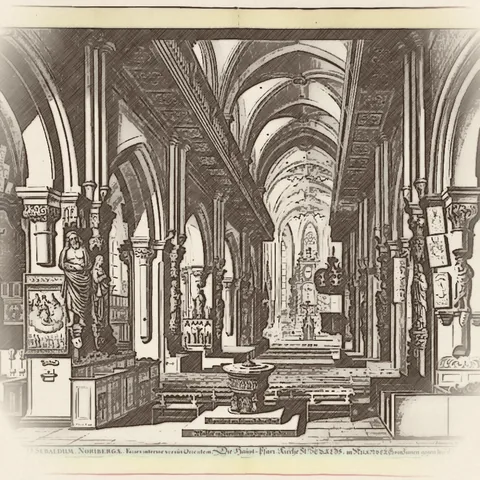
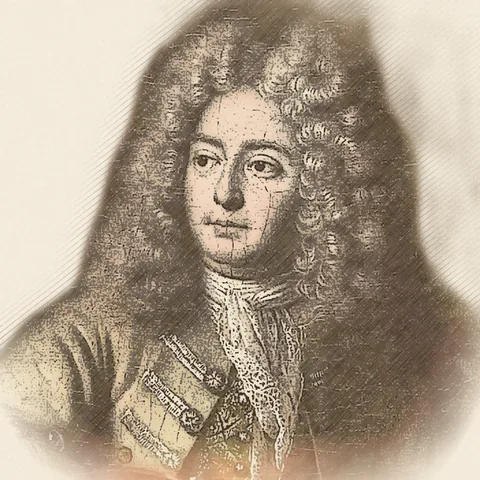
Johann Pachelbel
A German organist who influenced the south German keyboard tradition.
 1656 – 1728Baroque
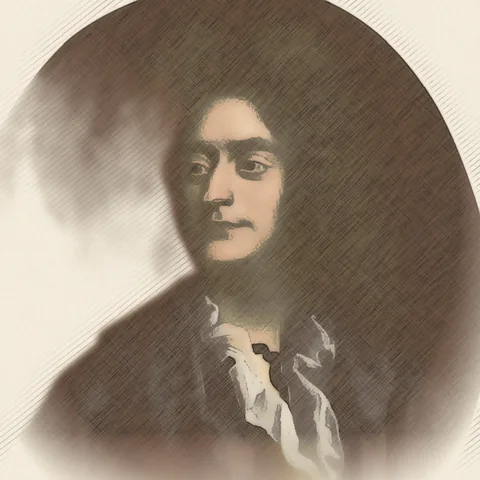
Marin Marais
A court musician under Louis XIV, he elevated the viola da gamba as a solo instrument.
 1659 – 1695Baroque
Henry Purcell
His stage music blends melodic subtlety and emotional force.
 1678 – 1741Baroque
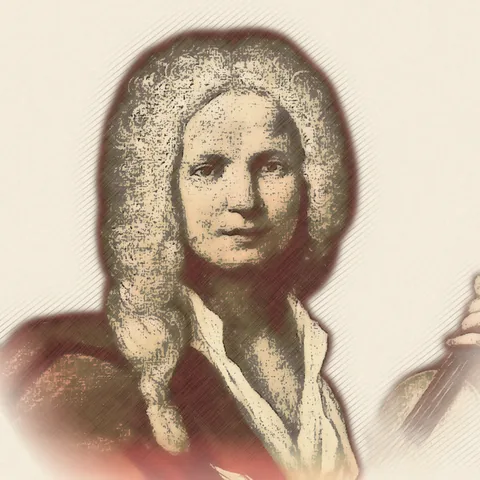
Antonio Vivaldi
A Venetian violinist and priest, he reshaped the concerto through contrast and virtuosity.
 1681 – 1767Baroque
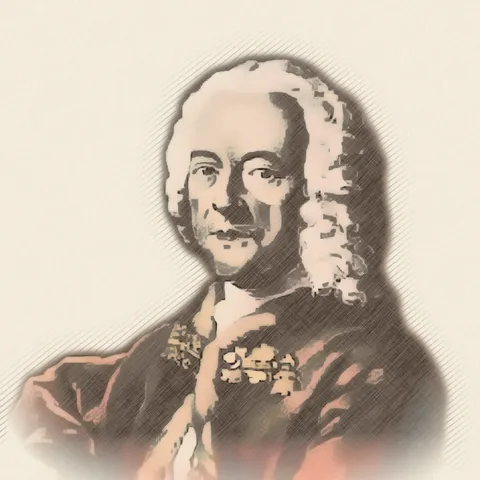
Georg Philipp Telemann
A prolific composer, he led Hamburg's musical life and combined European styles.
 1683 – 1764Baroque
Jean-Philippe Rameau
A harmony theorist and man of the theatre, he brought bold colors to French orchestration.