 Baroque
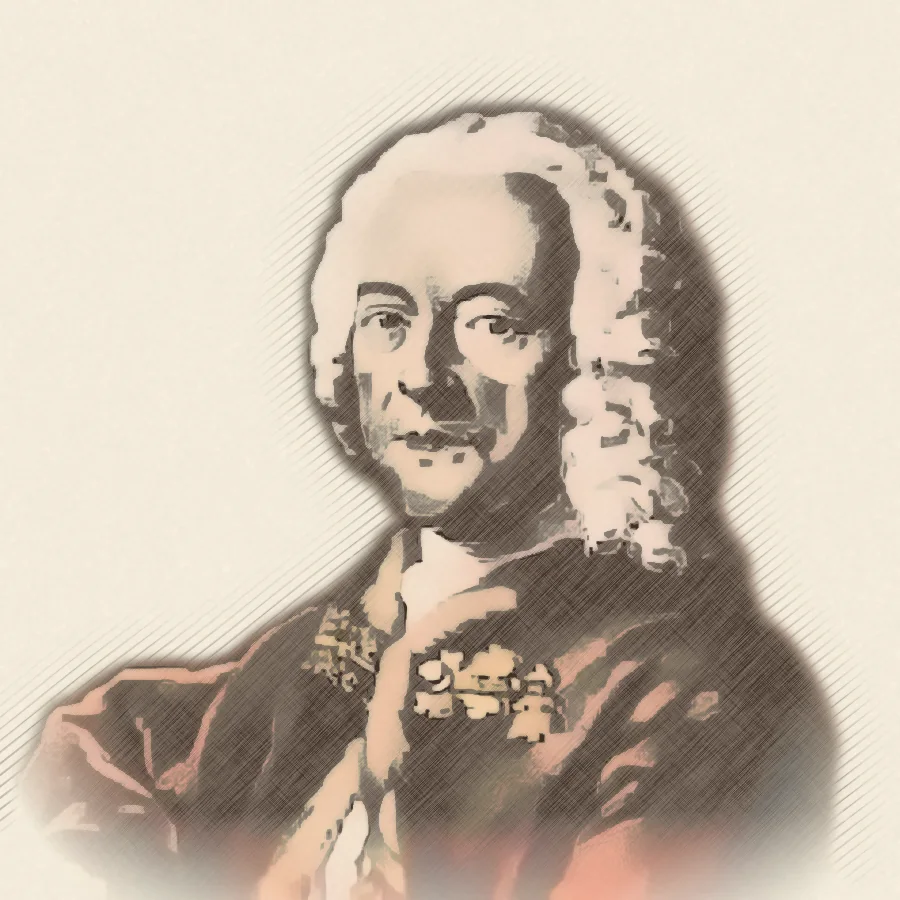
Georg Philipp Telemann
A prolific composer, he led Hamburg's musical life and combined European styles.
A life and its times
The milestones of the life and work, the contemporaries and the major world events, on a single line of time.
A life at a glance
- 1681Birth
Born in Magdeburg on 14 March
- 1682Meanwhile
The French court moves to Versailles
- 1687Meanwhile
Newton publishes the laws of gravitation
- 1693Trainingage 12
Teaches himself several instruments despite his mother’s opposition
- 1700Meanwhile
Bartolomeo Cristofori invents the piano in Florence (c. 1700)
- 1701Trainingage 20
Studies law in Leipzig; founds a student Collegium musicum
- 1705Careerage 24
Kapellmeister in Sorau; discovers Polish folk music
- 1708Careerage 27
Konzertmeister at the Eisenach court
- 1712Careerage 31
Music director of the city of Frankfurt
- 1714Private lifeage 33
Becomes godfather to Carl Philipp Emanuel Bach
- 1715Meanwhile
Death of Louis XIV
- 1719Meanwhile
Defoe publishes Robinson Crusoe
- 1721Milestoneage 40
Music director of Hamburg’s five main churches
- 1722Careerage 41
Elected Cantor in Leipzig, he declines — the post goes to J. S. Bach
- 1733Workage 52
Tafelmusik (Musique de table)
- 1737Journeyage 56
Triumphant stay in Paris: Paris Quartets
- 1751Meanwhile
First volume of Diderot and d’Alembert’s Encyclopédie
- 1752Meanwhile
Franklin studies lightning with a kite
- 1755Meanwhile
The Lisbon earthquake
- 1762Workage 81
Der Tag des Gerichts, oratorio
- 1767Deathage 86
Dies in Hamburg on 25 June, aged 86
Listen
Excerpts from freely licensed recordings, with their performers and licences.
Excerpts last up to 90 seconds. Georg Philipp Telemann’s compositions are in the public domain; each recording is streamed from Wikimedia Commons under the licence shown, credited to its performers or uploader.
Listen to complete works on Wikimedia Commons
Wikimedia Commons is a free media library: you will find the complete recordings there, with their reuse conditions.
- Complete recordingViola Concerto in G major — Largo
- Complete recordingViola Concerto in G major — Allegro
- Complete recordingFantasia in B minor
- Search for the workTafelmusik
- Search for the workParis Quartets
- Search for the work12 Fantasias for solo flute
- Search for the workViola Concerto in G major
- Search for the workDer Tag des Gerichts
- Search for the workPimpinone
- Everything on CommonsAll recordings of Georg Philipp Telemann
The life of Georg Philipp Telemann
Georg Philipp Telemann was born in Magdeburg on 14 March 1681. His father, a pastor, died when he was four. The boy was passionate about music from an early age and taught himself, in secret, the flute, violin, zither and keyboard. At twelve he even composed a little opera. His mother, who wanted him to be a lawyer, confiscated his instruments and sent him to a distant school at Zellerfeld in the Harz. But Telemann kept composing, and his teachers ended up encouraging his talent.
In 1701 he went to study law at the University of Leipzig. On the way he stopped in Halle, where he met young Handel, who became a lifelong friend. In Leipzig his musical gifts were soon noticed: he founded a Collegium musicum, a student orchestra giving public concerts, directed the city’s opera and composed for St Thomas’s Church. He then gave up law for good in favour of music.
In 1705 he became Kapellmeister to Count Promnitz at Sorau in Silesia (now Żary in Poland). There he discovered Polish and Moravian folk music played in inns, whose “barbaric beauty” he admired and incorporated into his own music. He also studied the works of Lully and Campra and composed many French-style overtures. In 1708 he was appointed Konzertmeister at the court of Eisenach, where he met Johann Sebastian Bach.
In 1712 he became director of music for the free city of Frankfurt am Main, where he organised public concerts. In 1714 he was godfather to Bach’s second son, Carl Philipp Emanuel. In 1721 he obtained the most prestigious post of his career: director of music for the five main churches of Hamburg, the richest city in Germany. He stayed there until his death forty-six years later, also running the city’s opera and organising countless concerts.
In 1722 the Leipzig council elected him Cantor of St Thomas’s. Telemann used the offer to obtain better conditions in Hamburg and ultimately declined. After another candidate also refused, the council resigned itself to hiring… Johann Sebastian Bach, in 1723. At the time Telemann was considered the greatest composer in Germany, far more famous than Bach.
Telemann is one of the most prolific composers in history: more than three thousand works, including over a thousand sacred cantatas, forty-six Passions, some fifty operas and hundreds of overture-suites and concertos for all kinds of instruments. He published much of his music himself and invented the subscription: with Der getreue Music-Meister (1728) he issued new pieces every two weeks, like a musical magazine. The Tafelmusik (1733), table music for banquets, is among his most famous collections.
In 1737–38 he made a triumphant visit to Paris, where he had his Paris Quartets published and performed. In old age he became passionate about botany and grew rare flowers, which Handel sent him from England. Past eighty he was still composing the oratorio Der Tag des Gerichts (1762). He died in Hamburg on 25 June 1767, aged eighty-six. His godson Carl Philipp Emanuel Bach succeeded him. Long dismissed as superficial, he is now recognised as a master of elegance and variety.
Works to know
- 1716
Viola Concerto in G major
One of the first concertos for viola.
Listen on Wikimedia Commons - 1725
Pimpinone
Comic intermezzo between a maid and her master.
Listen on Wikimedia Commons - 1732
12 Fantasias for solo flute
Solo pieces that seem to play several voices.
Listen on Wikimedia Commons - 1733
Tafelmusik
Three large collections of refined ‘table music’.
Listen on Wikimedia Commons - 1738
Paris Quartets
Quartets for flute, violin, viol and continuo.
Listen on Wikimedia Commons - 1762
Der Tag des Gerichts
Oratorio on the Last Judgement.
Listen on Wikimedia Commons
Anecdotes
Telemann is listed by Guinness as one of the most prolific composers ever.
He was a keen grower of rare flowers.
He invented a kind of musical magazine: new pieces sent to subscribers every two weeks.
It was because he turned down the Leipzig cantorship that Bach got it.
Same era · Baroque
 1659 – 1695Baroque
Henry Purcell
His stage music blends melodic subtlety and emotional force.
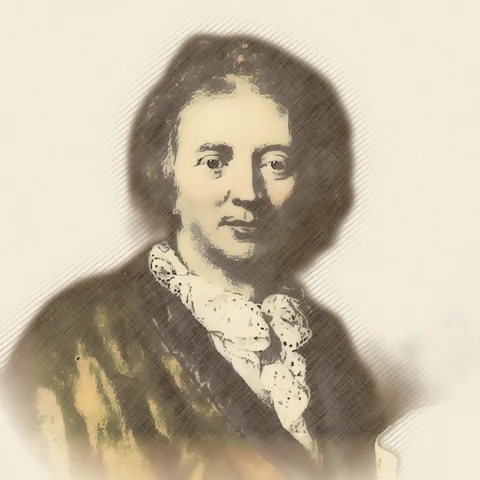 1668 – 1733Baroque
François Couperin
A French court harpsichordist, he blended French elegance and Italian influences.
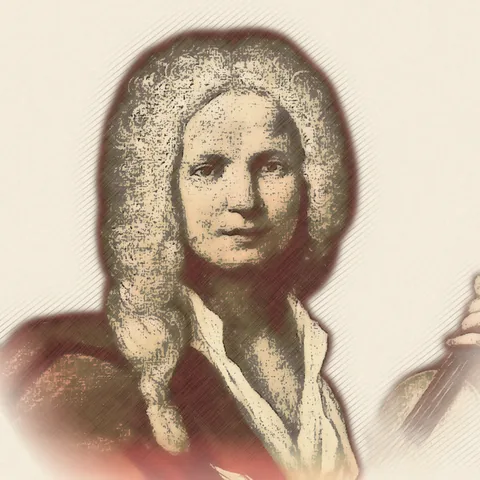 1678 – 1741Baroque
Antonio Vivaldi
A Venetian violinist and priest, he reshaped the concerto through contrast and virtuosity.
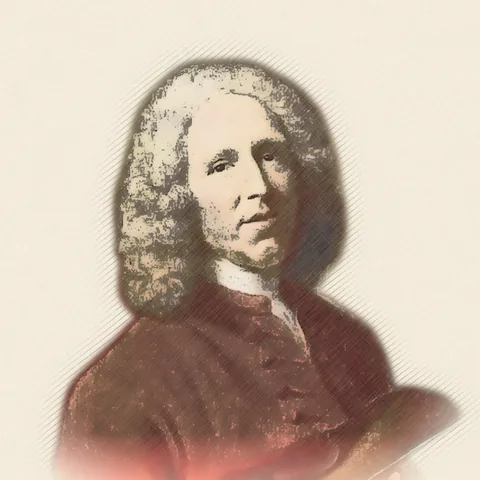 1683 – 1764Baroque
Jean-Philippe Rameau
A harmony theorist and man of the theatre, he brought bold colors to French orchestration.
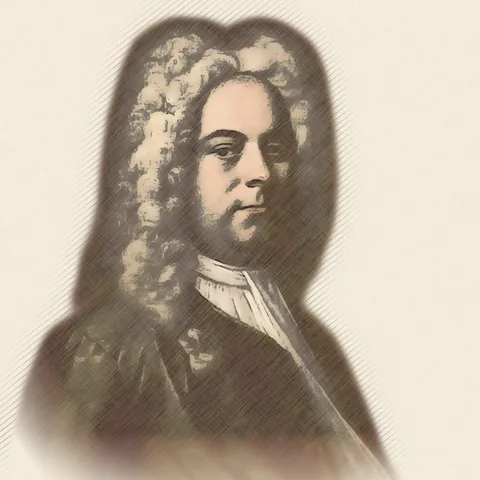 1685 – 1759Baroque
Georg Friedrich Haendel
Born in Germany and active in London, he excelled in oratorio and public spectacle.
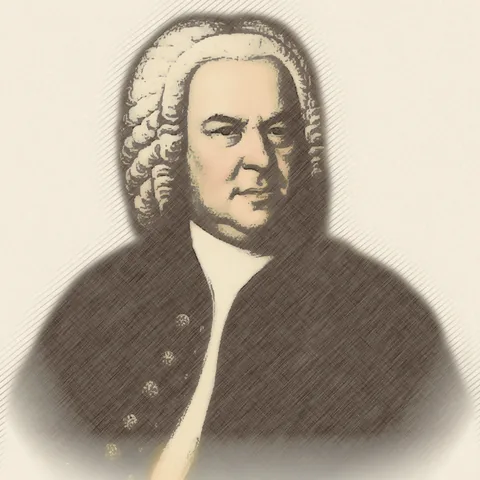 1685 – 1750Baroque
Johann Sebastian Bach
An organist and master of counterpoint, he built musical structures of exceptional depth.