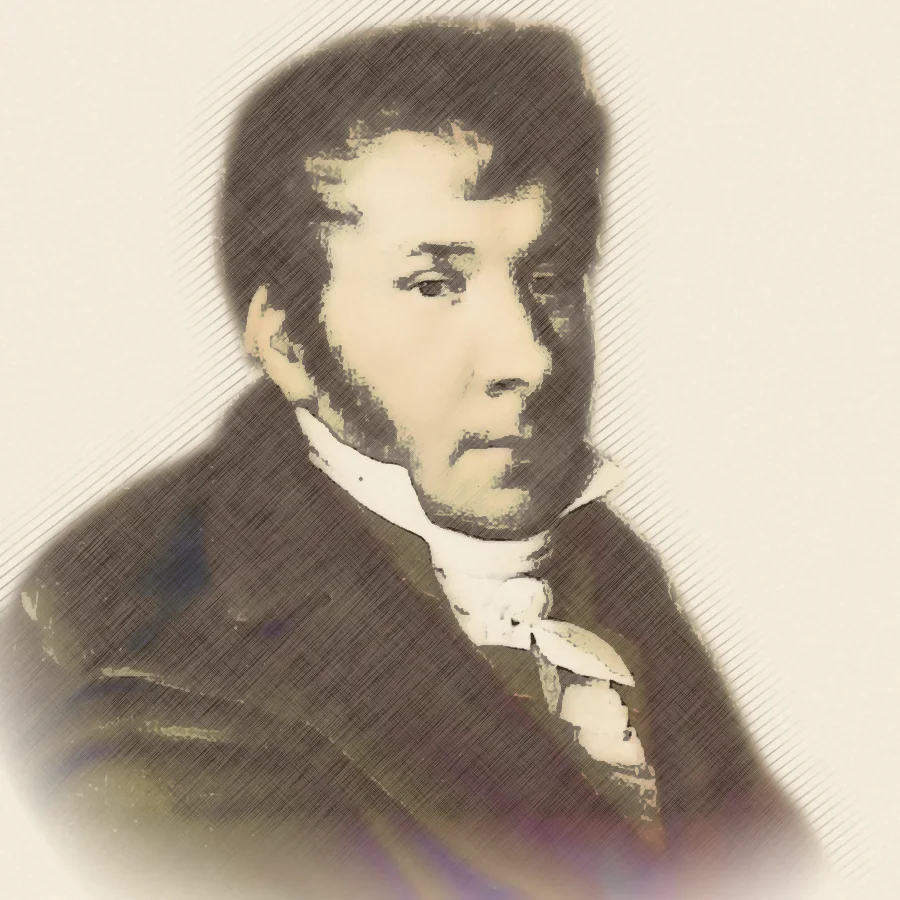
 Classical to Romantic
Johann Nepomuk Hummel
A pianist and composer bridging Viennese classicism and Romantic virtuosity.
A life and its times
The milestones of the life and work, the contemporaries and the major world events, on a single line of time.
A life at a glance
- 1778Birth
Born in Pressburg (Bratislava) on 14 November
- 1778Meanwhile
La Scala opera house opens in Milan
- 1783Meanwhile
First manned flight in a hot-air balloon
- 1786Trainingage 8
Lives for two years with Mozart in Vienna, who teaches him for free
- 1788Journeyage 10
European tour as a child prodigy; lessons with Clementi in London
- 1793Trainingage 15
Back in Vienna, studies with Albrechtsberger, Salieri and Haydn
- 1795Meanwhile
The Paris Conservatoire is founded
- 1803Workage 25
Trumpet Concerto in E major
- 1804Careerage 26
Konzertmeister to the Esterházy princes in Eisenstadt
- 1804Meanwhile
Napoleon crowned emperor
- 1813Private lifeage 35
Marries the singer Elisabeth Röckel
- 1815Meanwhile
Battle of Waterloo
- 1816Careerage 38
Kapellmeister in Stuttgart
- 1816Meanwhile
Maelzel patents the metronome (1815–16)
- 1819Careerage 41
Kapellmeister in Weimar, friend of Goethe
- 1822Meanwhile
Champollion deciphers hieroglyphs
- 1827Private lifeage 49
At Beethoven’s deathbed
- 1828Workage 50
Comprehensive piano method
- 1830Meanwhile
July Revolution in France
- 1837Deathage 59
Dies in Weimar on 17 October
Listen
Excerpts from freely licensed recordings, with their performers and licences.
Johann Nepomuk Hummel’s music is in the public domain, but Wikimedia Commons does not yet offer a freely licensed recording of these works. The links below lead to scores and searches on Commons; as soon as a free recording is published, it can be added here.
Listen to complete works on Wikimedia Commons
Wikimedia Commons is a free media library: you will find the complete recordings there, with their reuse conditions.
- Search for the workTrumpet Concerto
- Search for the workPiano Concerto in A minor
- Search for the workSeptet in D minor
- Search for the workPiano Quintet in E-flat minor
- Search for the workPiano Method
- ScoresScores by Johann Nepomuk Hummel on Wikimedia Commons
- Everything on CommonsAll recordings of Johann Nepomuk Hummel
The life of Johann Nepomuk Hummel
Johann Nepomuk Hummel was born on 14 November 1778 in Pressburg, today’s Bratislava, then a city in the Kingdom of Hungary. His father, Johannes, was a music master who became musical director of a Vienna theatre, where the family moved in 1786. A child prodigy, Johann played the piano from the age of four. Mozart heard him and, impressed, took him into his home as a pupil: for two years the boy lived with the Mozart family and received free lessons from the master.
In 1788 his father took him on a grand concert tour across Europe: Germany, Denmark, Scotland, England and the Netherlands. In London he studied with Muzio Clementi and played for Haydn, who reportedly dedicated a sonata to him. Back in Vienna in 1793 because of the war with revolutionary France, he completed his training with the best masters: counterpoint with Albrechtsberger, singing and opera with Salieri and organ with Haydn. His fellow student was Beethoven, with whom he had a friendship of admiration and rivalry.
In the 1790s Hummel made a name in Vienna as a teacher and pianist. His elegant, clear, brilliant playing was much admired, and many preferred it to Beethoven’s more powerful and tempestuous style. In 1803 he composed the Trumpet Concerto in E major for the trumpeter Anton Weidinger, inventor of a keyed trumpet able to play every note of the scale. This concerto is now one of the most performed in the trumpet repertoire.
In 1804, on the recommendation of the ageing Haydn, he became Konzertmeister to the Esterházy princes at Eisenstadt, in effect running the music in his master’s place. He composed sacred music, operas and ballets. But he sometimes neglected his duties, and Prince Nikolaus II dismissed him in 1811. Hummel returned to Vienna, where in 1813 he married the singer Elisabeth Röckel, sister of a friend of Beethoven’s.
In 1816 he became Kapellmeister in Stuttgart and in 1819 in Weimar, where he stayed until his death. Weimar was then the intellectual centre of Germany, and Hummel became a friend of Goethe. He directed the court orchestra and opera and every year undertook major concert tours: Russia, Paris, London, Poland. He was regarded as one of the greatest pianists in Europe, and his improvisations were legendary.
In 1827, learning that Beethoven was dying, he travelled to Vienna with his wife and his pupil Ferdinand Hiller to see him one last time. At the funeral he was one of the pallbearers, and he improvised at a memorial concert. In 1828 he published a large, highly detailed three-volume Piano Method, which was very successful and helped establish modern fingering. He also campaigned for composers’ copyright.
Hummel died in Weimar on 17 October 1837. In his lifetime he was one of the most famous composers in Europe; his piano concertos, his Septet and his Piano Quintet in E flat minor — with the same scoring as Schubert’s “Trout” — were admired. His brilliant style directly influenced Chopin, Schumann and Liszt. Forgotten after his death, overshadowed by Beethoven, he is now being rediscovered as a master of the transition from Classicism to Romanticism.
Works to know
- 1802
Piano Quintet in E-flat minor
With double bass — a line-up that would inspire Schubert’s ‘Trout’.
Listen on Wikimedia Commons - 1803
Trumpet Concerto
A cornerstone of the trumpet repertoire.
Listen on Wikimedia Commons - 1819
Septet in D minor
Brilliant chamber music with piano.
Listen on Wikimedia Commons - 1821
Piano Concerto in A minor
Brilliant virtuosity that anticipates Chopin.
Listen on Wikimedia Commons - 1828
Piano Method
A widely used teaching work.
Listen on Wikimedia Commons
Anecdotes
He was a pupil of Mozart, Clementi, Salieri and Haydn!
His concerto was written for a new kind of trumpet fitted with keys.
As a child he lived for two years at Mozart’s home, receiving free lessons.
He was one of Beethoven’s pallbearers.