 Baroque
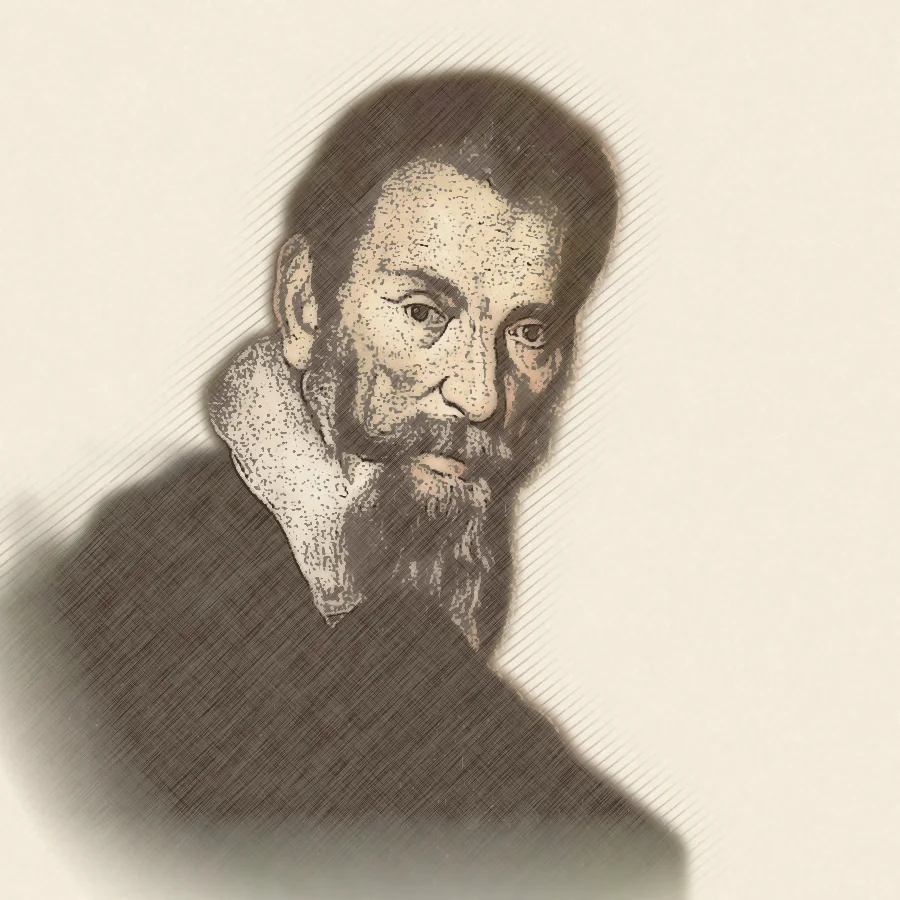
Claudio Monteverdi
Bridging Renaissance and Baroque, he made dramatic emotion central to music.
A life and its times
The milestones of the life and work, the contemporaries and the major world events, on a single line of time.
A life at a glance
- 1567Birth
Born in Cremona; baptised on 15 May
- 1572Meanwhile
St Bartholomew’s Day massacre
- 1582Workage 15
Publishes his first collection at 15
- 1588Meanwhile
Defeat of the Spanish Armada
- 1590Careerage 23
Viol player at the Gonzaga court in Mantua
- 1598Meanwhile
Edict of Nantes
- 1599Private lifeage 32
Marries the singer Claudia Cattaneo
- 1600Landmarkage 33
The theorist Artusi attacks his dissonances
- 1601Careerage 34
Chapel master to the Duke of Mantua
- 1605Workage 38
Fifth Book of Madrigals: he defends the ‘seconda pratica’
- 1607Workage 40
L’Orfeo, premiered in Mantua on 24 February
- 1609Meanwhile
Galileo observes the sky with his telescope
- 1610Workage 43
Vespers of the Blessed Virgin
- 1613Careerage 46
Chapel master of St Mark’s Basilica, Venice
- 1618Meanwhile
The Thirty Years’ War begins
- 1620Meanwhile
The Mayflower reaches America
- 1624Workage 57
The Combat of Tancredi and Clorinda
- 1632Careerage 65
Ordained a priest
- 1637Landmarkage 70
Venice opens the first public, paying opera house
- 1637Meanwhile
The first public opera house opens in Venice
- 1643Workage 76
The Coronation of Poppea
- 1643Deathage 76
Dies in Venice on 29 November
- 1643Meanwhile
Louis XIV becomes King of France aged four
Listen
Excerpts from freely licensed recordings, with their performers and licences.
Excerpts last up to 90 seconds. Claudio Monteverdi’s compositions are in the public domain; each recording is streamed from Wikimedia Commons under the licence shown, credited to its performers or uploader.
Listen to complete works on Wikimedia Commons
Wikimedia Commons is a free media library: you will find the complete recordings there, with their reuse conditions.
- Complete recordingL’Orfeo — opening Toccata
- Complete recordingLamento della ninfa
- Complete recordingCombattimento di Tancredi e Clorinda — battle music
- Complete recordingCruda Amarilli (madrigal)
- Search for the workL’Orfeo
- Search for the workVespers of 1610
- Search for the workThe Coronation of Poppea
- Search for the workLament of Ariadne
- Search for the workCombat of Tancredi and Clorinda
- Search for the workMadrigals of War and Love
- Everything on CommonsAll recordings of Claudio Monteverdi
The life of Claudio Monteverdi
Claudio Monteverdi was baptised on 15 May 1567 in Cremona, Lombardy, a city famous for its violin-makers. The eldest son of a barber-surgeon, he studied music with Marc’Antonio Ingegneri, choirmaster of the cathedral. Very precocious, he published in 1582, aged fifteen, a collection of little three-voice motets, then spiritual madrigals and, in 1587, his first book of secular madrigals.
Around 1590 he entered the service of Duke Vincenzo I Gonzaga in Mantua, one of the most lavish courts in Italy, as a viol player and singer. He accompanied the duke on military campaigns in Hungary in 1595 and in Flanders in 1599. That same year he married the court singer Claudia Cattaneo, with whom he had two sons and a daughter. In 1601 he became the duke’s master of music. But the work was exhausting and his salary often paid late.
His madrigals caused a scandal. In 1600 the Bolognese theorist Giovanni Maria Artusi published a pamphlet attacking passages by Monteverdi, still unpublished at the time, which he judged full of incorrect dissonances. Monteverdi replied in the preface to his Fifth Book of Madrigals (1605): there is, he said, a “second practice” in which “the words are the mistress of the harmony and not its servant”. Dissonance became a means of expressing the passions. This quarrel symbolically marks the passage from Renaissance to Baroque.
In 1607 he premiered L’Orfeo in Mantua, to a libretto by Alessandro Striggio, performed on 24 February before the Accademia degli Invaghiti. It was not the first opera, but it was the first masterpiece of the genre: Monteverdi brought together expressive recitative, arias, choruses, dances and a richly coloured orchestra to tell the story of the poet who goes down to the Underworld to fetch his wife Eurydice. That same year his own wife Claudia died, leaving him devastated. The following year he composed L’Arianna, of which only the heartbreaking Lamento d’Arianna survives.
In 1610 he published the Vespers of the Blessed Virgin, a monument of sacred music combining the old polyphonic style with the new concertato style, perhaps to obtain a post in Rome. After Duke Vincenzo died in 1612, his successor dismissed him. But in 1613 he obtained one of the most prestigious posts in Europe: maestro di cappella of St Mark’s Basilica in Venice. He stayed there for thirty years, reorganising the basilica’s music and composing for the Republic’s great festivals.
In Venice he kept innovating. In the Combat of Tancredi and Clorinda (1624) he invented the “stile concitato”, the agitated style, with rapidly repeated string notes imitating galloping horses and clashing swords; it also contains one of the first uses of pizzicato. In 1638 he published his Madrigals of War and Love. In 1630–31 plague ravaged Venice; Monteverdi survived and in 1632 was ordained priest.
In 1637 Venice opened the world’s first public, paying opera house, the Teatro San Cassiano: opera was no longer reserved for princely courts. Monteverdi, in his seventies, wrote for this new public The Return of Ulysses to his Homeland (1640) and The Coronation of Poppea (1643), of astonishing psychological realism. He died in Venice on 29 November 1643 and lies in the basilica of the Frari. He is regarded as the father of modern opera and one of the great figures in the history of music.
Works to know
- 1607
L’Orfeo
The first great masterpiece in the history of opera.
Listen on Wikimedia Commons - 1608
Lament of Ariadne
The only surviving fragment of L’Arianna, which moved audiences to tears.
Listen on Wikimedia Commons - 1610
Vespers of 1610
Spectacular sacred fresco for voices and instruments.
Listen on Wikimedia Commons - 1624
Combat of Tancredi and Clorinda
Sung duel in which strings imitate horses and swords.
Listen on Wikimedia Commons - 1638
Madrigals of War and Love
Eighth book, including the Lamento della ninfa.
Listen on Wikimedia Commons - 1643
The Coronation of Poppea
Opera of love and ambition at Nero’s court.
Listen on Wikimedia Commons
Anecdotes
L’Orfeo opens with a trumpet fanfare, one of the oldest known opera overtures.
He invented the string tremolo to depict anger and combat.
In the Combat of Tancredi and Clorinda he asked the strings to pluck with their fingers: one of the first pizzicatos in history.
Of his opera L’Arianna only one piece survives, the Lament, which became famous throughout Europe.
Same era · Baroque
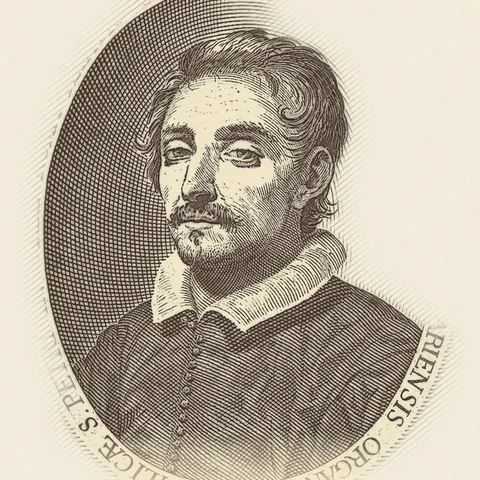 1583 – 1643Baroque
Girolamo Frescobaldi
A Roman organist who transformed keyboard writing and the art of variation.
 1585 – 1672Baroque
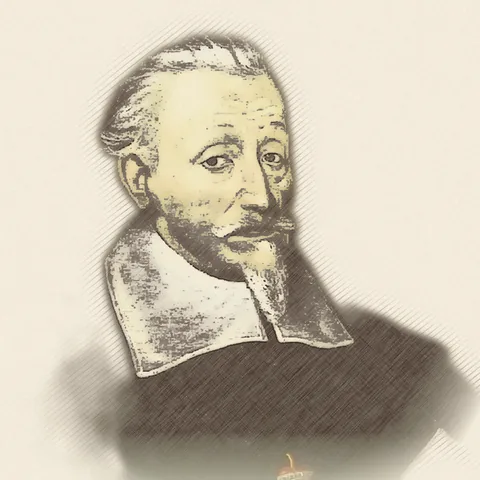
Heinrich Schütz
He brought Italian expressive innovations to German sacred music.
 1587 – c. 1641Baroque
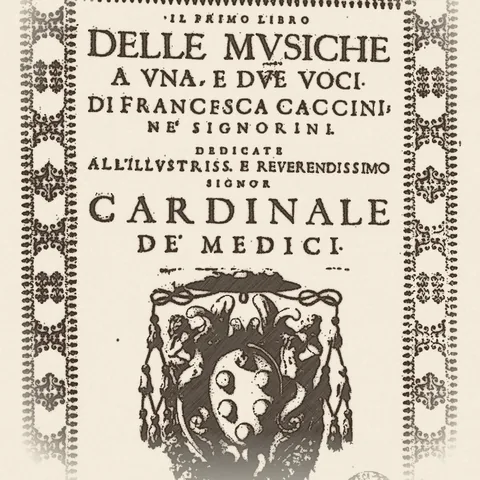
Francesca Caccini
A Medici court musician, she was a pioneer of early Italian musical theatre.
 1619 – 1677Baroque
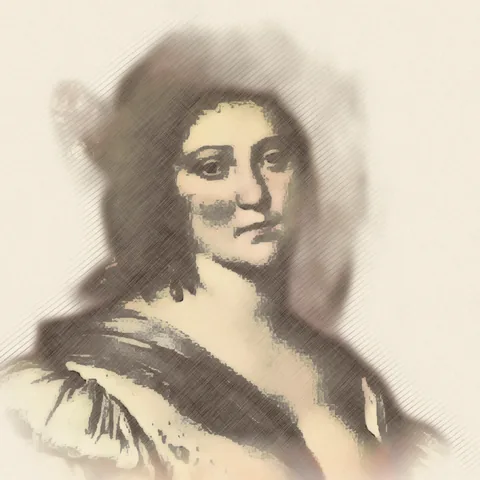
Barbara Strozzi
A Venetian singer and composer who published extensive vocal collections under her own name.
 1632 – 1687Baroque
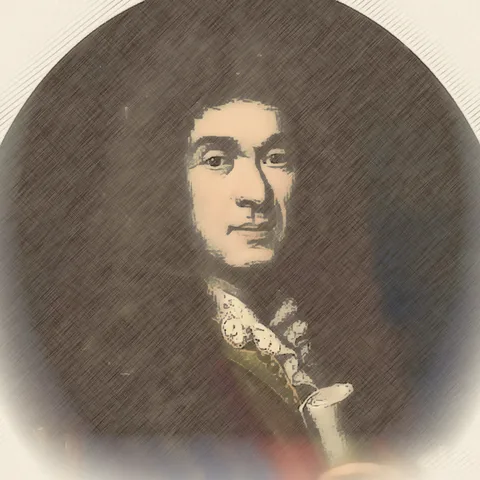
Jean-Baptiste Lully
At Louis XIV's court, he shaped French opera and ballet music.
 1643 – 1704Baroque
Marc-Antoine Charpentier
A French composer of sacred and theatre music, he mastered Italian style.