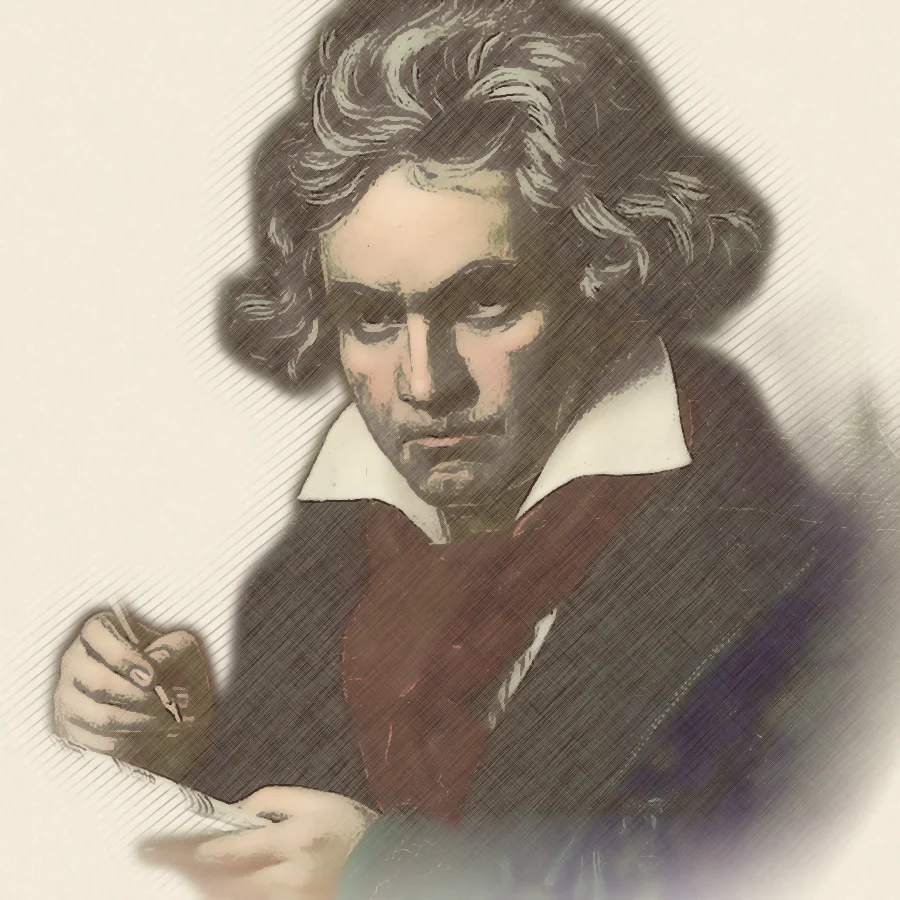
 Classical to Romantic
Ludwig van Beethoven
He expanded classical forms and made music a powerful personal dramatic statement.
A life and its times
The milestones of the life and work, the contemporaries and the major world events, on a single line of time.
A life at a glance
- 1770Birth
Born in Bonn; baptised on 17 December
- 1776Meanwhile
United States Declaration of Independence
- 1778Careerage 8
First public concert at 7 in Cologne
- 1778Meanwhile
La Scala opera house opens in Milan
- 1782Careerage 12
Assistant court organist in Bonn; pupil of Neefe
- 1787Journeyage 17
First trip to Vienna; his mother’s death calls him back
- 1789Landmarkage 19
French Revolution
- 1789Meanwhile
Storming of the Bastille: the French Revolution
- 1792Milestoneage 22
Settles in Vienna and studies with Haydn
- 1795Meanwhile
The Paris Conservatoire is founded
- 1798Private lifeage 28
First signs of deafness
- 1801Workage 31
‘Moonlight’ Sonata
- 1802Private lifeage 32
Heiligenstadt Testament
- 1804Workage 34
‘Eroica’ Symphony, first dedicated to Napoleon
- 1804Meanwhile
Napoleon crowned emperor
- 1808Workage 38
Premiere of Symphonies No. 5 and No. 6 ‘Pastoral’
- 1810Workage 40
Für Elise
- 1814Workage 44
Final version of his opera Fidelio
- 1815Meanwhile
Battle of Waterloo
- 1816Meanwhile
Maelzel patents the metronome (1815–16)
- 1818Private lifeage 48
Almost totally deaf: he converses through notebooks
- 1824Workage 54
Premiere of the Ninth Symphony and the Ode to Joy
- 1825Meanwhile
First public passenger railway (England)
- 1826Workage 56
Last string quartets
- 1827Deathage 57
Dies in Vienna on 26 March; thousands attend his funeral
Listen
Excerpts from freely licensed recordings, with their performers and licences.
Excerpts last up to 90 seconds. Ludwig van Beethoven’s compositions are in the public domain; each recording is streamed from Wikimedia Commons under the licence shown, credited to its performers or uploader.
Listen to complete works on Wikimedia Commons
Wikimedia Commons is a free media library: you will find the complete recordings there, with their reuse conditions.
- Complete recordingFür Elise
- Complete recording“Moonlight” Sonata — 1st movement
- Complete recordingSymphony No. 5 — Allegro con brio
- Complete recordingThe Ruins of Athens — Turkish March
- Search for the workSymphony No. 9
- Search for the workSymphony No. 5
- Search for the work‘Moonlight’ Sonata
- Search for the workFür Elise
- Search for the workSymphony No. 6 ‘Pastoral’
- Search for the workPiano Concerto No. 5 ‘Emperor’
- Search for the workFidelio
- Search for the workLate String Quartets
- Everything on CommonsAll recordings of Ludwig van Beethoven
The life of Ludwig van Beethoven
Ludwig van Beethoven was baptised in Bonn on 17 December 1770. His family, of Flemish origin, served the Prince-Elector of Cologne: his grandfather and namesake was Kapellmeister, and his father Johann was a court tenor. Johann, wanting to turn his son into a new Mozart, subjected him to a harsh training in piano and violin, sometimes waking him at night to practise. Ludwig gave his first public concert in Cologne in 1778, at seven.
He found a real teacher in Christian Gottlob Neefe, the court organist, who introduced him to Bach’s Well-Tempered Clavier and published his first works. In 1782 he became assistant organist and later viola player in the court orchestra. In 1787 he went to Vienna, perhaps to study with Mozart, but his mother’s illness called him back to Bonn; she died soon after. As his father sank into alcoholism, Ludwig, at nineteen, had to take charge of his two younger brothers.
In 1792, with the support of Count Waldstein, he settled in Vienna for good to study with Haydn, then with Albrechtsberger and Salieri. He soon became known as a prodigious pianist and improviser with a powerful, passionate style. Princes of the Viennese aristocracy such as Lichnowsky, Lobkowitz and Archduke Rudolf supported him and became his patrons. He published his first trios, sonatas and piano concertos, which caused a sensation.
But around 1798 Beethoven noticed the first signs of a deafness that would steadily worsen. In 1802 at Heiligenstadt near Vienna he wrote a heartbreaking letter to his brothers, the “Heiligenstadt Testament”, confiding his despair but also his resolve to live for his art. He then entered a period of extraordinary creativity: the “Moonlight” Sonata (1801) and the “Eroica” Symphony (1804), which he intended for Napoleon before violently scratching out the dedication when Napoleon proclaimed himself emperor.
On 22 December 1808, at a marathon concert of more than four hours in a freezing theatre, he premiered the Fifth Symphony, with its famous “fate” motif, and the Sixth, the “Pastoral”, which evokes nature and a storm. He also composed the “Emperor” Piano Concerto No. 5, his only opera Fidelio, a hymn to freedom and married love whose final version dates from 1814, and more intimate pieces such as Für Elise. In 1809 three aristocrats pledged him an annuity so that he would stay in Vienna.
From 1818 Beethoven was almost totally deaf and communicated with visitors through “conversation books”. He went through difficult years: poor health, lawsuits to gain guardianship of his nephew Karl, isolation. Yet he composed his boldest works: the last piano sonatas, the Missa solemnis and the Ninth Symphony, premiered on 7 May 1824. For the first time a symphony included singers and a choir, on Schiller’s Ode to Joy. At the end Beethoven, who could not hear the applause, had to be turned to face the audience by a singer.
His late string quartets (1825–26), of astonishing depth and modernity, baffled his contemporaries. He died in Vienna on 26 March 1827, during a thunderstorm. Nearly twenty thousand people attended his funeral; the young Schubert carried a torch. Beethoven bridged Classicism and Romanticism and transformed the image of the composer into that of a free, creative artist. The Ode to Joy has become the anthem of the European Union.
Works to know
- 1801
‘Moonlight’ Sonata
Dreamy, mysterious first movement.
Listen on Wikimedia Commons - 1808
Symphony No. 5
Da-da-da-dum: the most famous motif in music.
Listen on Wikimedia Commons - 1808
Symphony No. 6 ‘Pastoral’
A country walk with storm and birdsong.
Listen on Wikimedia Commons - 1809
Piano Concerto No. 5 ‘Emperor’
Heroic, majestic concerto.
Listen on Wikimedia Commons - 1810
Für Elise
Little piano piece known worldwide.
Listen on Wikimedia Commons - 1814
Fidelio
His only opera: a wife frees her imprisoned husband.
Listen on Wikimedia Commons - 1824
Symphony No. 9
With the Ode to Joy, now the European anthem.
Listen on Wikimedia Commons - 1826
Late String Quartets
Visionary music written by a deaf composer.
Listen on Wikimedia Commons
Anecdotes
To feel the piano’s vibrations, he is said to have held a stick between the instrument and his teeth.
He moved house more than 60 times in Vienna!
He scratched out the dedication of the “Eroica” Symphony to Napoleon so hard that he tore through the paper.
The Ode to Joy from his Ninth Symphony is the anthem of the European Union.