 Late Romantic
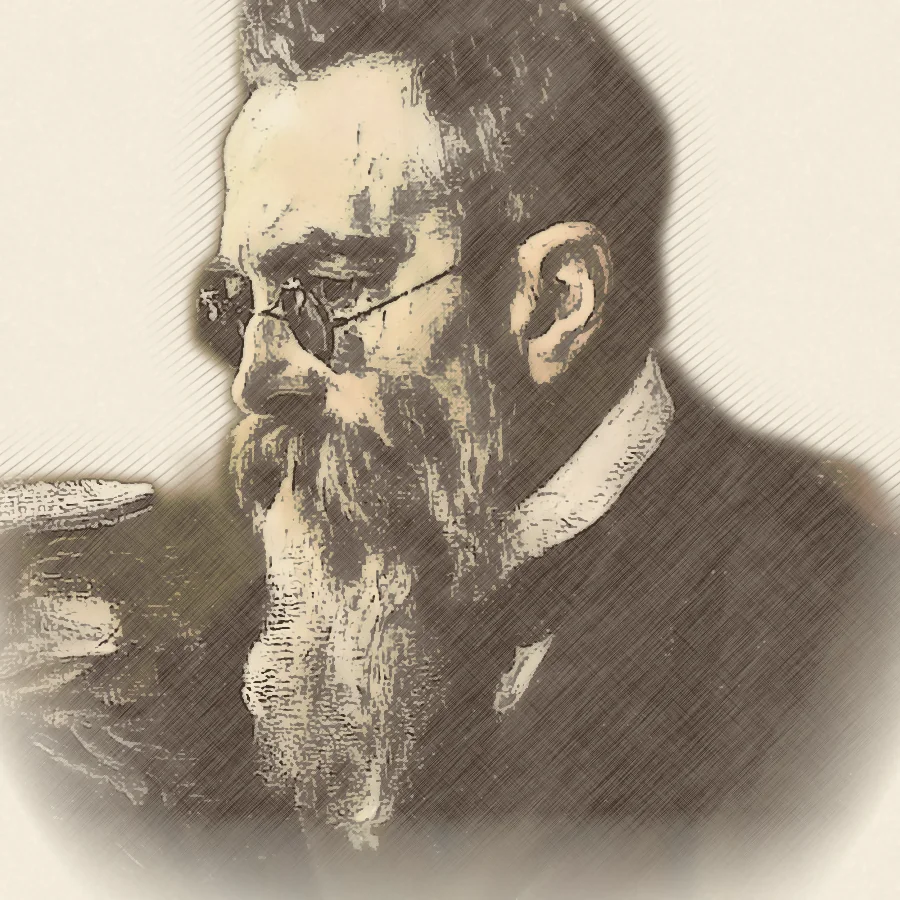
Nikolaï Rimski-Korsakov
A brilliant orchestrator whose sound palette influenced generations.
A life and its times
The milestones of the life and work, the contemporaries and the major world events, on a single line of time.
A life at a glance
- 1844Birth
Born in Tikhvin on 18 March into a noble family
- 1848Meanwhile
Revolutions of 1848; slavery abolished in France
- 1856Trainingage 12
Naval Cadet School in St Petersburg
- 1861Careerage 17
Meets Balakirev and joins ‘The Five’
- 1862Journeyage 18
Nearly three-year voyage around the world on a warship
- 1865Meanwhile
End of the American Civil War; slavery abolished in the USA
- 1869Meanwhile
The Suez Canal opens
- 1871Careerage 27
Professor of composition at the St Petersburg Conservatory
- 1872Private lifeage 28
Marries the pianist Nadezhda Purgold
- 1873Careerage 29
Inspector of Navy bands
- 1875Meanwhile
The Palais Garnier opera house opens in Paris
- 1877Meanwhile
Edison invents the phonograph: sound can be recorded!
- 1887Workage 43
Capriccio espagnol
- 1888Workage 44
Scheherazade and Russian Easter Festival Overture
- 1889Meanwhile
The Eiffel Tower opens for the World’s Fair
- 1895Meanwhile
The Lumière brothers’ first cinema show
- 1900Workage 56
The Tale of Tsar Saltan, with Flight of the Bumblebee
- 1905Careerage 61
Dismissed from the Conservatory for supporting his students
- 1905Meanwhile
Einstein publishes special relativity
- 1907Workage 63
The Golden Cockerel
- 1908Deathage 64
Dies at Lyubensk on 21 June
Listen
Excerpts from freely licensed recordings, with their performers and licences.
Excerpts last up to 90 seconds. Nikolaï Rimski-Korsakov’s compositions are in the public domain; each recording is streamed from Wikimedia Commons under the licence shown, credited to its performers or uploader.
Listen to complete works on Wikimedia Commons
Wikimedia Commons is a free media library: you will find the complete recordings there, with their reuse conditions.
- Complete recordingFlight of the Bumblebee
- Complete recordingScheherazade — The Sea and Sinbad’s Ship
- Complete recordingSadko — Song of India (violin, 1929)
- Search for the workScheherazade
- Search for the workFlight of the Bumblebee
- Search for the workCapriccio espagnol
- Search for the workRussian Easter Festival Overture
- Search for the workThe Golden Cockerel
- Search for the workSadko
- Everything on CommonsAll recordings of Nikolaï Rimski-Korsakov
The life of Nikolaï Rimski-Korsakov
Nikolai Rimsky-Korsakov was born on 18 March 1844 in Tikhvin, a small town north-east of St Petersburg, into a noble family with several naval officers. As a child he showed remarkable musical talent and took piano lessons, but above all he dreamed of the sea, inspired by his elder brother Voin, a naval officer. In 1856, aged twelve, he entered the Naval College in St Petersburg. During his studies he went to the opera and discovered Glinka, the father of Russian music.
In 1861 his piano teacher introduced him to the composer Mily Balakirev, who became his mentor and brought him into his circle of young composers, the future “Five”, with César Cui, Mussorgsky and later Borodin. Balakirev encouraged him to write a symphony. But in 1862 Rimsky-Korsakov had to embark as an officer on the clipper Almaz for a cruise of nearly three years: England, the United States, Brazil, the Mediterranean. He kept composing during his stopovers. When he returned in 1865, his Symphony No. 1 was premiered under Balakirev.
He remained a naval officer but composed more and more: the symphonic picture Sadko (1867), the symphony Antar (1868), inspired by an Arabian tale, and the opera The Maid of Pskov (1873). In 1871, to his great surprise, he was appointed professor of composition and orchestration at the St Petersburg Conservatory, though he admitted he had not mastered classical harmony. He then studied relentlessly, learning as he taught, and became a master of technique.
In 1872 he married Nadezhda Purgold, a pianist and composer who helped him in his work. From 1873 to 1884 he was inspector of the Russian Navy bands, a post that gave him a thorough knowledge of wind instruments. He taught at the Conservatory for nearly forty years and trained more than two hundred pupils, including Glazunov, Lyadov, Respighi, Prokofiev and Igor Stravinsky, whom he taught privately.
Rimsky-Korsakov was a master of the orchestra, renowned for his dazzling colours. In 1887–88 he composed three orchestral works that are among his most famous: Capriccio espagnol, the Russian Easter Festival Overture and above all Scheherazade, inspired by the Thousand and One Nights. The solo violin represents the storyteller Scheherazade, who tells the sultan marvellous tales to escape death: the sea and Sinbad’s ship, the Kalender prince, the young prince and princess, the festival at Baghdad.
After the deaths of Mussorgsky and Borodin he spent many years completing and revising their works, notably Prince Igor and Boris Godunov, to make them known. He composed mainly operas based on Russian tales and legends: The Snow Maiden (1882), Sadko (1898), The Tale of Tsar Saltan (1900), from which comes the famous Flight of the Bumblebee, in which the prince, turned into an insect, buzzes around his enemies. He also wrote a major treatise, Principles of Orchestration.
In 1905, during the first Russian revolution, he defended his striking students and criticised the Conservatory’s management: he was dismissed, causing a scandal and the resignation of several professors. He was reinstated soon after. His last opera, The Golden Cockerel (1907), a satire on a ridiculous tsar, was banned by the censors. He never saw it staged: he died on 21 June 1908 at his estate at Lyubensk near Luga. Rimsky-Korsakov had coloured hearing: for him each key evoked a colour.
Works to know
- 1887
Capriccio espagnol
Colourful Spanish fiesta.
Listen on Wikimedia Commons - 1888
Scheherazade
Tales of the Arabian Nights, told by a solo violin.
Listen on Wikimedia Commons - 1888
Russian Easter Festival Overture
Bells and Orthodox chant.
Listen on Wikimedia Commons - 1898
Sadko
Legend-opera with the Song of India.
Listen on Wikimedia Commons - 1900
Flight of the Bumblebee
A furious bumblebee in a whirlwind of notes.
Listen on Wikimedia Commons - 1907
The Golden Cockerel
Satirical opera, at first censored.
Listen on Wikimedia Commons
Anecdotes
He saw colours when he heard keys — for him C major was white!
He was the teacher of Stravinsky and Prokofiev.
He made a voyage of nearly three years around the world as a naval officer.
In Scheherazade a solo violin plays the storyteller of the Thousand and One Nights.
Same era · Late Romantic
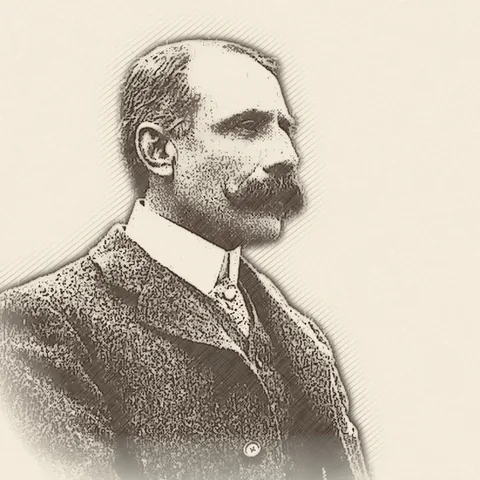 1857 – 1934Late Romantic
Edward Elgar
An English composer combining orchestral grandeur and intimate lyricism.
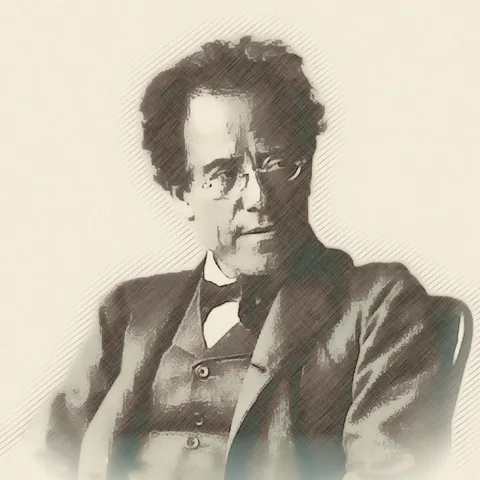 1860 – 1911Late Romantic
Gustav Mahler
His vast symphonies confront nature, irony, love and existential questions.
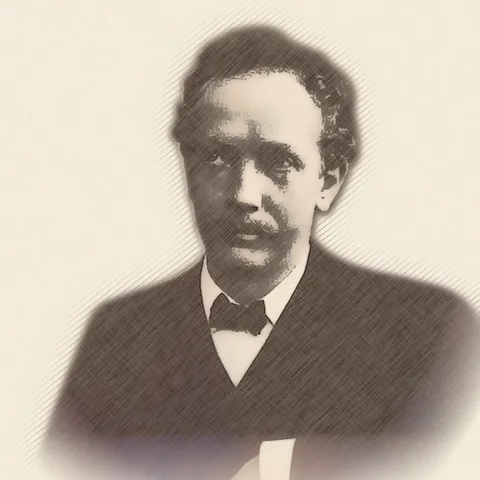 1864 – 1949Late Romantic
Richard Strauss
He pushed Romantic orchestration toward extraordinary richness and contrast.
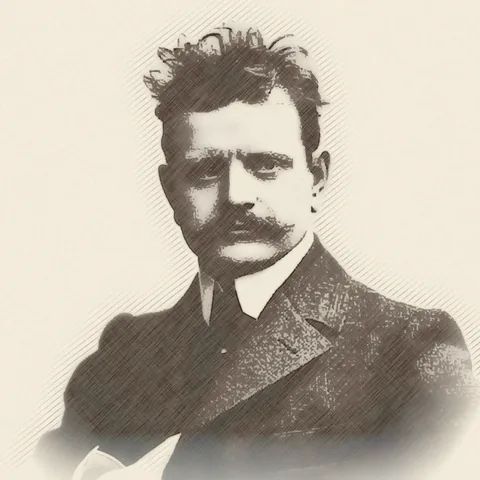 1865 – 1957Late Romantic
Jean Sibelius
He composed organic forms inspired by Finnish landscapes and culture.
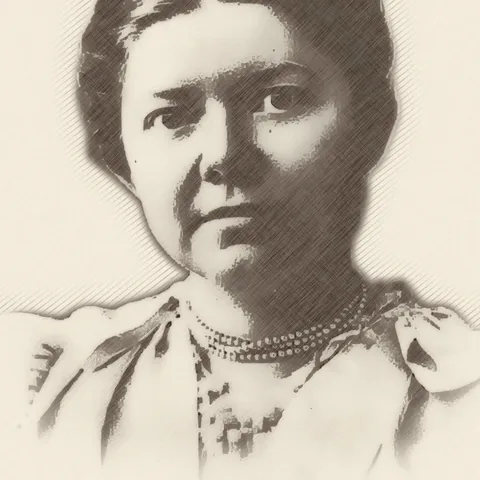 1867 – 1944Late Romantic
Amy Beach
An American pianist and composer who excelled in symphonic and chamber music.
 1872 – 1958Late Romantic
Ralph Vaughan Williams
An English composer inspired by folk songs and choral tradition.