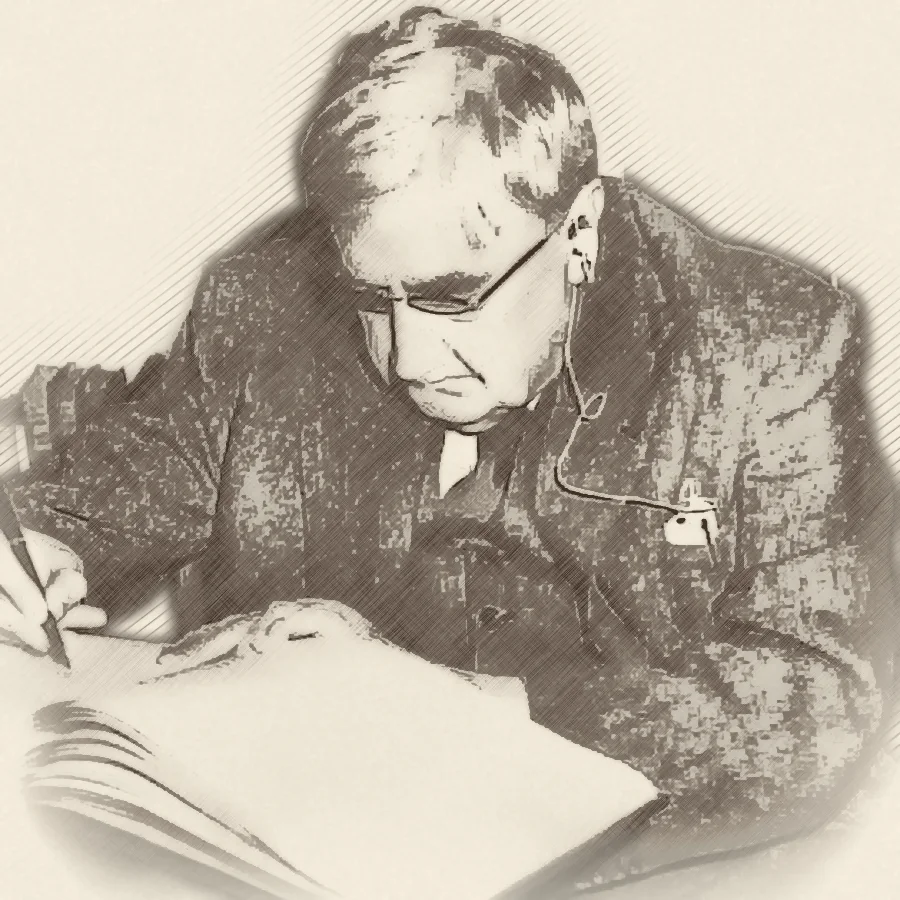
 Late Romantic
Ralph Vaughan Williams
An English composer inspired by folk songs and choral tradition.
A life and its times
The milestones of the life and work, the contemporaries and the major world events, on a single line of time.
A life at a glance
- 1872Birth
Born in Down Ampney on 12 October, son of a vicar
- 1875Private lifeage 3
Death of his father; grows up with his grandparents, relatives of Darwin
- 1875Meanwhile
The Palais Garnier opera house opens in Paris
- 1877Meanwhile
Edison invents the phonograph: sound can be recorded!
- 1890Trainingage 18
Royal College of Music, then Cambridge
- 1897Private lifeage 25
Marries Adeline Fisher; studies with Max Bruch in Berlin
- 1903Workage 31
Begins collecting English folk songs
- 1903Meanwhile
First powered aeroplane flight (Wright brothers)
- 1906Workage 34
Edits The English Hymnal
- 1908Trainingage 36
Lessons with Ravel in Paris
- 1910Workage 38
Fantasia on a Theme by Thomas Tallis; A Sea Symphony
- 1912Meanwhile
The Titanic sinks
- 1914Careerage 42
Volunteers at 41 as an ambulance orderly, later an artillery officer
- 1918Meanwhile
End of the First World War
- 1921Workage 49
Premiere of The Lark Ascending
- 1929Meanwhile
Wall Street Crash
- 1934Workage 62
Fantasia on Greensleeves
- 1945Meanwhile
End of the Second World War; United Nations founded
- 1948Workage 76
Score for the film Scott of the Antarctic
- 1948Meanwhile
The long-playing record (LP) goes on sale
- 1958Workage 86
Symphony No. 9
- 1958Deathage 86
Dies in London on 26 August; buried in Westminster Abbey
Listen
Excerpts from freely licensed recordings, with their performers and licences.
Ralph Vaughan Williams’s music is still protected by copyright: to respect the rights holders, no excerpt is hosted here. You can hear it on the radio, in concert or on licensed streaming platforms.
Listen to complete works on Wikimedia Commons
Wikimedia Commons is a free media library: you will find the complete recordings there, with their reuse conditions.
The life of Ralph Vaughan Williams
Ralph Vaughan Williams was born on 12 October 1872 at Down Ampney, a village in Gloucestershire where his father was vicar. He pronounced his first name “Rafe”, the old way. When his father died in 1875 his mother took him to live with her parents at Leith Hill Place in Surrey. He belonged to a brilliant family: his mother was a Wedgwood, of the famous pottery family, and the naturalist Charles Darwin was his great-uncle. An aunt gave him his first piano and theory lessons, and he learned violin and then viola.
After school at Charterhouse he entered the Royal College of Music in London in 1890, studying with Hubert Parry, then went to Cambridge University, where he took degrees in music and history. He then returned to the Royal College of Music to study with Charles Villiers Stanford and formed a deep friendship with the composer Gustav Holst, with whom he exchanged advice and criticism all his life. In 1897 he married Adeline Fisher and went to study for a few months in Berlin with Max Bruch.
Vaughan Williams was at first a slow developer who doubted himself. In 1903 he discovered the riches of English folk song, passed down orally in the countryside and in danger of disappearing. He travelled through villages with a notebook and later a phonograph, collecting more than eight hundred songs from old farmworkers, shepherds and fishermen. This ancient music, based on old modes, transformed his style. From 1904 to 1906 he edited The English Hymnal, a collection of hymns for the Church of England in which he adapted many folk melodies.
In 1908, aged thirty-five and dissatisfied with his technique, he went to Paris to take orchestration lessons from Maurice Ravel, three years his junior. Ravel taught him lightness and colour, and the two became friends. In 1910 he premiered the Fantasia on a Theme by Thomas Tallis for double string orchestra, inspired by a psalm tune by the Renaissance composer, a work of mystical beauty that made him famous. That same year A Sea Symphony, on poems by Walt Whitman, was premiered in Leeds.
When the First World War broke out he volunteered at forty-one as a stretcher-bearer in the medical corps in France and Greece, later becoming an artillery officer. The experience of the front, where he lost many friends including the young composer George Butterworth, marked him deeply; the noise of the guns left him partly deaf. His Symphony No. 3, the “Pastoral” (1922), a serene yet sorrowful meditation, was partly inspired by the landscapes of France during the war.
After the war he taught composition at the Royal College of Music and conducted the Bach Choir. In 1921 he premiered The Lark Ascending, a romance for violin and orchestra inspired by a poem by George Meredith, in which the violin imitates the lark rising into the sky: it is now one of the British public’s favourite works. He composed nine symphonies, operas, choral music, the Fantasia on Greensleeves (1934), drawn from his opera Sir John in Love, and in 1948 the score for the film Scott of the Antarctic, which became the Sinfonia antartica (1952).
He refused a knighthood but accepted the Order of Merit in 1935. After Adeline’s death in 1951 he married the poet Ursula Wood in 1953. He remained active to the end, travelling to the United States past the age of eighty and composing his Ninth Symphony at eighty-five. He died in London on 26 August 1958. His ashes lie in Westminster Abbey, near those of Purcell. He is regarded as the father of the twentieth-century renaissance of English music.
Works to know
- 1910
Fantasia on a Theme by Thomas Tallis
Sumptuous strings inspired by the Renaissance.
- 1910
A Sea Symphony
Choral symphony on poems by Walt Whitman.
- 1914
The Lark Ascending
The violin imitates a lark soaring.
- 1934
Fantasia on Greensleeves
On a famous old English tune.
- 1943
Symphony No. 5
Luminous symphony written in wartime.
- 1952
Sinfonia antartica
Ice, wind and penguins, from his film score.
Anecdotes
He was a distant relative of Charles Darwin.
He composed his Ninth Symphony at 85.
He collected more than eight hundred folk songs from shepherds, farmers and fishermen.
At thirty-five he went to take orchestration lessons from Ravel, who was younger than him.
Same era · Late Romantic
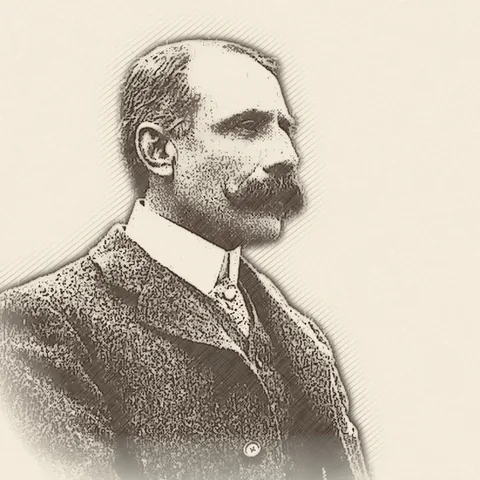 1857 – 1934Late Romantic
Edward Elgar
An English composer combining orchestral grandeur and intimate lyricism.
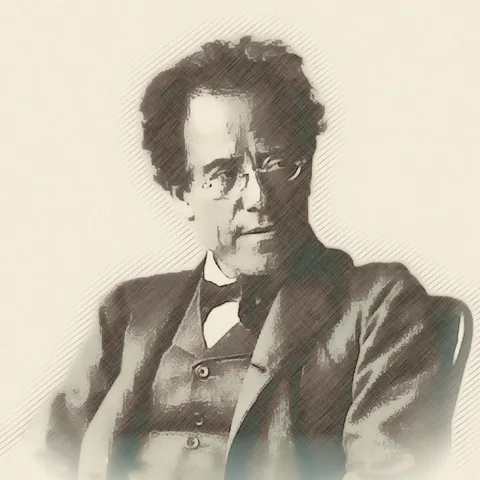 1860 – 1911Late Romantic
Gustav Mahler
His vast symphonies confront nature, irony, love and existential questions.
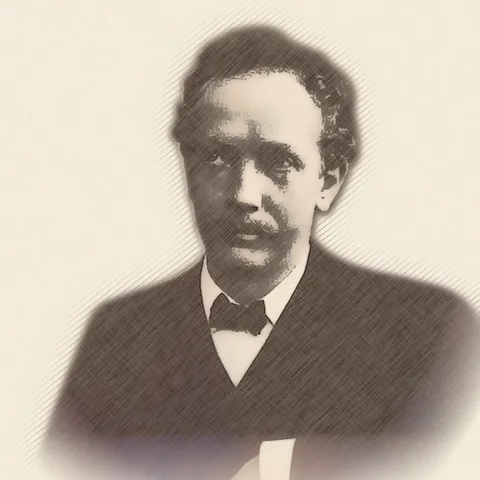 1864 – 1949Late Romantic
Richard Strauss
He pushed Romantic orchestration toward extraordinary richness and contrast.
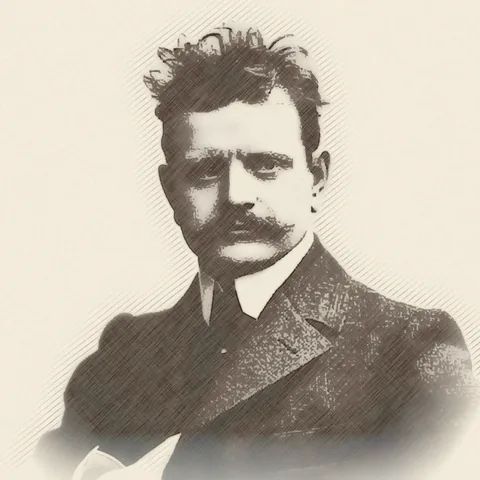 1865 – 1957Late Romantic
Jean Sibelius
He composed organic forms inspired by Finnish landscapes and culture.
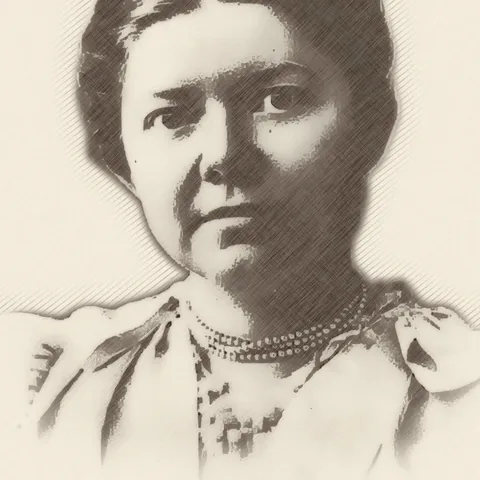 1867 – 1944Late Romantic
Amy Beach
An American pianist and composer who excelled in symphonic and chamber music.
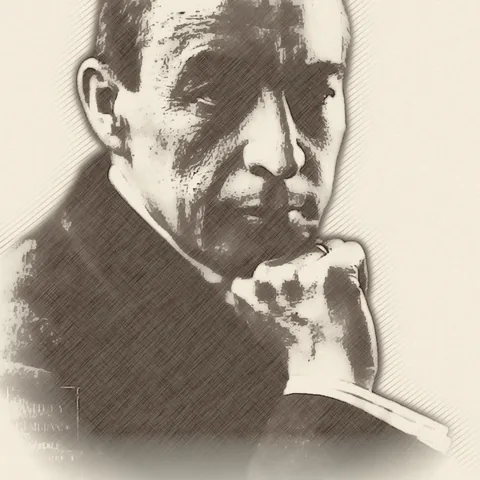 1873 – 1943Late Romantic
Sergueï Rachmaninov
A virtuoso pianist, he carried Russian lyric Romanticism into the twentieth century.