 Romantic
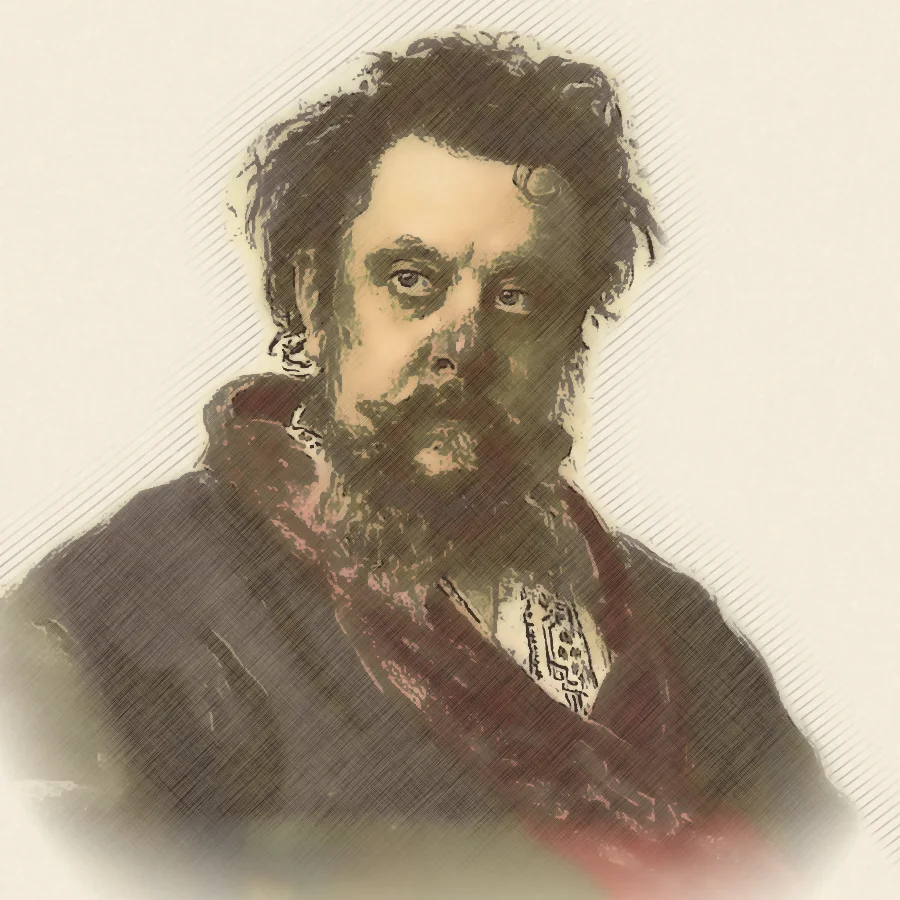
Modeste Moussorgski
A member of The Five, he sought an original dramatic and vocal language.
A life and its times
The milestones of the life and work, the contemporaries and the major world events, on a single line of time.
A life at a glance
- 1839Birth
Born in Karevo on 21 March into a landowning family
- 1839Meanwhile
Photography is invented (daguerreotype)
- 1840Meanwhile
Adolphe Sax invents the saxophone (c. 1840)
- 1846Trainingage 7
Learns piano from his mother; loves his nanny’s folk tales
- 1848Meanwhile
Revolutions of 1848; slavery abolished in France
- 1852Trainingage 13
Cadet School of the Guards in St Petersburg
- 1856Careerage 17
Officer in the Preobrazhensky Regiment; meets Borodin
- 1857Careerage 18
Meets Balakirev and joins the future ‘Five’
- 1858Careerage 19
Leaves the army for music
- 1859Meanwhile
Darwin publishes On the Origin of Species
- 1861Landmarkage 22
Abolition of serfdom in Russia; his family is ruined
- 1867Workage 28
St John’s Night on the Bare Mountain
- 1869Workage 30
First version of Boris Godunov
- 1869Meanwhile
The Suez Canal opens
- 1874Workage 35
Premiere of Boris Godunov; Pictures at an Exhibition
- 1874Meanwhile
First exhibition of the Impressionist painters
- 1875Meanwhile
The Palais Garnier opera house opens in Paris
- 1877Workage 38
Songs and Dances of Death
- 1877Meanwhile
Edison invents the phonograph: sound can be recorded!
- 1881Landmarkage 42
The painter Repin paints his famous portrait
- 1881Deathage 42
Dies in St Petersburg on 28 March, aged 42
Listen
Excerpts from freely licensed recordings, with their performers and licences.
Excerpts last up to 90 seconds. Modeste Moussorgski’s compositions are in the public domain; each recording is streamed from Wikimedia Commons under the licence shown, credited to its performers or uploader.
Listen to complete works on Wikimedia Commons
Wikimedia Commons is a free media library: you will find the complete recordings there, with their reuse conditions.
- Complete recordingPictures at an Exhibition — Promenade
- Complete recordingPictures at an Exhibition — Gnomus
- Complete recordingPictures at an Exhibition — The Great Gate of Kiev
- Complete recordingNight on Bald Mountain
- Wikimedia Commons fileModest Mussorgsky - pictures at an exhibition - promenade - moderato comodo e con delicatezza
- Search for the workPictures at an Exhibition
- Search for the workBoris Godunov
- Search for the workNight on Bald Mountain
- Search for the workSongs and Dances of Death
- Search for the workKhovanshchina
- Search for the workThe Nursery
- Everything on CommonsAll recordings of Modeste Moussorgski
The life of Modeste Moussorgski
Modest Mussorgsky was born on 21 March 1839 at Karevo in the Pskov province of north-western Russia, into a family of wealthy landowners. He grew up in the countryside among peasants and serfs. His nurse told him Russian fairy tales and legends, which nourished all his work. His mother taught him the piano, and at nine he was already playing a John Field concerto for guests.
Destined for a military career like many young noblemen, he entered the School of Guards Cadets in St Petersburg in 1852. In 1856 he became an officer in the prestigious Preobrazhensky Regiment. There he met the young army doctor Alexander Borodin, who described him as an elegant officer with refined manners, playing extracts from Italian operas on the piano. In 1857 he met the composer Mily Balakirev, who became his teacher and brought him into the circle that would become “The Five”.
In 1858 Mussorgsky left the army to devote himself to music. But in 1861 the abolition of serfdom in Russia ruined his family, which lost much of its income. He had to work as a civil servant in various ministries to live, leaving him little time to compose. He led a difficult life, often in poverty, and already suffered from nervous crises and alcoholism, which worsened over the years.
Mussorgsky wanted truthful music that would reproduce the inflections of spoken Russian and depict the life of the people without embellishment. In 1867 he composed St John’s Night on Bald Mountain, a symphonic picture of a witches’ sabbath. His songs, such as The Nursery (1872), in which he imitates the way a small child speaks, and Songs and Dances of Death (1877), are strikingly original.
His masterpiece is the opera Boris Godunov, after Pushkin’s drama, which tells of a sixteenth-century tsar tormented by remorse for having the young heir to the throne murdered. A first version, completed in 1869, was rejected by the imperial theatre, partly because it had no major female role. Mussorgsky revised it, and the opera was successfully premiered at the Mariinsky Theatre in St Petersburg in 1874. The Russian people play a central role in it through great choral scenes.
That same year, 1874, the death of his friend the painter and architect Viktor Hartmann devastated him. After visiting an exhibition of his works, he composed in a few weeks Pictures at an Exhibition, a piano suite in which each piece describes a picture, linked by a “Promenade” representing the visitor walking from one work to the next: the gnome, the old castle, the chicks in their shells, Baba Yaga’s hut, the Great Gate of Kiev. In 1922 Maurice Ravel made a dazzling orchestration that made it famous all over the world.
In his last years Mussorgsky worked on two other operas, Khovanshchina and Sorochintsy Fair, which he was unable to finish. His health declined because of alcohol. In March 1881, a few days before his death, the painter Ilya Repin painted his famous portrait at the military hospital. He died in St Petersburg on 28 March 1881, aged forty-two. His friend Rimsky-Korsakov completed and revised several of his works. His bold musical language deeply influenced Debussy, Ravel and Stravinsky.
Works to know
- 1867
Night on Bald Mountain
A witches’ sabbath (famous from Disney’s Fantasia).
Listen on Wikimedia Commons - 1872
The Nursery
Song cycle in a child’s voice.
Listen on Wikimedia Commons - 1874
Pictures at an Exhibition
A stroll through an exhibition: gnome, chicks, witch, great gate…
Listen on Wikimedia Commons - 1874
Boris Godunov
Grand historical opera about a guilt-ridden tsar.
Listen on Wikimedia Commons - 1877
Songs and Dances of Death
Four gripping songs.
Listen on Wikimedia Commons - 1880
Khovanshchina
Unfinished opera on Peter the Great’s Russia.
Listen on Wikimedia Commons
Anecdotes
In the Pictures, Baba Yaga’s hut walks on chicken legs!
Night on Bald Mountain features in Disney’s Fantasia (1940).
Ravel orchestrated his Pictures at an Exhibition in 1922, making them famous all over the world.
In The Nursery he imitates the way a small child speaks.
Same era · Romantic
 1833 – 1887Romantic
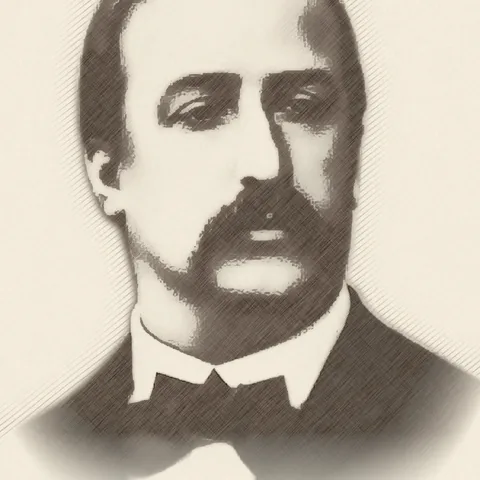
Alexandre Borodine
A chemist and composer who combined scientific research and musical creativity.
 1833 – 1897Romantic
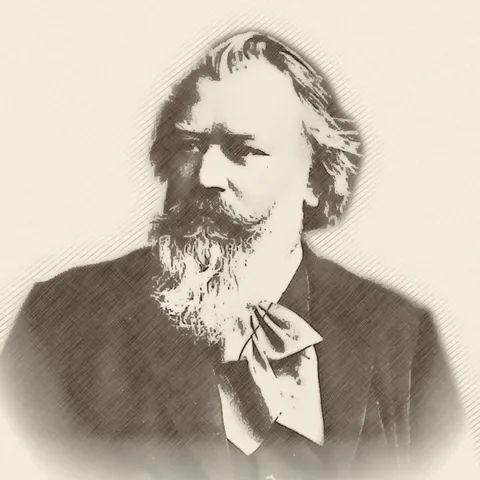
Johannes Brahms
He reinvented classical forms with Romantic intensity and dense thematic craft.
 1838 – 1875Romantic
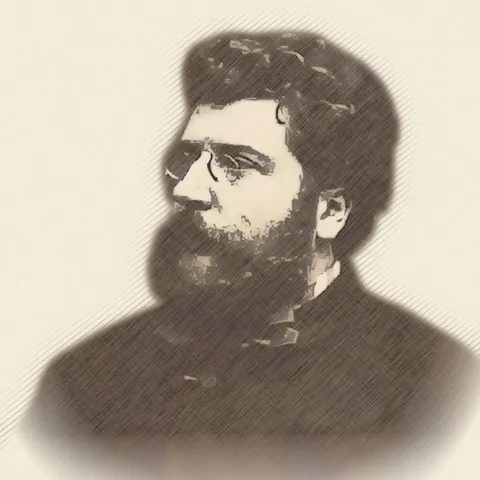
Georges Bizet
His opera Carmen, initially controversial, became a landmark of musical theatre.
 1840 – 1893Romantic
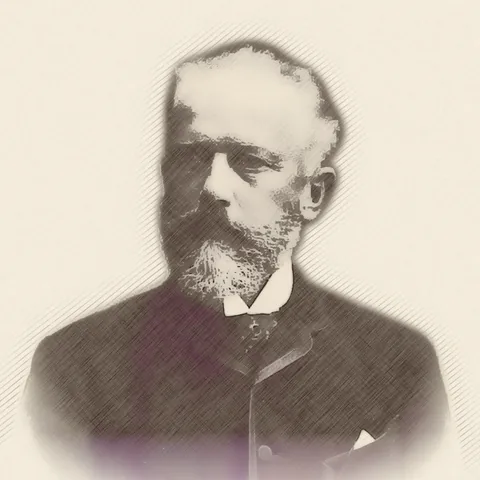
Piotr Ilitch Tchaïkovski
His ballets and symphonies unite memorable melodies and dramatic emotion.
 1841 – 1904Romantic
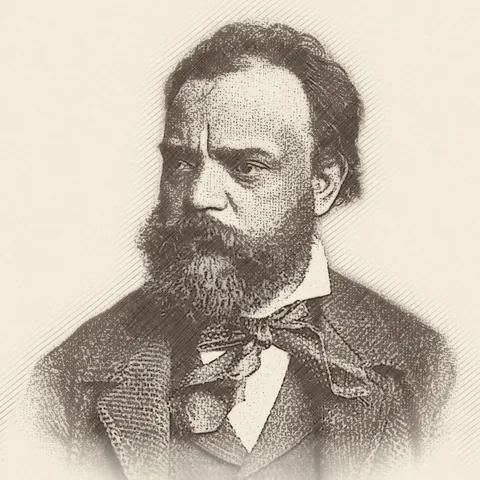
Antonín Dvořák
He blended symphonic tradition with Czech and American folk inspirations.
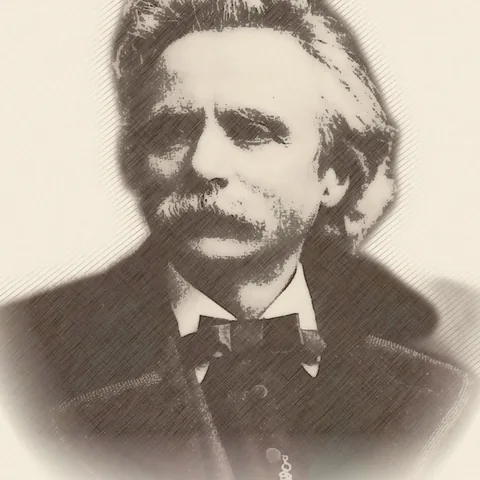 1843 – 1907Romantic
Edvard Grieg
He created evocative soundscapes inspired by Norwegian traditions.