 Romantic
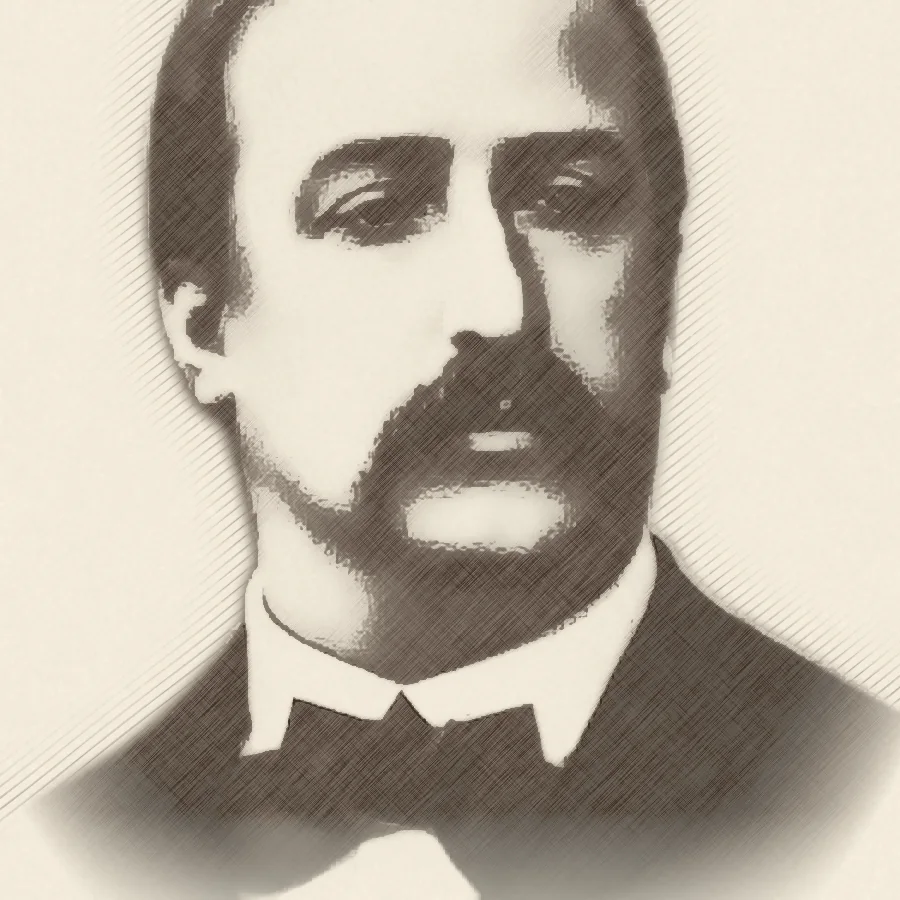
Alexandre Borodine
A chemist and composer who combined scientific research and musical creativity.
A life and its times
The milestones of the life and work, the contemporaries and the major world events, on a single line of time.
A life at a glance
- 1833Birth
Born in St Petersburg on 12 November, illegitimate son of a Georgian prince
- 1839Meanwhile
Photography is invented (daguerreotype)
- 1840Meanwhile
Adolphe Sax invents the saxophone (c. 1840)
- 1842Trainingage 9
Learns flute, piano and cello; composes from age 9
- 1848Meanwhile
Revolutions of 1848; slavery abolished in France
- 1850Trainingage 17
Enters the Medical-Surgical Academy
- 1858Trainingage 25
Doctorate in chemistry
- 1859Journeyage 26
Research in Heidelberg; meets the pianist Ekaterina Protopopova
- 1859Meanwhile
Darwin publishes On the Origin of Species
- 1862Careerage 29
Meets Balakirev and joins ‘The Five’
- 1863Private lifeage 30
Marries Ekaterina Protopopova
- 1864Careerage 31
Professor of chemistry at the Medical Academy
- 1869Workage 36
Begins Prince Igor, which he will never finish
- 1869Meanwhile
The Suez Canal opens
- 1872Careerage 39
Helps found medical courses for women
- 1874Meanwhile
First exhibition of the Impressionist painters
- 1875Meanwhile
The Palais Garnier opera house opens in Paris
- 1876Workage 43
Symphony No. 2
- 1877Meanwhile
Edison invents the phonograph: sound can be recorded!
- 1880Workage 47
In the Steppes of Central Asia
- 1881Workage 48
String Quartet No. 2, with its famous Notturno
- 1887Deathage 54
Dies suddenly at a ball, on 27 February
- 1890Landmark3 years after death
Premiere of Prince Igor, completed by Rimsky-Korsakov and Glazunov
Listen
Excerpts from freely licensed recordings, with their performers and licences.
Excerpts last up to 90 seconds. Alexandre Borodine’s compositions are in the public domain; each recording is streamed from Wikimedia Commons under the licence shown, credited to its performers or uploader.
Listen to complete works on Wikimedia Commons
Wikimedia Commons is a free media library: you will find the complete recordings there, with their reuse conditions.
- Complete recordingIn the Steppes of Central Asia
- Complete recordingString Quartet No. 2 — Notturno
- Wikimedia Commons fileAlexander Borodin - In The Steppes Of Central Asia
- Search for the workPrince Igor (Polovtsian Dances)
- Search for the workIn the Steppes of Central Asia
- Search for the workString Quartet No. 2
- Search for the workSymphony No. 2
- Search for the workSymphony No. 1
- Everything on CommonsAll recordings of Alexandre Borodine
The life of Alexandre Borodine
Alexander Borodin was born in St Petersburg on 12 November 1833. He was the illegitimate son of an elderly Georgian prince, Luka Gedevanishvili, and a young woman, Avdotya Antonova. As was customary, he was registered as the son of one of the prince’s serfs, Porfiry Borodin, whose name he took. His father freed him and provided for his education. Brought up by his mother in comfort, he received an excellent education and was passionate from an early age about both music and chemistry: as a child he turned his bedroom into a laboratory.
He learned flute, piano and cello and composed a polka at nine. But he chose a scientific career: in 1850 he entered the Medical-Surgical Academy in St Petersburg, where he received a doctorate in chemistry in 1858. He nonetheless continued to play chamber music with friends. From 1859 to 1862 he pursued research in Germany, at Heidelberg, and in Italy, mixing with the greatest chemists of the day, such as Mendeleev, inventor of the periodic table.
In Heidelberg he met Ekaterina Protopopova, a highly talented young pianist from Moscow, who introduced him to Chopin and Schumann. They married in 1863. Back in St Petersburg in 1862, Borodin met the composer Mily Balakirev, who persuaded him to take composition seriously. He thus joined “The Five”, a circle of Russian composers — Balakirev, César Cui, Mussorgsky, Rimsky-Korsakov and himself — who sought to create an authentically Russian music inspired by folklore and national history.
In 1864 he became professor of chemistry at the Medical Academy, where he pursued a brilliant scientific career all his life. He discovered several chemical reactions, one of which bears his name, the Borodin (or Hunsdiecker) reaction, and took part in discoveries about aldehydes. He also devoted himself to his students and to the cause of women: in 1872 he helped found the first medical courses for women in Russia, where he taught.
Music remained a pastime for him, practised in his rare free moments or when he was ill. He called himself a “Sunday composer”. Rimsky-Korsakov recalled that when he visited, he often found him moving between the laboratory and the piano. This explains why his output is small and why several of his compositions remained unfinished. Yet he completed two symphonies, including the powerful, epic Second (1876), and two string quartets.
His String Quartet No. 2 (1881), dedicated to his wife for the twentieth anniversary of their meeting, contains a famous Nocturne, one of the most beautiful melodies in the repertoire. In 1880 he wrote In the Steppes of Central Asia, a symphonic picture evoking a caravan crossing the desert escorted by Russian soldiers. For nearly eighteen years he worked on his grand opera Prince Igor, after a medieval Russian epic, telling of Prince Igor’s struggle against the Polovtsians, a nomadic people. The famous Polovtsian Dances come from it.
On 27 February 1887, at a costume ball held at the Academy, Borodin, dressed in traditional Russian costume, collapsed mid-conversation from a heart attack. He was fifty-three. His friends Rimsky-Korsakov and Alexander Glazunov completed Prince Igor, premiered in 1890 in St Petersburg; Glazunov even reconstructed from memory the overture he had heard Borodin play on the piano. In 1953 his melodies were used in the Broadway musical Kismet.
Works to know
- 1867
Symphony No. 1
His first major work, praised by Liszt.
Listen on Wikimedia Commons - 1869
Prince Igor (Polovtsian Dances)
Wild dances and oriental melodies.
Listen on Wikimedia Commons - 1876
Symphony No. 2
Heroic symphony with epic colours.
Listen on Wikimedia Commons - 1880
In the Steppes of Central Asia
A caravan crosses the steppe, blending Russian and oriental themes.
Listen on Wikimedia Commons - 1881
String Quartet No. 2
With the Notturno, a declaration of love to his wife.
Listen on Wikimedia Commons
Anecdotes
A chemical reaction is named after him: the Borodin reaction.
His melodies were reused in a Broadway musical, Kismet.
He called himself a “Sunday composer”, since chemistry took up most of his time.
Glazunov reconstructed the overture to Prince Igor from memory, having heard Borodin play it on the piano.
Same era · Romantic
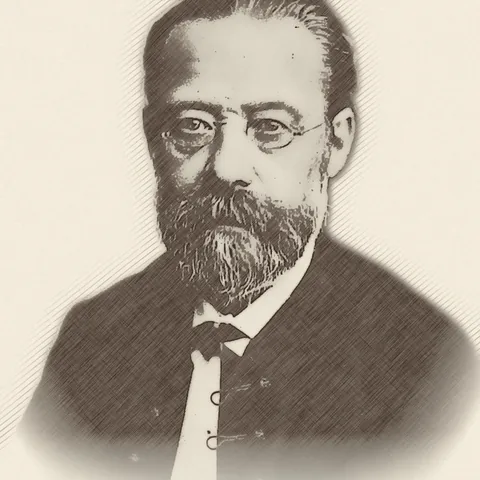 1824 – 1884Romantic
Bedřich Smetana
A leading Czech composer who joined opera, symphonic poetry and national identity.
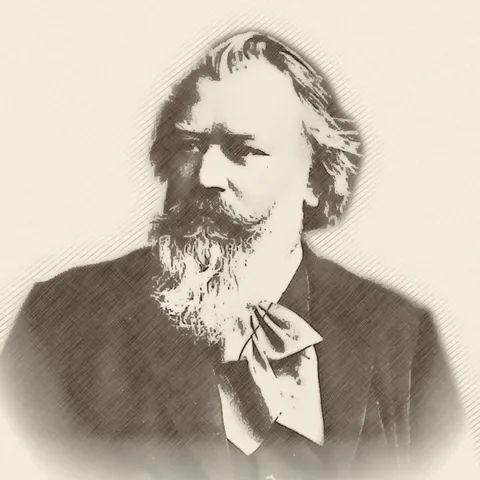 1833 – 1897Romantic
Johannes Brahms
He reinvented classical forms with Romantic intensity and dense thematic craft.
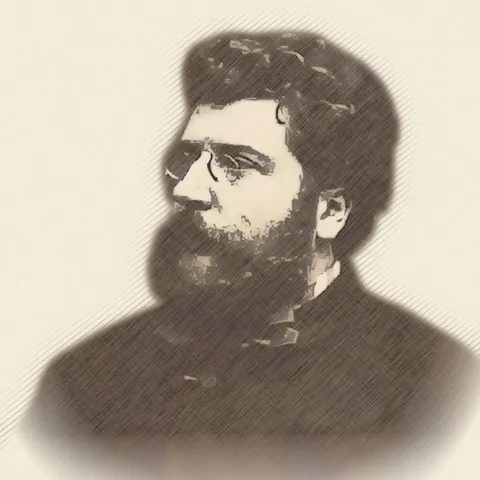 1838 – 1875Romantic
Georges Bizet
His opera Carmen, initially controversial, became a landmark of musical theatre.
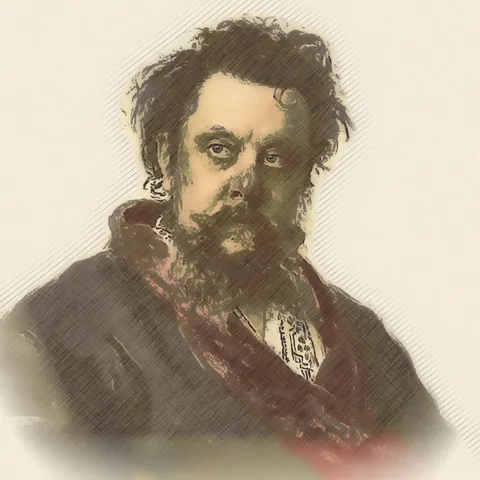 1839 – 1881Romantic
Modeste Moussorgski
A member of The Five, he sought an original dramatic and vocal language.
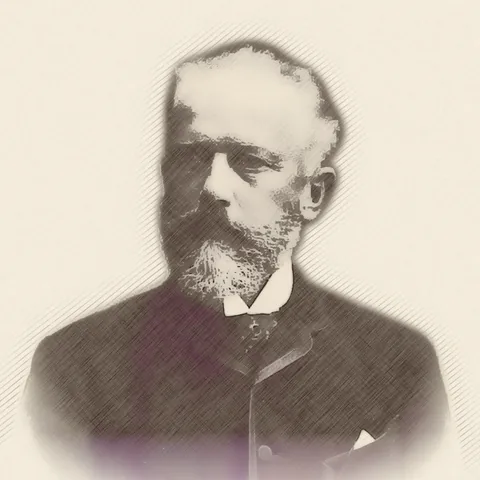 1840 – 1893Romantic
Piotr Ilitch Tchaïkovski
His ballets and symphonies unite memorable melodies and dramatic emotion.
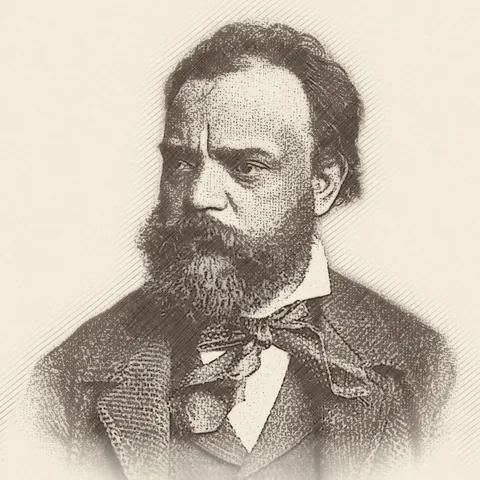 1841 – 1904Romantic
Antonín Dvořák
He blended symphonic tradition with Czech and American folk inspirations.