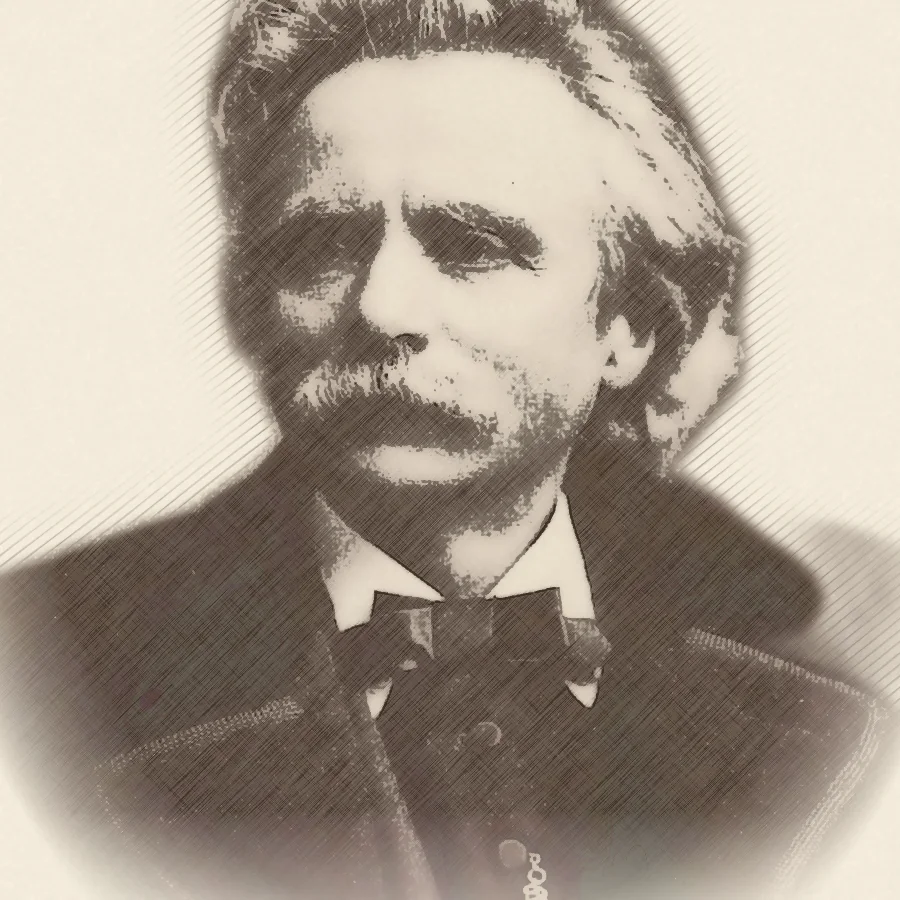
A life and its times
The milestones of the life and work, the contemporaries and the major world events, on a single line of time.
A life at a glance
- 1843Birth
Born in Bergen on 15 June; his pianist mother teaches him music
- 1848Meanwhile
Revolutions of 1848; slavery abolished in France
- 1858Trainingage 15
On the violinist Ole Bull’s advice, studies at the Leipzig Conservatory
- 1863Milestoneage 20
Moves to Copenhagen; meets the ardent patriot Rikard Nordraak
- 1865Meanwhile
End of the American Civil War; slavery abolished in the USA
- 1867Private lifeage 24
Marries his cousin, the singer Nina Hagerup; first book of Lyric Pieces
- 1868Workage 25
Piano Concerto in A minor
- 1869Meanwhile
The Suez Canal opens
- 1870Journeyage 27
In Rome, Liszt sight-reads his concerto and encourages him
- 1875Meanwhile
The Palais Garnier opera house opens in Paris
- 1876Workage 33
Premiere of Peer Gynt, music for Ibsen’s play
- 1877Meanwhile
Edison invents the phonograph: sound can be recorded!
- 1884Workage 41
Holberg Suite
- 1885Milestoneage 42
Settles in his villa at Troldhaugen, near Bergen
- 1888Workage 45
Peer Gynt Suite No. 1
- 1889Meanwhile
The Eiffel Tower opens for the World’s Fair
- 1895Meanwhile
The Lumière brothers’ first cinema show
- 1903Landmarkage 60
Records his own pieces on disc in Paris
- 1905Landmarkage 62
Norway becomes independent
- 1905Meanwhile
Einstein publishes special relativity
- 1907Deathage 64
Dies in Bergen on 4 September
Listen
Excerpts from freely licensed recordings, with their performers and licences.
Excerpts last up to 90 seconds. Edvard Grieg’s compositions are in the public domain; each recording is streamed from Wikimedia Commons under the licence shown, credited to its performers or uploader.
Listen to complete works on Wikimedia Commons
Wikimedia Commons is a free media library: you will find the complete recordings there, with their reuse conditions.
- Complete recordingPeer Gynt — Morning Mood
- Complete recordingPeer Gynt — In the Hall of the Mountain King
- Complete recordingWedding Day at Troldhaugen — played by Grieg (1903)
- Complete recordingPiano Concerto in A minor — I
- Search for the workPeer Gynt
- Search for the workPiano Concerto
- Search for the workLyric Pieces
- Search for the workHolberg Suite
- Search for the workWedding Day at Troldhaugen
- Everything on CommonsAll recordings of Edvard Grieg
The life of Edvard Grieg
Edvard Grieg was born in Bergen, on the west coast of Norway, on 15 June 1843. His great-grandfather, a Scottish merchant, had settled in Norway in the eighteenth century. His father, Alexander, was British consul and a merchant; his mother, Gesine Hagerup, an excellent pianist, gave him his first lessons from the age of six. A dreamy child, Edvard improvised at the piano and composed little pieces very early. Norway was then united with Sweden and seeking to assert its cultural identity.
In 1858 the famous Norwegian violinist Ole Bull, a family friend, heard young Edvard play his compositions and persuaded his parents to send him to the Leipzig Conservatory, one of the most renowned in Europe. Grieg stayed four years. He had mixed memories of this very academic teaching, but there he discovered Schumann, who influenced him deeply. During his studies he caught pleurisy, which left one lung destroyed: all his life he had fragile health and a small stature (about 1.52 m).
In 1863 he moved to Copenhagen, then the cultural capital of Scandinavia. There he met the young Norwegian composer Rikard Nordraak, an ardent patriot and composer of the Norwegian national anthem, who encouraged him to draw on his country’s folk music. Nordraak’s early death in 1866 devastated him. In 1867 Grieg married his cousin Nina Hagerup, a remarkable singer who performed his songs all her life. That same year he published his first book of Lyric Pieces for piano; he wrote ten in all, sixty-six pieces.
In 1868 he composed his Piano Concerto in A minor, inspired by Schumann’s, with its spectacular opening and themes with Norwegian folk accents. In 1870 in Rome he showed it to Liszt, who played it at sight from the manuscript and exclaimed enthusiastically, encouraging him to follow his own path. The concerto became one of the best-loved in the repertoire. Grieg founded a concert society in Christiania (Oslo) and conducted its orchestra.
In 1874 the playwright Henrik Ibsen asked him to write incidental music for his play Peer Gynt, the story of a whimsical, lying young peasant who roams the world. Grieg accepted, not without difficulty, and the play was premiered in Christiania in 1876. He later drew from it two orchestral suites that became extremely famous, with pieces such as Morning Mood, The Death of Åse, Anitra’s Dance and In the Hall of the Mountain King, in which a repeated theme speeds up into a frenzy.
In 1884, for the bicentenary of the birth of the writer Ludvig Holberg, born like him in Bergen, he composed the Holberg Suite in the style of eighteenth-century dances. In 1885 he settled with Nina in his villa at Troldhaugen (“Troll Hill”) near Bergen, where he composed in a small hut by the fjord. He nonetheless continued to make long concert tours of Europe as pianist and conductor and became one of the most popular composers of his time.
In 1903 in Paris he recorded several of his pieces on disc, so we can still hear him play today. He rejoiced at Norway’s independence in 1905. Ill, he died in Bergen on 4 September 1907, just as he was about to leave for a festival in England. More than thirty thousand people attended his funeral. His ashes rest in a cave in the cliff at Troldhaugen, above the fjord. He is regarded as Norway’s greatest composer.
Works to know
- 1867
Lyric Pieces
66 piano miniatures in ten books.
Listen on Wikimedia Commons - 1868
Piano Concerto
Spectacular opening; one of the best-loved concertos.
Listen on Wikimedia Commons - 1876
Peer Gynt
Morning Mood, In the Hall of the Mountain King, Solveig’s Song…
Listen on Wikimedia Commons - 1884
Holberg Suite
String homage to the Baroque age.
Listen on Wikimedia Commons - 1896
Wedding Day at Troldhaugen
For his silver wedding with Nina.
Listen on Wikimedia Commons
Anecdotes
You can still hear Grieg play — he recorded himself in 1903!
He always carried a little lucky frog in his pocket.
Liszt played his Piano Concerto at sight, straight from the manuscript, and encouraged him.
His ashes rest in a cave in the cliff above the fjord, near his home at Troldhaugen.
Same era · Romantic
 1833 – 1887Romantic
Alexandre Borodine
A chemist and composer who combined scientific research and musical creativity.
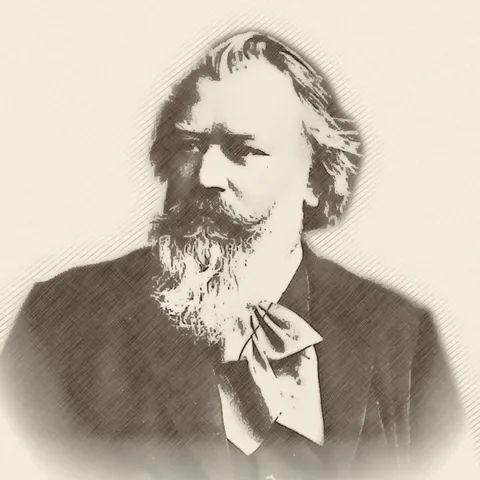 1833 – 1897Romantic
Johannes Brahms
He reinvented classical forms with Romantic intensity and dense thematic craft.
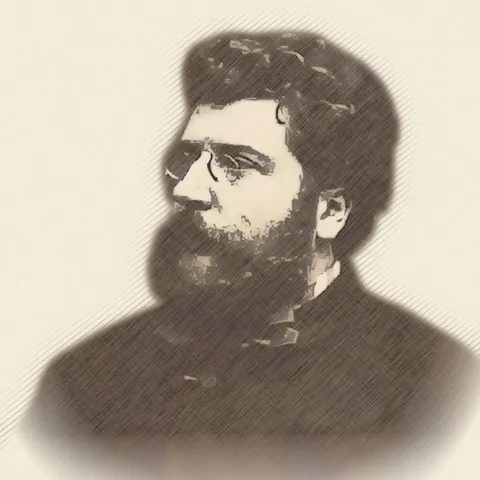 1838 – 1875Romantic
Georges Bizet
His opera Carmen, initially controversial, became a landmark of musical theatre.
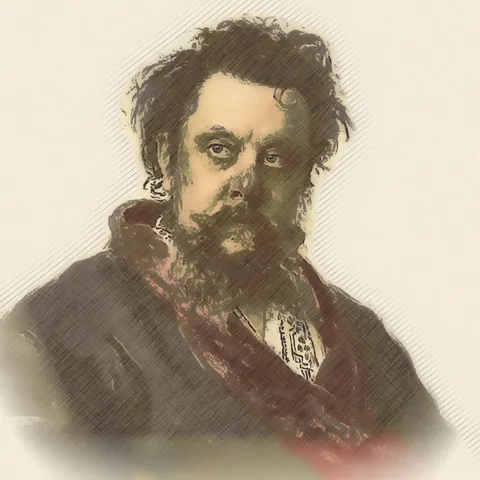 1839 – 1881Romantic
Modeste Moussorgski
A member of The Five, he sought an original dramatic and vocal language.
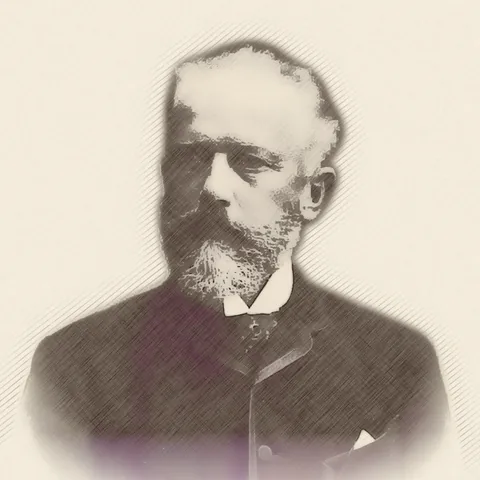 1840 – 1893Romantic
Piotr Ilitch Tchaïkovski
His ballets and symphonies unite memorable melodies and dramatic emotion.
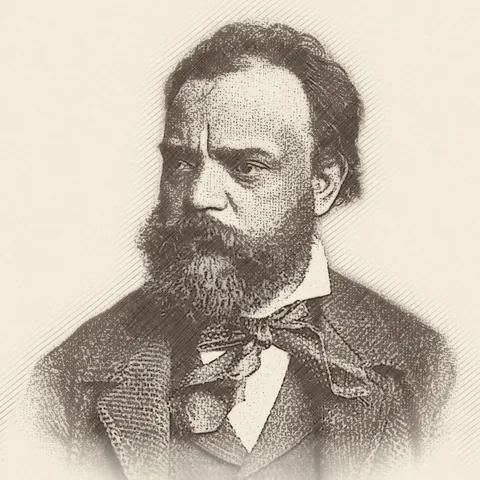 1841 – 1904Romantic
Antonín Dvořák
He blended symphonic tradition with Czech and American folk inspirations.